달러의 가격표
파운드는 제국의 화폐였고, 달러는 동맹의 화폐였다
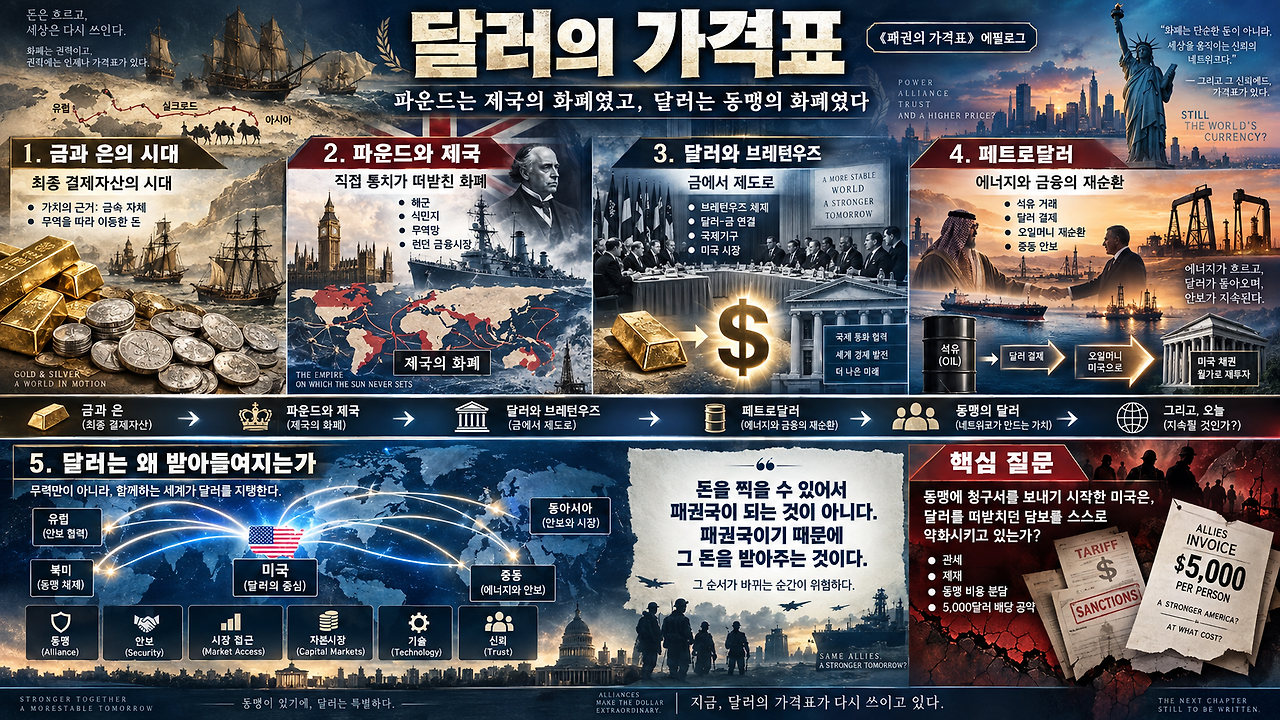
달러의 가격표
파운드는 제국의 화폐였고, 달러는 동맹의 화폐였다
《패권의 가격표》를 끝내려고 했다.
열 편이면 충분하다고 생각했다.
동맹과 에너지, 공급망과 기후까지 이야기했으니 이제 마침표를 찍어도 된다고 생각했다.
그런데 마지막 글이 공개되던 날, 트럼프가 새로운 가격표를 꺼내 들었다.
공화당이 중간선거에서 상원과 하원을 모두 지켜내면 미국 성인 시민에게 1인당 5,000달러를 지급하겠다는 공약이었다.
모든 성인 시민에게 지급한다면 필요한 돈은 1조 달러를 훌쩍 넘는다.
구체적인 재원은 명확하지 않았다.
대신 한 가지가 눈에 들어왔다.
트럼프는 그 돈을 미국 안에서 쓰도록 하겠다고 말했다.
순간 이런 생각이 들었다.
한 표의 가격이 5,000달러가 된 것인가?
하지만 곧 더 중요한 질문이 떠올랐다.
그 5,000달러는 누가 내는가?
경제에는 공짜가 없다.
미국 국민에게 추가로 세금을 걷지 않는다면 정부가 빚을 내거나, 다른 지출을 줄이거나, 관세를 걷거나, 다른 누군가에게 비용을 이전해야 한다.
비용은 사라지지 않는다.
가격표를 받는 사람이 달라질 뿐이다.
그리고 그 순간, 지난 열 편에서 이야기했던 것들이 다시 연결되기 시작했다.
동맹국에는 더 부담하라고 요구한다.
교역국에는 관세를 부과한다.
기업에는 미국으로 공장을 옮기라고 압박한다.
그리고 미국 국민에게는 돈을 돌려주겠다고 한다.
이것을 단순히 하나의 선거공약으로만 봐야 할까?
나는 더 오래된 질문으로 돌아가게 됐다.
달러는 도대체 무엇을 담보로 하고 있는가?
2011년 대학에서 국제통상론을 공부할 때 교수님은 앞으로 민족주의가 다시 강해지고 경제가 블록화될 가능성을 이야기했다.
당시에는 세계화가 당연해 보였다.
상품은 국경을 넘었고, 자본은 더 빠르게 움직였다.
자유무역은 한번 열린 문처럼 다시 닫히지 않을 것 같았다.
15년이 지나자 풍경은 달라졌다.
우리는 다시 관세를 이야기한다.
공급망에 국적을 붙인다.
반도체와 배터리, 핵심광물과 에너지를 동맹국과 비동맹국으로 나눠 공급하려 한다.
그렇다면 질문하지 않을 수 없다.
트럼프가 이런 세상을 만든 것일까?
아니면 이런 세상이 트럼프를 낳은 것일까?
나는 후자에서 출발한다.
민족주의와 블록경제로의 이동은 트럼프 이전부터 시작됐다.
바이든 역시 그것을 되돌리지 못했다.
중국을 견제했고, 미국 제조업을 지원했으며, 공급망을 미국과 동맹국 중심으로 재편하려 했다.
다만 차이가 있었다.
바이든은 동맹을 비용이 아니라 미국이 가진 자산으로 다시 묶으려 했다.
트럼프는 그 동맹에도 가격표를 붙였다.
세상이 트럼프를 만들었지만, 트럼프 역시 그 변화를 훨씬 빠르고 거칠게 밀어붙이고 있는 셈이다.
그리고 그 차이를 이해하려면 달러보다 이전의 세계로 돌아가야 한다.
달러 이전에는 파운드가 있었다.
그 이전에는 금과 은이 있었다.
정확히 말하면 금과 은은 오늘날의 기축통화라기보다 국가를 넘어 가치를 인정받는 최종 결제자산에 가까웠다.
누가 찍었느냐보다 그 안에 얼마나 많은 금과 은이 들어 있는지가 중요했다.
그다음 영국이 세계의 중심으로 올라왔다.
산업혁명,해군,식민지,세계 무역망,런던 금융시장이다.
이 모든 것이 파운드 뒤에 있었다.
파운드는 단순한 화폐가 아니었다.
대영제국이라는 거대한 시스템의 영수증에 가까웠다.
영국은 세계 곳곳을 직접 지배했고, 식민지와 항로와 금융망을 통해 파운드를 퍼뜨렸다.
말하자면, 파운드는 제국의 화폐였다.
하지만 제국에는 비용이 들었다.
군대를 보내야 했다.
해군을 유지해야 했다.
식민지를 관리해야 했다.
두 차례의 세계대전을 거치면서 영국은 그 비용을 감당할 힘을 잃어갔다.
그리고 그 사이 미국은 세계 최대의 생산국이자 채권국으로 올라섰다.
통화패권은 어느 날 갑자기 파운드에서 달러로 넘어간 것이 아니다.
경제력과 금융의 중심이 먼저 움직였다.
화폐는 그 뒤를 따라갔다.
1944년 브레턴우즈 체제가 만들어졌다.
각국의 통화는 달러에 연결되고, 달러는 다시 금에 연결됐다.
하지만 나는 여기서 금보다 더 중요한 변화를 본다.
패권을 유지하는 방식이 바뀌었다.
영국은 세계를 직접 통치했다.
미국은 모든 나라를 직접 통치하지 않았다.
대신 동맹을 만들었다.
시장을 열었다.
국제기구를 만들었다.
안보를 제공했다.
자본시장을 제공했다.
그리고 그 시스템의 한가운데 달러를 놓았다.
그래서 나는 이렇게 생각한다.
파운드는 제국의 화폐였고, 달러는 동맹의 화폐였다.
냉전 역시 단순한 군사적 경쟁만은 아니었다.
한쪽에는 미국을 중심으로 한 달러와 시장경제, 자본시장, 무역과 동맹의 네트워크가 있었다.
다른 한쪽에는 소련을 중심으로 한 계획경제와 별도의 경제블록이 있었다.
이것을 단순히 달러와 루블의 싸움이라고 부르면 정확하지 않다.
경쟁한 것은 화폐 한 장이 아니라 화폐를 둘러싼 시스템 전체였다.
어느 체제에 들어가야 더 많은 상품을 살 수 있는가?
어디에서 더 쉽게 자본을 조달할 수 있는가?
어느 시장에서 더 많은 물건을 팔 수 있는가?
어느 동맹에 들어가는 것이 더 안전한가?
결과적으로 미국이 이겼다.
달러가 이긴 것이기도 했다.
하지만 더 정확히 말하면, 달러를 사용하는 세계가 더 매력적이었던 것이다.
그리고 1971년, 중요한 변화가 일어났다.
미국은 달러와 금의 교환을 중단했다.
금태환이 사라졌다.
그렇다면 달러는 무너졌어야 하지 않았을까?
그런데 무너지지 않았다.
왜였을까?
금이 사라진 자리에는 이미 다른 것들이 들어오고 있었기 때문이다.
그중 하나가 석유였다.
1970년대 세계경제에서 석유는 산업과 군사, 운송과 발전을 움직이는 핵심 자원이었다.
국제 원유거래는 달러를 중심으로 이루어졌다.
오일쇼크 이후 산유국에는 막대한 달러가 쌓였다.
그리고 그 달러는 다시 미국 금융시장과 은행, 채권시장과 국제대출시장으로 흘러 들어갔다.
이른바 페트로달러 재순환이다.
미국과 사우디아라비아의 관계 역시 에너지와 금융, 안보가 서로 얽혀가는 방향으로 발전했다.
석유를 팔아 달러를 벌고, 그 달러를 다시 달러 자산에 투자하고, 미국은 중동 안보질서의 핵심 역할을 맡았다.
금과 달러의 연결은 끊어졌지만, 세계경제에는 달러를 필요로 하는 새로운 순환이 만들어졌다.
금이 사라진 뒤 달러를 떠받친 것이 아무것도 아니었던 것은 아니다.
석유가 있었고, 금융시장이 있었고, 동맹이 있었고, 그 질서를 지키는 미국의 힘이 있었다.
달러의 담보가 사라진 것이 아니라, 물질적 담보에서 네트워크적 담보로 바뀐 것이다.
그러면 처음 질문으로 돌아가 보자.
달러는 어디까지 팽창할 수 있는가?
미국 정부가 국채를 발행하면 누군가는 그것을 산다.
만기가 오면 다시 국채를 발행해 차환할 수도 있다.
부채에는 이자가 붙는다.
그리고 부채가 계속 증가한다면 이자부담 역시 커질 수밖에 없다.
하지만 어느 숫자에 도달한다고 달러가 갑자기 끝나는 것은 아니다.
세계가 달러를 필요로 하고, 미 국채를 안전자산으로 여기고, 미국의 경제와 금융시장과 법제도를 믿는다면 그 구조는 계속될 수 있다.
그래서 진짜 질문은 부채의 숫자가 아닐지도 모른다.
세계는 미국의 부채를 언제까지 자신의 자산으로 받아들여 줄 것인가?
미국의 국가부채는 미국에게는 빚이다.
하지만 누군가에게 미 국채는 자산이다.
바로 이 역설이 달러 패권의 핵심에 있다.
물론 트럼프 진영에는 다른 설명이 있다.
그들은 오히려 지금의 국제통화질서가 미국에 지나치게 큰 비용을 지우고 있다고 본다.
달러가 기축통화이기 때문에 세계적으로 끊임없는 달러 수요가 발생하고, 그 결과 달러 가치가 높게 유지되며, 미국 제조업과 수출산업이 경쟁력을 잃는다는 논리다.
스티븐 미란이 제시한 문제의식도 여기에 가깝다.
미국은 세계에 달러라는 안전자산을 제공하고, 안보우산을 제공하고, 시장을 제공한다.
그렇다면 왜 그 비용을 미국만 부담해야 하는가?
트럼프식 사고에서 동맹국에 방위비를 더 요구하고, 관세를 부과하고, 제조업 투자를 미국으로 끌어오는 것은 서로 떨어진 정바카라이 아닐 수 있다.
패권의 계약서를 다시 쓰려는 하나의 전략일 수도 있다.
그렇다면 트럼프의 행동을 단순한 모순이라고만 부르는 것도 부족하다.
트럼프는 패권을 포기하려는 것이 아니라 패권의 비용을 다시 나누려는 것일 수 있다.
하지만 여기에서 새로운 질문이 생긴다.
미국이 계약서를 다시 쓴다고 해서 상대방도 그 계약서에 서명할까?
냉전의 동맹은 기본적으로 공동의 적을 상대로 한 협력체제였다.
미국은 군사기지와 정보망, 시장과 외교적 영향력을 얻었다.
동맹국은 안보와 억지력을 얻었다.
누가 정확히 얼마를 더 얻었는지는 계산하기 어려웠지만 양쪽 모두 얻는 것이 있었다.
Positive-sum game.
동맹은 미국이 일방적으로 제공하는 자선이 아니었다.
미국 역시 동맹을 통해 패권을 얻었다.
그런데 동맹을 비용의 장부로만 보기 시작하면 질문이 달라진다.
우리는 얼마를 냈는가?
너희는 얼마를 냈는가?
우리가 너희에게 시장을 열어줘 무역적자가 생겼다면 우리가 손해 본 것 아닌가?
우리가 너희를 지켜줬다면 그 값을 내야 하는 것 아닌가?
관계가 조금씩 바뀐다.
공동으로 더 큰 이익을 만드는 구조에서, 누가 더 얻었는지를 계산하는 구조로 이동한다.
Positive-sum이 Zero-sum에 가까워진다.
문제는 동맹에 가격표가 있다는 사실이 아니다.
원래부터 가격표는 있었다.
문제는 가격만 계산하기 시작했을 때 자산의 가치가 장부에서 사라지는 것이다.
여기서 다시 5,000달러짜리 수표로 돌아온다.
나는 그 공약의 금액보다 그 뒤에 있는 사고방식에 더 관심이 간다.
미국 국민에게 더 많은 이익을 돌려준다.
미국으로 투자를 끌어온다.
미국의 무역적자를 줄인다.
동맹국에는 더 부담하라고 한다.
교역국에는 관세를 매긴다.
패권의 비용을 미국 밖으로 이전할 수 있다면 미국 국민에게는 매력적인 제안일 수 있다.
하지만 그렇다면 다시 물어야 한다.
그 비용을 떠안게 된 국가들은 언제까지 미국 중심의 질서에 남아 있으려 할까?
관세를 올려도 비용은 사라지지 않는다.
동맹국의 부담을 늘려도 비용은 사라지지 않는다.
국채를 더 발행해도 비용은 사라지지 않는다.
가격표를 받는 사람이 달라질 뿐이다.
스페인은 은을 가졌다.
영국은 제국을 가졌다.
미국은 동맹을 가졌다.
그리고 어쩌면 미국이 만든 가장 강력한 상품은 자동차도, 석유도, 반도체도 아니었을지 모른다.
미국이 만든 질서 안에 들어오면 당신도 이익을 얻을 수 있다는 믿음.
그 믿음이 달러의 힘을 만들었다.
돈을 찍을 수 있어서 패권국이 되는 것이 아니다.
패권국이기 때문에 그 돈을 다른 사람들이 받아주는 것이다.
그 순서가 바뀌는 순간이 위험하다.
트럼프는 미국을 다시 위대하게 만들겠다고 말한다.
과거의 영광을 되찾고 싶은 마음은 이해하기 어렵지 않다.
국가에도 향수는 존재한다.
하지만 과거는 같은 모습으로 돌아오지 않는다.
제국을 유지하지 않으면서 파운드 패권만 되찾을 수 없었던 것처럼,
동맹의 비용을 부담하지 않으면서 달러 패권의 편익만 그대로 유지할 수 있는지도 알 수 없다.
그래서 처음의 질문을 다시 고쳐야겠다.
달러는 어디까지 팽창할 수 있는가?
아니다.
더 중요한 질문은 이것이다.
미국은 달러가 팽창할 수 있도록 만들어준 세계를 어디까지 해체할 수 있는가?
파운드는 제국의 화폐였다.
달러는 동맹의 화폐였다.
그렇다면 동맹에 계속 청구서를 보내기 시작한 미국의 달러는 앞으로 무엇을 담보로 하게 될까?
관세일까?
제재일까?
거대한 금융시장일까?
군사력일까?
아니면 여전히 미국과 함께하는 것이 더 이익이라고 믿게 만드는 신뢰일까?
강제력은 달러를 사용하게 만들 수는 있다.
하지만 그것만으로 달러를 기꺼이 보유하게 만들 수 있을까?
《패권의 가격표》를 끝내려고 했다.
그런데 열 편을 모두 쓰고 나서야 더 근본적인 가격표가 보였다.
패권의 가장 큰 가격표는 어쩌면 달러 자체에 붙어 있었는지도 모른다.
The Price Tag on the Dollar
The pound was the currency of an empire. The dollar was the currency of an alliance.
I meant to end The Price of Hegemony at ten essays. Alliances, energy, supply chains, climate — I had covered what I set out to cover. It was time for a full stop.
Then, on the day the final installment went up, Trump produced a new price tag.
Speaking at the Republican midterm convention in Dallas, he promised every adult American citizen $5,000 if his party holds both the House and the Senate in November. Paid to every adult, the bill runs well past a trillion dollars. He did not say where the money would come from. He did say one thing that caught my eye: the money would have to be spent inside the United States.
My first reaction was arithmetic. Has a vote now been priced at $5,000?
The second reaction was the better question. Who pays?
There are no free lunches in economics. If Americans are not taxed more, the government borrows, cuts something else, collects tariffs, or shifts the cost to someone outside the country. The cost does not vanish. Only the name on the invoice changes.
And that is when the ten essays snapped back together.
Allies are told to pay more. Trading partners are hit with tariffs. Companies are pressed to move their factories to America. And American citizens are promised a refund.
Is this just one campaign promise? I found myself going back to an older question.
What, exactly, backs the dollar?
A door that would not close
In 2011, in an international trade course, my professor told us that nationalism would return and the world economy would break into blocs. It sounded implausible. Goods crossed borders, capital moved faster every year, and free trade looked like a door that, once opened, would not close again.
Fifteen years later, we talk about tariffs again. We attach nationalities to supply chains. We sort semiconductors, batteries, critical minerals and energy into allied and non-allied lanes.
So: did Trump make this world, or did this world make Trump?
I start from the second answer. The drift toward nationalism and bloc economics predates him. Biden did not reverse it; he contained China, subsidized American manufacturing, and rebuilt supply chains around the United States and its allies. The difference was in the accounting. Biden treated alliances as an asset to be re-bundled. Trump put a price tag on the alliances themselves. The world made Trump — and Trump is pushing that world faster and harder than it would have moved on its own.
To see why that matters, you have to go back further than the dollar.
The currency of an empire
Before the dollar there was the pound, and before the pound there were gold and silver. Strictly speaking, gold and silver were not reserve currencies in the modern sense; they were the final settlement asset that any country would accept. What mattered was not who struck the coin but how much metal was in it.
Then Britain rose. Behind the pound stood the industrial revolution, the Royal Navy, the colonies, a global trading network and the City of London. The pound was less a piece of paper than a receipt for the British Empire. Britain ruled much of the world directly, and spread its currency through the colonies, the sea lanes and the financial system it controlled.
The pound was the currency of an empire.
But empires cost money. Armies must be sent, navies maintained, colonies administered. Two world wars drained Britain's capacity to pay, and in the meantime the United States became the world's largest producer and its largest creditor. Monetary hegemony did not switch from the pound to the dollar overnight. The center of economic and financial gravity moved first; the currency followed.
Bretton Woods, in 1944, tied every currency to the dollar and the dollar to gold. But the more important change had nothing to do with gold. It was a change in how hegemony was maintained.
Britain had governed the world. America did not try to. Instead it built alliances. It opened its market. It founded international institutions. It provided security. It provided capital markets. And it placed the dollar at the center of that system.
This is why I put it the way I do: the pound was the currency of an empire, and the dollar was the currency of an alliance.
The Cold War was not only a military contest. On one side stood the dollar with its market economy, its capital markets, its trade and alliance network; on the other, the Soviet bloc with its planned economy. It is inaccurate to call this a fight between the dollar and the ruble. What competed were entire systems. In which one could you buy more? Raise capital more easily? Sell more? Be safer?
America won. The dollar won. But more precisely, the world that used the dollar was the more attractive one.
What replaced gold
Then, in 1971, the United States stopped exchanging dollars for gold.
The dollar should have collapsed. It did not.
Something else was already moving into the space gold had left. One of those things was oil. In the 1970s oil ran industry, armies, transport and power generation, and it was traded in dollars. After the oil shocks, producer states accumulated enormous dollar surpluses, and those dollars flowed back into American banks, bond markets and international lending — the petrodollar recycling. The relationship between Washington and Riyadh grew into a braid of energy, finance and security: sell oil for dollars, hold the dollars in dollar assets, and let America anchor the security order of the Gulf.
The link to gold was cut, but a new circulation that required dollars had been built. What held the dollar up after gold was not nothing. It was oil, financial markets, alliances, and American power to keep that order in place.
The collateral did not disappear. It changed from physical collateral to network collateral.
How far can it go?
So back to the original question. How far can the dollar expand?
When the Treasury issues bonds, someone buys them. When they mature, they can be rolled over. Debt carries interest, and as the debt grows, so does the interest bill. But there is no number at which the dollar simply stops. As long as the world needs dollars, treats Treasuries as the safe asset, and trusts America's economy, markets and legal institutions, the structure holds.
The real question, then, is not the size of the debt. It is how long the rest of the world will keep counting America's debt as its own asset.
What is a liability in Washington is an asset in Tokyo, Riyadh and Frankfurt. That paradox sits at the core of dollar hegemony.
The other side of the ledger
To be fair, Trump's camp has its own account of this. In their view the present monetary order imposes an outsized cost on the United States. Because the dollar is the reserve currency, the world demands it without pause, the dollar stays strong, and American manufacturers and exporters lose competitiveness. This is close to the diagnosis laid out by Stephen Miran. America supplies the world with a safe asset, a security umbrella and an open market — so why should America alone bear the cost?
Seen that way, demanding more defense spending from allies, imposing tariffs and pulling factory investment home are not separate policies. They may be a single strategy: rewriting the contract of hegemony. If so, calling Trump's behavior merely self-contradictory is too easy. He may not be giving up hegemony. He may be trying to redistribute its cost.
But that raises a new question. If America rewrites the contract, will the other parties sign it?
The Cold War alliances were cooperative arrangements against a common enemy. America got bases, intelligence networks, markets and diplomatic leverage. Allies got security and deterrence. Nobody could calculate precisely who got more, but everyone got something.
Positive-sum.
The alliance was never American charity. America obtained its hegemony through it.
Once you start reading the alliance as a ledger, the questions change. How much did we pay? How much did you? If we opened our market to you and ran a deficit, didn't we lose? If we protected you, don't you owe us?
The relationship drifts, step by step, from building a larger shared gain to counting who took the bigger share. Positive-sum starts to look like zero-sum.
The problem is not that the alliance has a price tag. It always did. The problem is that when you count only the price, the value of the asset drops off the books.
Back to the check
Which brings me back to the $5,000. I care less about the amount than about the thinking behind it.
Return more to American citizens. Pull investment into America. Shrink the trade deficit. Tell allies to pay more. Tax trading partners. If the cost of hegemony can be pushed outside America's borders, that is an attractive offer to American voters.
But then: how long will the countries absorbing that cost want to stay inside the American order?
Raising tariffs does not make the cost disappear. Neither does raising allied contributions. Neither does issuing more debt. Only the name on the invoice changes.
Spain had silver. Britain had an empire. America had allies.
And perhaps the most powerful product America ever made was not the car, not oil, not the semiconductor. It was the belief that if you joined the order America built, you too would come out ahead. That belief is what gave the dollar its power.
A country does not become a hegemon because it can print money. Others accept its money because it is a hegemon. The dangerous moment is when that order of causation flips.
The question, corrected
Trump says he wants to make America great again. The wish to recover past glory is not hard to understand; nations have nostalgia too. But the past does not return in the same shape. Britain could not get the pound's era back without maintaining the empire that had produced it. Whether America can keep the benefits of dollar hegemony without paying for the alliances that produced it is far from clear.
So let me correct my question. Not "how far can the dollar expand?" The better one is this: how much of the world that allowed the dollar to expand can America dismantle?
The pound was the currency of an empire. The dollar was the currency of an alliance. What, then, will back the dollar of a country that has begun sending its allies the bill?
Tariffs? Sanctions? The depth of its financial markets? Its military? Or, still, the trust that being on America's side is the better deal?
Coercion can make a country use the dollar. Whether it can make a country want to hold the dollar is another matter.
I meant to end The Price of Hegemony. Only after ten essays did I see the more fundamental price tag.
The biggest price of hegemony may have been hanging on the dollar all along.