미국은 왜 스스로 패권을 내려놓고 있는가
미국은 왜 스스로 패권을 내려놓고 있는가
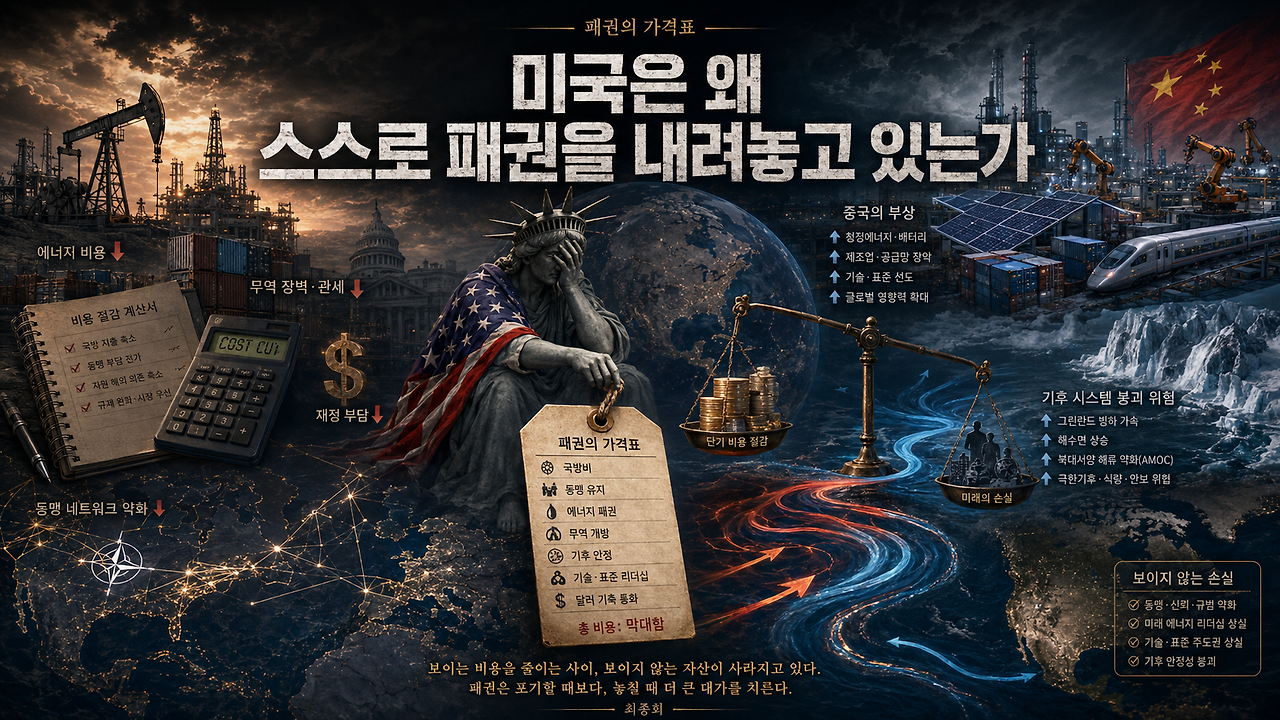
이 카지노 게임을 시작하면서 제목부터 결론처럼 보이는 질문을 던졌다.
미국은 왜 스스로 패권을 내려놓고 있는가?
그런데 아홉 편을 쓰고 여기까지 오면서 생각이 조금 달라졌다.
어쩌면 질문부터 틀렸을지도 모른다.
트럼프는 미국의 패권을 내려놓으려는 것이 아닐 수 있다.
오히려 반대일 수도 있다.
미국이 패권을 유지하기 위해 너무 많은 돈을 쓰고 있다고 생각하고, 그 비용을 줄여서 더 오래 패권을 유지하려는 것일 수도 있다.
동맹국에게 더 많은 국방비를 요구하고, 미국의 석유와 천연가스를 더 생산하고, 중국산 제품에는 관세를 부과하고, 핵심광물과 전략물자의 공급망을 미국과 동맹국으로 가져오며, 미국의 직접적인 이익과 연결되지 않는 국제적 부담에서는 물러난다.
모두 하나의 논리로 설명할 수 있다.
미국이 지불하는 비용을 줄인다.
그렇다면 트럼프는 패권을 포기하는 대통령이 아니라, 패권을 구조조정하는 대통령일지도 모른다.
문제는 하나다.
그가 줄이고 있는 것이 정말 비용뿐인가?
패권국은 무엇을 가지고 있는가
세계에서 가장 강한 나라를 고르라고 하면 여러 숫자를 볼 수 있다.
GDP, 국방비, 핵무기, 항공모함, 인구, 기업의 시가총액, 기술력 등 이다. 그런데 이 카지노 게임을 쓰면서 나는 패권이라는 것을 조금 다르게 생각하게 됐다.
패권은 내가 얼마나 가지고 있는가만으로 결정되지 않는다.
다른 나라가 나를 중심으로 얼마나 움직이는가?
이것도 중요하다.
미국에는 달러가 있다.
세계적인 금융시장이 있다.
세계 최고 수준의 대학과 연구기관이 있다.
거대한 소비시장이 있다.
첨단기술 기업들이 있다.
엄청난 군사력이 있다.
하지만 미국의 진짜 독특한 자산은 그것만이 아니다.
캐나다가 있다.
유럽이 있다.
일본이 있다.
대한민국이 있다.
호주가 있다.
수많은 국가가 안보와 금융, 기술과 무역에서 미국과 연결되어 있다.
미국이 어떤 기술을 수출하지 않겠다고 하면 세계 기업들이 계산을 바꾼다.
미국이 금융제재를 하면 다른 나라 은행들까지 신경을 쓴다.
미군이 움직이면 동맹국 군대가 함께 움직일 수 있다.
미국시장의 규칙이 바뀌면 세계 기업들이 생산방식을 바꾼다.
나는 이것이 패권이라고 생각한다.
혼자 모든 것을 할 수 있는 힘이 아니라, 다른 나라의 선택까지 움직일 수 있는 힘.
그런데 그런 힘은 공짜가 아니었다
미국은 그 힘을 얻기 위해 오랫동안 비용을 지불했다.
해외에 군대를 주둔시켰다.
동맹을 유지했다.
국제기구를 만들고 돈을 냈다.
세계 해상교역로를 지키는 데 막대한 군사력을 사용했다.
자국시장을 다른 나라 상품에도 열어주었다.
때로는 동맹국이 미국보다 적은 국방비를 지출하는 것도 받아들였다.
왜 그랬을까?
미국이 특별히 착해서였다고 생각하면 국제정치를 지나치게 낭만적으로 보는 것이다.
미국도 이익을 얻었다.
그 질서 안에서 달러가 세계의 중심 통화가 됐고, 미국 기업들은 세계시장에 진출했으며,
유럽과 일본은 미국의 동맹이 됐다.
소련과의 냉전에서도 미국 혼자 싸우지 않았다.
2차 세계대전이 끝난 뒤 미국은 세계의 모든 땅을 식민지로 만들지 않았다.
대신 미국이 중심인 시스템을 만들었다.
어쩌면 이것이 20세기 미국 패권의 가장 중요한 발명이었을지도 모른다.
다른 나라를 점령하지 않아도, 그 나라가 미국 중심의 질서 안에 있도록 만드는 것.
그리고 당연히 그 시스템에는 유지비가 들었다.
트럼프는 그 유지비를 다시 계산하기 시작했다
트럼프의 정치가 이전 미국 대통령들과 가장 다른 지점 가운데 하나가 바로 이것이라고 생각한다.
그는 미국이 오랫동안 당연하게 지불해온 비용들을 다시 꺼내놓는다.
NATO에 얼마를 쓰는가?
한국과 일본의 방위에 얼마가 들어가는가?
미국의 무역적자는 얼마인가?
국제기구에 미국이 왜 그렇게 많은 돈을 내는가?
기후변화 대응으로 미국 기업은 얼마의 비용을 부담하는가?
재생에너지 보조금에 세금이 얼마나 들어가는가?
그리고 묻는다.
왜 미국이 이 돈을 내야 하는가?
이 질문은 미국 유권자의 입장에서는 충분히 매력적이다.
특히 미국의 공장이 문을 닫고, 일자리가 해외로 이동하고, 동맹국들은 미국보다 적은 비율의 국방비를 사용하며, 중국이 세계 2위 경제대국으로 올라온 모습을 본 사람들에게는 더욱 그렇다.
왜 우리가 세계를 지키는데, 다른 나라들이 돈을 벌고 있는가?
트럼프는 그 불만에 매우 명확한 답을 내놓았다.
이제는 돈을 내라고 하겠다.
그리고 실제로 성과도 있다
그래서 트럼프의 전략을 단순히 ‘고립주의’라고 규정하기는 어렵다.
2026년 미국 국가방위전략은 아예 그렇게 쓰고 있다.
미국의 전략은 고립이 아니라 집중된 해외 관여이며, 동맹과 파트너는 여전히 필수적이라고 한다.
대신 동맹국이 이전 세대처럼 미국에 의존해서는 안 된다는 것이다.
유럽은 유럽에 더 직접적인 위협을 스스로 더 많이 바카라임지고, 미국은 중국 억제와 본토방위에 더 많은 힘을 집중한다.
즉 동맹을 버리는 것이 아니라 동맹의 비용구조를 바꾸겠다는 전략이다. (U.S. Department of War)
그리고 NATO는 실제로 움직였다.
유럽과 캐나다는 더 많은 방위비를 지출하고 있다.
2026년 앙카라 정상회의에서도 유럽 동맹국과 캐나다가 동맹방위에서 더 큰 바카라임을 떠맡고 있다는 방향이 공식적으로 확인됐다. (나토)
만약 이것이 계속 성공한다면 그림은 상당히 좋아진다.
미국은 돈을 덜 쓴다.
유럽은 더 강해진다.
동맹은 유지된다.
미국은 중국에 더 많은 자원을 집중한다.
그 과정에서 동맹국은 미국산 무기도 구매한다.
그렇다면 트럼프는 패권을 내려놓은 것이 아니다.
더 싼 가격으로 패권을 운영하는 방법을 찾아낸 것이다.
이 경우 이 카지노 게임의 제목은 틀리게 된다.
그리고 나는 그것도 충분히 가능한 결론이라고 생각한다.
에너지에서도 같은 전략이 보인다
석유에서도 그렇다.
트럼프는 미국이 이미 세계 최강 수준의 경쟁력을 가진 산업을 활용한다.
석유와 천연가스다.
2025년 미국의 LNG 수출은 사상 최고치를 기록했고, 트럼프 행정부는 이를 ‘Energy Dominance’라는 이름으로 국가안보와 제조업 경쟁력에 연결하고 있다. (The White House)
미국 입장에서는 합리적이다.
에너지를 자국에서 생산한다.
중동에 덜 의존한다.
유럽과 아시아에 판매한다.
제조업에 싼 에너지를 공급한다.
그리고 경쟁국이 에너지를 무기로 사용하는 것을 어렵게 만든다.
동시에 트럼프는 핵심광물 공급망까지 그냥 두고 있지 않는다.
2026년에는 국방생산법까지 동원해 핵심광물 확보를 국가안보 문제로 규정했고, 군사장비에 사용되는 중요 소재와 부품은 국내 또는 동맹국에서 조달하는 방향을 강화했다. (The White House)
최근에는 폴리실리콘과 태양광 공급망 역시 국가안보 문제로 다루기 시작했다.
미국 정부는 2024년 세계 폴리실리콘 생산능력에서 미국 비중이 2% 미만으로 떨어졌고, 태양광용 잉곳·웨이퍼·셀은 사실상 전적으로 수입에 의존한다고 평가했다. (The White House)
트럼프가 문제를 모르는 것은 아니다.
오히려 아주 정확하게 알고 있다.
미국의 약점이 어디에 있는지 알고 있다.
그래서 내가 걱정하는 것은 방향이 아니라 시간이다
문제는 여기서부터다.
석유와 천연가스는 오늘 미국이 강한 산업이다.
태양광과 배터리는 중국이 강하다.
IEA에 따르면 중국은 현재 세계 태양광 공급망 생산능력의 약 85%, 리튬이온 배터리는 약 80%를 차지한다. 웨이퍼에서는 약 95%, 배터리 음극재에서는 약 97%다. (IEA)
미국이 당장의 패권을 기준으로 선택한다면 석유를 택하는 것이 이해된다.
그런데 패권에는 시간이 있다.
20년 전의 전략산업과 20년 뒤의 전략산업이 같다는 보장은 없다.
석탄의 시대에는 석탄을 가진 나라가 중요했다.
석유의 시대가 오면서 세계의 지도가 달라졌다.
반도체와 인터넷이 등장하면서 또 바뀌었다.
그렇다면 다음 에너지 체제에서도 똑같은 일이 일어날 수 있다.
태양광, 배터리, ESS, 송전망, 원자력, 전력전자, 핵심광물 가공 등 이런 산업의 가치가 앞으로 훨씬 커진다면, 지금 석유에서 미국이 압도적으로 강하다는 사실만으로 미래 패권까지 보장되지는 않는다.
그래서 나는 계속 같은 질문을 했다.
현재의 비교우위를 지키느라 미래의 비교우위를 만들 시간을 잃고 있는 것은 아닐까?
하지만 여기에서도 트럼프가 틀렸다고 단정할 수 없다
왜냐하면 미국은 실제로 새로운 공급망을 구축하려고 하고 있기 때문이다.
핵심광물을 미국과 동맹국에서 확보하고, 전력망에 들어가는 외국산 장비의 안보위험을 문제 삼고, 대규모 에너지 인프라를 국가안보의 필수 산업으로 규정하고 있다.
불과 며칠 전인 2026년 8월 26일에도 트럼프 행정부는 외국산 대규모 전력망 장비에 대한 의존이 사이버공격과 공급차질의 취약성을 만든다며 국가비상사태를 선언했다. AI와 데이터센터, 첨단제조업이 늘어날수록 안정적인 전력망 자체가 국가안보 자산이라는 논리다. (The White House)
이걸 보면 트럼프의 전략은 단순히 “석유만 캐자.” 가 아니다.
더 깊은 곳에는 '미국이 통제할 수 있는 산업체계를 만들자'는 생각이 있다.
나는 이 문제의식에는 상당 부분 동의한다.
코로나19를 겪으면서 공급망이 얼마나 쉽게 무너질 수 있는지 봤다.
반도체 부족으로 자동차 생산이 중단됐고, 러시아의 우크라이나 침공 뒤에는 에너지가 얼마나 강력한 안보무기가 될 수 있는지도 봤다.
국가가 전략산업의 공급망을 전부 시장가격에만 맡겨서는 안 된다는 교훈은 충분했다.
문제는 다시 하나다.
무엇을 전략산업으로 볼 것인가?
미래의 에너지산업까지 전략산업이라면
그 답에 따라 트럼프의 역사적 평가가 달라질 수 있다.
만약 2030년대와 2040년대에도 석유와 천연가스가 지금과 비슷한 국제적 영향력을 유지하고, 재생에너지 산업의 전략적 중요성이 우리가 예상했던 것보다 작으며, 미국이 핵심광물과 원전, 전력망에서 다시 강력한 산업을 구축한다면, 트럼프의 선택은 매우 현실적이었던 것으로 평가될 수 있다.
반대로 태양광과 배터리, ESS와 전기화, 차세대 전력망이 세계 제조업의 핵심으로 성장하는 동안 중국이 그 생산생태계를 계속 장악한다면, 미국은 자신이 이긴 산업에 머무르느라 새로운 산업에서 뒤처진 셈이 된다.
그리고 제조업의 패권은 한번 넘어가면 되찾기가 어렵다.
공장 하나만 만들면 되는 것이 아니기 때문이다.
사람이 필요하고, 협력회사가 필요하고, 공정기술이 필요하고, 수십 년의 경험이 필요하다.
중국이 가진 것은 값싼 노동력만이 아니다.
시간이다.
미국도 시간을 투자해야 한다.
그런데 가장 되찾기 어려운 자산은 따로 있다
공장은 돈을 들이면 다시 만들 수 있다.
광산도 개발할 수 있다.
배터리 기술도 따라갈 수 있다.
막대한 자본을 가지고 있는 미국이라면 시간이 걸려도 가능한 일이다.
하지만 훨씬 복구하기 어려운 것이 있다.
신뢰다.
동맹에서 가장 중요한 자산이다.
지난 5화에서 이야기했다.
동맹국에게 국방비를 더 내라고 요구하는 것 자체는 문제가 아니다.
오히려 성공하면 미국에 유리하다.
문제는 동맹국이 더 많은 돈을 쓰면서 동시에 '미국 없이도 살아갈 방법을 준비하기 시작하는가'이다.
이 차이는 지금 당장은 잘 보이지 않는다.
국방비는 숫자로 보인다.
미국이 절약한 돈도 보인다.
그러나 신뢰가 100에서 95로 떨어졌는지, 90에서 80으로 떨어졌는지는 통계로 쉽게 나오지 않는다.
수십 년 뒤에야 결과가 나타날 수도 있다.
그래서 동맹의 장부는 어렵다.
비용은 오늘 보이고, 자산가치의 하락은 늦게 보인다.
패권은 빼앗기는 것만이 아니다
우리는 보통 패권교체를 전쟁처럼 생각한다.
한 국가가 강해진다.
기존 패권국을 밀어낸다.
그리고 왕좌를 차지한다.
영국에서 미국으로 패권이 이동한 것처럼, 언젠가 중국이 미국을 밀어내는 장면을 상상한다.
하지만 꼭 그래야 할까?
패권은 상대방이 직접 빼앗지 않아도 줄어들 수 있다.
한 지역에서 미국이 빠진다.
다른 국가들이 미국 없는 체제를 만든다.
미국이 국제규칙을 만드는 자리에서 물러난다.
남은 국가들이 자기들끼리 기준을 만든다.
미국 기업들이 나중에 그 기준을 따라야 한다.
새로운 산업의 공장은 다른 나라에 생긴다.
동맹국은 미국에 대한 의존도를 조금씩 낮춘다.
이 과정이 수십 년 반복되면 어느 날 미국은 여전히 세계에서 가장 강력한 군대를 가지고 있어도 이전만큼 세계의 선택을 움직이지 못할 수 있다.
즉 패권은 어느 날 누군가에게 빼앗기는 것이 아니라, 조금씩 비워질 수도 있다.
그리고 빈자리는 오래 비어 있지 않는다.
중국은 미국을 쓰러뜨릴 필요가 없다
이 관점에서 중국의 전략도 조금 다르게 보인다.
중국이 미국 항공모함보다 많은 항공모함을 가져야만 패권경쟁에서 이기는 것은 아니다.
세계 모든 국가와 군사동맹을 맺을 필요도 없다.
미국이 빠지는 영역을 하나씩 채우면 된다.
태양광 공급망에서 중국산 장비를 사용한다.
배터리에서 중국 기술과 공장을 사용한다.
개도국의 전력망 건설에 중국 금융과 기업이 들어간다.
중국산 전기차가 시장에 깔린다.
중국이 만든 기술표준을 다른 나라가 사용한다.
이것이 반복되면 어느 순간 중국을 배제하는 비용이 너무 커진다.
그러면 영향력이 생긴다.
패권의 씨앗이다.
그래서 미국의 가장 강력한 중국 견제는 중국을 완전히 고립시키는 것만이 아닐 것이다.
중국보다 더 매력적인 시스템을 유지하는 것.
나는 그것이 미국이 지난 세기에 가장 잘했던 일이라고 생각한다.
미국은 혼자 강해서 이긴 것이 아니었다
2차 세계대전 뒤 미국에는 압도적인 산업력이 있었다.
하지만 미국은 그 산업력만으로 냉전에서 승리한 것이 아니다.
서유럽을 재건했다.
일본을 자기 질서 안에 넣었다.
한국을 동맹으로 만들었다.
국제통화기금과 세계은행 같은 국제금융제도를 만들었다.
무역질서를 만들었다.
달러를 중심으로 국제금융을 연결했다.
그 안에서 다른 나라들도 성장했다.
여기에는 역설이 있다.
미국은 다른 나라가 부유해지는 것을 어느 정도 허용했다.
독일이 성장했다.
일본이 성장했다.
한국이 성장했다.
그러나 이 나라들의 성장은 상당 부분 미국 중심의 질서를 더 강하게 만들었다.
그들이 미국보다 가난해야만 미국의 패권이 유지되는 구조가 아니었다.
함께 부유해져도 미국 중심으로 연결되어 있으면 됐다.
나는 이것이 패권과 제국의 중요한 차이 가운데 하나라고 생각한다.
그래서 동맹은 미국의 약점이 아니라 무기다
트럼프는 동맹국의 무임승차를 비판한다.
일리가 있다.
하지만 미국이 중국과 경쟁한다면 미국의 동맹망은 비용 이전에 가장 강력한 무기다.
중국이 핵심광물을 장악했다면
호주와 캐나다가 있다.
배터리에서는 한국과 일본이 있다.
반도체에서는 대만과 한국, 일본과 유럽이 있다.
원전에서도 미국과 한국, 프랑스, 캐나다 등 다양한 기술국가가 있다.
미국은 모든 공장을 자국 안에 넣지 않아도 된다.
미국 중심의 공급망 안에 넣으면 된다.
이것이 패권국의 특권이다.
그래서 나는 미국의 경제 블록화 자체를 나쁘게 보지 않는다.
오히려 전략적으로 매우 강력할 수 있다.
문제는 동맹을 공급망의 동료로 볼 것인가, 돈을 더 내야 하는 고객으로만 볼 것인가다.
캐나다는 그 차이를 가장 잘 보여준다
우리는 6화와 7화에서 캐나다를 보았다.
미국은 캐나다에 관세를 부과할 수 있다.
무역조건을 다시 협상할 수도 있다.
하지만 미국은 캐나다를 이웃이 아니게 만들 수 없다.
로키산맥을 자를 수 없다.
오대호의 미국 쪽 물과 캐나다 쪽 물을 벽으로 나눌 수도 없다.
NORAD에서는 지금도 북미의 하늘을 함께 지킨다.
캐나다의 광물과 에너지, 전력망, 자동차 공급망은 미국과 연결되어 있다.
그러니까 캐나다라는 나라의 가치를 미국에 수출하는 상품의 가격만으로 계산하면 많은 것을 놓치게 된다.
동맹도 그렇고, 기후도 그렇다.
가격이 없는 것처럼 보이는 자산들이 있다.
그리고 기후는 가장 잔인한 장부를 가지고 있다
이 카지노 게임을 쓰게 만든 것은 네팔의 빙하 붕괴였다.
빙하가 무너졌다.
그리고 나는 트럼프의 미국을 생각했다.
처음에는 연결이 너무 멀어 보였다.
하지만 캐나다를 보고, 오대호를 보고, 그린란드와 AMOC까지 따라가면서 생각이 달라졌다.
기후는 국제정치에서 굉장히 이상한 존재다.
협정을 탈퇴할 수는 있다.
하지만 결과에서 탈퇴할 수는 없다.
미국은 국제적인 탄소감축 비용을 줄일 수 있다.
그런데 해수면 상승에 대비하는 비용은 미국 도시가 부담한다.
산불이 늘어나면 보험료를 미국인이 낸다.
가뭄이 발생하면 미국 농업이 영향을 받는다.
전력망을 극한기후에 맞춰 보강하려면 미국 정부와 기업이 돈을 낸다.
AMOC가 변화하면 북대서양의 물리법칙은 미국의 정치적 선택을 묻지 않는다.
즉 기후는 매우 이상한 계산서를 보낸다.
지금 비용을 내지 않았다고 계산서가 사라지는 것이 아니다.
나중에 다른 항목으로 돌아올 수 있다.
이것이 트럼프의 가장 큰 도박일지도 모른다
트럼프의 에너지정바카라은 경제적으로 이해할 수 있다.
값싼 에너지, 미국산 에너지, 안정적인 전력, 중국 의존도 축소, 제조업의 귀환 모두 미국 경제에 중요한 목표다.
그런데 여기에는 시간차가 있다.
오늘 석유를 더 사용해서 얻는 이익은 오늘 또는 몇 년 안에 나타난다.
일자리가 생기고, LNG를 수출하고, 에너지가격이 낮아질 수 있다.
반면 기후의 비용은 수십 년에 걸쳐 나타난다.
그래서 정치적으로는 오늘의 이익이 훨씬 매력적이다.
대통령 임기는 4년이다.
빙하의 시간은 수십 년이고, 바다의 시간은 수백 년이다.
정치의 시간과 기후의 시간이 다르다.
나는 이것이 민주주의 국가가 기후문제를 다루기 어려운 이유 가운데 하나라고 생각한다.
미국은 패권을 내려놓고 있는가
이제 처음 질문에 답해보자.
나는 아직 그렇다고 단정할 수 없다.
오히려 트럼프의 전략이 성공할 가능성도 충분히 있다고 생각한다.
동맹국들이 더 많은 국방비를 쓰면서도 미국과 계속 강하게 연결되어 있다.
미국은 석유와 천연가스의 강점을 활용해 제조업을 키운다.
핵심광물과 전력망 공급망을 미국과 동맹국 중심으로 재편한다.
중국에 대한 의존도를 줄인다.
미국이 절약한 돈은 AI와 반도체, 국방과 차세대 에너지 같은 핵심 분야에 집중한다.
그 결과 미국은 이전보다 더 적은 비용으로 세계질서의 중심에 남는다.
그렇다면 트럼프는 패권을 내려놓은 것이 아니다.
패권을 경량화한 것이다.
그리고 그것은 미국 역사에서 매우 중요한 성공으로 평가될 수도 있다.
하지만 실패하는 길도 선명하다
반대의 경우를 생각해보자.
유럽이 군사적으로 강해지면서 미국에 대한 의존을 줄인다.
캐나다와의 관계가 거래관계로 변한다.
아시아 동맹국들이 미국의 안보보장을 이전만큼 확신하지 못한다.
미국이 청정에너지 산업에서 속도를 늦추는 동안 중국이 태양광과 배터리 공급망을 더 깊게 장악한다.
국제기후질서와 기술표준에서 미국의 자리가 줄어든다.
미국이 국제기구에서 물러난 공간을 다른 국가가 채운다.
그리고 화석연료를 더 오래 사용함으로써 생긴 기후적 비용은 수십 년 뒤 미국의 도시와 산업에도 돌아온다.
그러면 역사적 평가는 완전히 달라질 것이다.
중국이 미국을 쓰러뜨린 것이 아니다.
미국이 스스로 동맹의 가치, 국제제도의 가치, 미래 산업의 가치, 기후협력의 가치를 비용으로만 계산한 결과일 수 있다.
비용과 투자는 숫자만 보면 똑같다
회계장부에서는 둘 다 돈이 나간다.
공장에 10억 달러를 투자해도 현금이 나가고, 불필요한 비용으로 10억 달러를 써도 현금이 나간다.
그날의 통장잔고만 보면 같다.
차이는 미래에 나타난다.
투자는 자산을 남긴다.
비용은 사라진다.
그래서 트럼프 시대 미국을 이해하려면 이런 질문을 해야 한다고 생각한다.
동맹에 들어가는 돈은 비용인가?
투자인가?
기후대응에 들어가는 돈은 비용인가?
보험료인가?
재생에너지 공급망에 들어가는 보조금은 낭비인가?
미래 산업을 사는 투자비인가?
국제기구 분담금은 남의 나라를 위한 돈인가?
규칙을 만드는 자리를 사는 비용인가?
어떤 답을 선택하느냐에 따라 같은 정바카라도 전혀 다르게 보인다.
그래서 이 카지노 게임의 제목이 《패권의 가격표》가 됐다.
트럼프가 발견한 것은 분명히 있다
이 글을 트럼프 비판으로만 끝내고 싶지는 않다.
트럼프가 현대 세계에 던진 질문 가운데는 앞으로도 사라지지 않을 것들이 있기 때문이다.
무역은 정말 모두에게 공정했는가?
동맹의 부담은 적절하게 나뉘어 있었는가?
전략산업을 시장에만 맡겨도 되는가?
중국에 지나치게 많은 공급망이 집중된 것은 위험하지 않은가?
세계화로 손해를 본 지역과 노동자는 어떻게 할 것인가?
패권국이라고 해서 미국 국민이 무한정 비용을 부담해야 하는가?
이 질문들은 트럼프가 사라져도 남을 것이다.
어쩌면 2011년 교수님이 이야기했던 경제 내셔널리즘과 블록화 역시 이런 질문에서 출발했던 것인지 모른다.
세계화는 사라지지 않았지만, 세계화가 만들어낸 비용에 대한 정치적 반작용이 시작됐다.
트럼프는 그 반작용을 가장 강력하게 정치화한 사람이다.
그러나 2011년에는 지금만큼 보이지 않았던 것이 있었다
기후다.
경제는 블록으로 나눌 수 있다.
미국 중심의 공급망을 만들 수 있다.
중국 중심의 공급망도 만들어질 수 있다.
관세를 세우고, 기술을 통제하고, 자본의 이동을 제한할 수 있다.
하지만 기후는 그 블록에 들어가지 않는다.
대기는 하나다.
바다는 연결되어 있다.
빙하가 녹은 물도 연결된다.
그래서 앞으로 세계는 어쩌면 굉장히 역설적인 시대를 살게 될지 모른다.
경제적으로는 서로 떨어지면서, 자연적으로는 더 강하게 연결되어 있다는 사실을 확인하는 시대.
이 두 힘 사이에서 국가들은 새로운 답을 찾아야 한다.
어쩌면 패권의 정의부터 바뀌어야 한다
20세기의 패권국은 가장 강한 군대를 가진 국가였다.
가장 큰 경제와 산업을 가진 국가였다.
세계의 항로를 지키고 금융질서를 만든 국가였다.
21세기에는 하나가 더 필요할지도 모른다.
국경을 넘어오는 문제를 다른 국가들과 함께 해결할 수 있는 국가, 기후, 감염병, AI, 사이버안보, 공급망, 금융위기와 같은 문제에서는 그 어떤 것도 한 나라가 혼자 해결하기 어렵다.
그러면 미래의 패권은 명령하는 힘만으로 결정되지 않을 수도 있다.
'협력하게 만드는 힘' 그 힘이 더 중요해질 수도 있다.
그리고 아이러니하게도 미국은 이미 그 자산을 가장 많이 가지고 있다.
동맹이다.
시장이다.
기술이다.
금융이다.
오랫동안 쌓은 신뢰와 제도다.
그래서 미국의 문제는 패권을 새로 만드는 것이 아닐지도 모른다.
이미 가지고 있는 패권의 자산을 무엇으로 볼 것인가.
그것이 문제다.
15년 만에 다시 생각하는 국제통상론
2011년 나는 국제통상론 수업을 들었다.
교수님은 자유경제와 민족주의, 그리고 세계경제가 다시 블록으로 나뉠 가능성을 이야기하셨다.
나는 졸업했고, 교수님은 학교를 떠나 스탠퍼드대학교로 가셨다.
졸업 후 그 이야기를 다시 나눠볼 기회는 없었다.
15년이 지났다.
세상은 정말 이상하게 변했다.
자유무역을 가장 강하게 이끌었던 미국이 관세를 앞세운다.
세계화로 성장한 중국은 이제 미국의 가장 큰 전략적 경쟁자가 됐다.
반도체에는 국적이 생겼고, 배터리에도 국적이 생겼다.
석유와 희토류는 다시 안보가 됐다.
교수님의 강의를 듣던 2011년의 나에게 지금의 세계를 보여준다면 아마 꽤 오래 들여다봤을 것 같다.
그런데 그때의 질문에 이제 하나를 더 붙여야 한다.
경제가 다시 국가로 돌아갈 때, 국가를 넘어서는 문제는 어떻게 해결할 것인가?
그 질문을 나에게 던진 것이 네팔의 빙하였다.
다시 네팔로
2026년 8월, 히말라야에서 얼음과 암석이 무너졌다.
그 뉴스를 보면서 나는 미국을 생각했다.
지금 생각하면 조금 엉뚱한 연결이었다.
하지만 그 생각을 따라가 보니 미국의 로키산맥이 나왔고, 캐나다의 빙하가 나왔으며, 오대호가 나왔고, 그린란드와 AMOC까지 갔다.
그리고 결국 다시 트럼프에게 돌아왔다.
트럼프가 네팔의 빙하를 무너뜨렸다는 이야기를 하려는 것이 아니다.
그런 주장은 할 수도 없고, 해서도 안 된다.
내가 궁금했던 것은 훨씬 다른 문제였다.
기후라는 국경 없는 위험이 커지고 있는 시대에 세계에서 가장 강한 국가는 왜 자신의 국제적 부담을 줄이려 하는가?
그리고 아홉 편을 거쳐 얻은 답은 처음 생각했던 것보다 훨씬 복잡했다.
이유가 있었다.
돈이 들기 때문이다.
중국이 있기 때문이다.
미국의 제조업이 있기 때문이다.
동맹국의 무임승차 문제가 있기 때문이다.
공급망 안보가 있기 때문이다.
미국 국민이 있기 때문이다.
트럼프의 선택에는 논리가 있다.
그래서 오히려 그 결과가 더 중요하다.
패권의 가격표
미국은 패권을 공짜로 가진 적이 없다.
동맹에 돈을 냈다.
군사력을 유지했다.
시장을 열었다.
국제제도를 만들었다.
때로는 다른 국가보다 더 많은 부담을 감수했다.
그 대가로 미국은 세계의 중심에 있었다.
트럼프는 그 가격표를 다시 들여다보고 있다.
그리고 하나씩 흥정하고 있다.
이건 너무 비싸다.
더 내라.
우리는 덜 내겠다.
우리 것을 먼저 쓰겠다.
우리 공장을 먼저 지키겠다.
충분히 이해할 수 있다.
그러나 흥정에는 항상 한계가 있다.
가격을 너무 많이 깎으면 물건을 살 수 없다.
그래서 이 카지노 게임을 끝내며 내가 내릴 수 있는 결론은 의외로 단순하다.
미국이 지금 스스로 패권을 내려놓고 있다고 단정할 수는 없다.
트럼프는 어쩌면 패권을 포기하는 것이 아니라, 미국이 계속 감당할 수 있는 가격으로 패권을 다시 설계하고 있는지도 모른다.
그러나 그 실험이 성공하려면 아주 어려운 조건이 필요하다.
동맹의 비용을 줄이면서 동맹의 신뢰는 잃지 않아야 한다.
중국 공급망을 견제하면서 미래 산업에는 계속 투자해야 한다.
화석연료의 이익을 얻으면서 기후의 장기비용도 관리해야 한다.
국제기구의 부담을 줄이면서 세계의 규칙을 만드는 힘은 유지해야 한다.
미국 국민을 우선하면서도 다른 나라가 여전히 미국과 함께하고 싶도록 만들어야 한다.
이 모든 것을 동시에 해야 한다.
성공한다면 트럼프는 미국의 패권을 내려놓은 대통령이 아니다.
패권의 가격을 낮춘 대통령이 된다.
실패한다면 평가는 정반대가 된다.
중국이 미국의 패권을 빼앗아간 것이 아니라, 미국이 패권의 유지비를 너무 비싸다고 생각해 조금씩 그 자산을 처분했던 시대로 기록될 수도 있다.
아직 어느 쪽인지는 알 수 없다.
역사가 답할 것이다.
하지만 한 가지는 분명해 보인다.
패권에는 가격표가 붙어 있다.
그리고 가장 위험한 순간은 그 가격이 비싸다는 사실을 발견했을 때가 아니다.
그 가격을 왜 지불하고 있었는지를 잊어버렸을 때다.
그것이 2011년 국제통상론에서 시작해, 2026년 네팔의 빙하를 거쳐, 트럼프의 미국까지 따라온 끝에 내가 내린 답이다.
《패권의 가격표》를 마친다.
Episode 10 (Final)
Why Is America Giving Up Its Own Hegemony?
I opened this magazine with a title that already sounded like a conclusion: why is America giving up its own hegemony? Nine episodes later, my thinking has shifted. Maybe the question itself was wrong from the start.
Trump may not be trying to give up American hegemony at all. He may be doing the opposite — convinced that America has been spending too much to maintain it, and trying to cut those costs precisely in order to sustain hegemony longer. Demand more defense spending from allies. Produce more American oil and gas. Tariff Chinese goods. Pull critical-mineral and strategic-material supply chains toward America and its allies. Step back from international burdens that don't connect directly to American interests. All of it can be explained by one single logic: cut what America pays.
If that's the whole story, Trump isn't the president giving up hegemony — he's the president restructuring it. There's only one real question left: is what he's actually cutting purely cost?
What Does a Hegemon Actually Hold?
Ask who the strongest country in the world is, and the usual metrics come out: GDP, defense spending, nuclear weapons, aircraft carriers, population, corporate market caps, technological capability. But writing this series changed how I think about hegemony. It isn't decided purely by how much you have. How much other countries organize their own behavior around you matters just as much.
America has the dollar. Global financial markets. World-class universities and research institutions. An enormous consumer market. Leading technology companies. Overwhelming military power. But America's truly distinctive asset isn't any of that alone. It's Canada. Europe. Japan. South Korea. Australia. Dozens of countries whose security, finance, technology, and trade are wired into America's own. When America restricts a technology export, companies worldwide recalculate. When America imposes financial sanctions, banks in other countries pay attention. When American forces move, allied forces can move with them. When the rules of the American market change, companies around the world change how they manufacture.
That, I think, is what hegemony actually is. Not the power to do everything alone — the power to move other countries' choices.
That Power Was Never Free
America paid, for decades, to build that power. It stationed troops abroad. It maintained alliances. It built international institutions and funded them. It used enormous military capacity to protect global shipping lanes. It opened its own market to other countries' goods. It sometimes accepted allies spending less on defense, proportionally, than America did.
Why? Believing America did all this purely out of generosity would be a hopelessly romantic view of international politics. America benefited too. The dollar became the world's central currency inside that order. American companies expanded into global markets. Europe and Japan became American allies. America didn't fight the Cold War against the Soviet Union alone. After World War II, America didn't turn the world into a set of colonies — it built a system centered on itself instead.
That may have been the single most important invention of 20th-century American hegemony: making other countries part of an American-centered order without needing to occupy them directly. And, naturally, that system carried upkeep costs.
Trump Started Recalculating That Upkeep
This is one of the clearest ways Trump's politics differs from previous American presidents: he keeps pulling out costs America has long paid without questioning them. How much does NATO cost? What does defending South Korea and Japan cost? What's America's trade deficit? Why does America pay so much into international institutions? How much do American companies pay for climate compliance? How much tax revenue goes into renewable-energy subsidies?
And then he asks: why should America be the one paying this?
That question genuinely resonates with American voters — especially those who watched factories close, jobs move overseas, allies spend a smaller share of GDP on defense than America did, and China rise to become the world's second-largest economy. Why is America guarding the world while other countries get rich off it? Trump gave that frustration a very clear answer: start making them pay.
And There Have Been Real Results
Which makes it hard to simply label Trump's strategy "isolationism." The 2026 National Defense Strategy says as much directly: American strategy isn't isolation but focused overseas engagement, with allies and partners still essential — but allies can no longer depend on America the way previous generations did. Europe should take more direct responsibility for threats closer to home, while America concentrates more of its own power on deterring China and defending the homeland. In other words, this isn't abandoning alliances — it's restructuring their cost architecture.
And NATO has actually moved. Europe and Canada are spending more on defense. The 2026 Ankara summit formally confirmed that European allies and Canada are taking on greater responsibility for alliance defense.
If this keeps succeeding, the picture looks genuinely good: America spends less, Europe grows stronger, the alliance holds, and America redirects resources toward China. Along the way, allies buy more American weapons. If that's the outcome, Trump hasn't given up hegemony.
He's found a way to run it more cheaply.
In that scenario, this magazine's title turns out to be wrong — and I think that's a genuinely plausible outcome.
The Same Strategy Shows Up in Energy
The same logic applies to oil. Trump is leveraging an industry America already dominates globally — oil and gas. US LNG exports hit an all-time high in 2025, and the Trump administration has branded this "Energy Dominance," tying it directly to national security and manufacturing competitiveness.
From America's vantage point, this is rational: produce energy domestically, reduce Middle East dependence, sell to Europe and Asia, supply cheap energy to manufacturing, and make it harder for rivals to weaponize energy against the US. At the same time, Trump isn't simply leaving critical-mineral supply chains untouched — in 2026, he invoked the Defense Production Act to designate critical-mineral security a national security matter, strengthening requirements that key materials and components for military equipment be sourced domestically or from allies.
More recently, polysilicon and solar supply chains have started getting the same treatment. The administration itself has noted that US polysilicon manufacturing capacity fell below 2% of global capacity in 2024, and that ingots, wafers, and cells for solar panels are now almost entirely imported.
Trump clearly isn't unaware of the problem. If anything, he understands it with real precision — he knows exactly where America's weaknesses sit.
Which Is Why My Real Concern Isn't Direction — It's Time
Here's where the problem starts. Oil and gas are the industries America is strong in today. Solar and batteries belong to China. According to the IEA, China currently controls roughly 85% of global solar supply-chain manufacturing capacity and about 80% of lithium-ion battery capacity — climbing to roughly 95% in wafers and about 97% in battery anode materials.
If America chooses based purely on today's hegemony, choosing oil makes sense. But hegemony exists across time. There's no guarantee that the strategic industries of twenty years ago remain the strategic industries of twenty years from now. In the age of coal, the countries that held coal mattered most. The oil era redrew that map. Semiconductors and the internet redrew it again. The same could easily happen with the next energy system — solar, batteries, storage, transmission, nuclear power, power electronics, mineral processing. If the value of these industries grows dramatically going forward, America's current dominance in oil doesn't automatically guarantee its future hegemony.
Which is why I kept coming back to the same question throughout this series: is America losing the time it needs to build tomorrow's comparative advantage, by spending that time defending today's?
But Even Here, Trump Isn't Necessarily Wrong
Because America genuinely is trying to build a new supply chain. It's securing critical minerals through America and its allies. It's flagging foreign-made grid equipment as a security risk. It's classifying large-scale energy infrastructure as essential to national security. Just days ago, on August 26, 2026, the Trump administration declared a national emergency over dependence on foreign-made bulk power system equipment, citing vulnerability to cyberattacks and supply disruption — reasoning that as AI, data centers, and advanced manufacturing keep expanding, a stable power grid is itself a national security asset.
Which tells me Trump's strategy isn't simply "just drill for oil." Underneath it sits a deeper idea:
Build an industrial system America can actually control.
I largely agree with that underlying concern. Covid showed how easily supply chains can collapse. The chip shortage halted car production. Russia's invasion of Ukraine showed exactly how powerful a weapon energy can become. We've learned the lesson thoroughly: states cannot afford to leave strategic-industry supply chains entirely to market pricing. The only question left is:
What actually counts as a strategic industry?
If Tomorrow's Energy Industries Also Count
The answer to that question will shape how history judges Trump. If oil and gas retain roughly their current level of global influence through the 2030s and 2040s, if the strategic importance of renewable industries turns out smaller than expected, and if America rebuilds strong industries in critical minerals, nuclear power, and grid technology — Trump's choice will look genuinely pragmatic in hindsight.
But if solar, batteries, storage, electrification, and next-generation grids grow into the core of global manufacturing while China keeps tightening its grip on that production ecosystem, America ends up staying anchored in the industry it already won — while falling behind in the one that mattered next. And manufacturing hegemony, once lost, is extremely hard to win back. It isn't a matter of building one factory. You need people, supplier networks, process technology, decades of accumulated experience. What China has isn't just cheap labor. It's time. America has to invest time too.
But There's an Asset Even Harder to Recover
Factories can be rebuilt with money. Mines can be developed. Battery technology can be caught up on — given enough time, a capital-rich country like America can manage all of it. But there's something far harder to restore: trust.
It's the single most important asset in an alliance, as Episode 5 argued. Asking allies to spend more on defense isn't the problem — succeeding at it actually benefits America. The real question is whether allies, even as they spend more, start preparing to live without America. That distinction is nearly invisible right now. Defense spending shows up as a number. The money America saves shows up as a number too. But whether trust dropped from 100 to 95, or from 90 to 80, doesn't show up cleanly in any statistic — the consequences might not surface for decades. Which is exactly what makes an alliance's ledger so difficult to read: the cost is visible today, and the erosion of the asset's value shows up late.
Hegemony Isn't Only Taken Away
We tend to picture a change in hegemony as something like war: one power grows strong, pushes the old hegemon aside, and takes the throne — the way hegemony passed from Britain to America, or the way people imagine China someday displacing the US. But does it have to happen that way?
Hegemony can shrink without anyone taking it by force. America withdraws from a region; other countries build a system that doesn't include it. America steps back from writing international rules; the remaining countries set the standards among themselves, and American companies later have to comply with rules they had no hand in. Factories for new industries get built elsewhere. Allies gradually reduce their dependence on America. Repeat this pattern for a few decades, and one day America could still hold the world's most powerful military — while no longer moving the world's choices the way it once did.
Which means hegemony isn't always something taken from you one day. It can also empty out gradually. And an empty space rarely stays empty for long.
China Doesn't Need to Knock America Down
Seen this way, China's own strategy looks different too. China doesn't need more aircraft carriers than the US to win this contest, and it doesn't need military alliances with every country on Earth. It just needs to fill in, one space at a time, wherever America steps back. Chinese equipment gets used in solar supply chains. Chinese technology and factories dominate batteries. Chinese finance and companies build power grids across the developing world. Chinese EVs fill the market. Other countries adopt technical standards China wrote. Do this consistently enough, and eventually the cost of excluding China grows too high — and that's when influence takes root. The seed of hegemony.
Which means America's most powerful check on China may not be total isolation. It may be maintaining a system more attractive than China's. I think that's exactly what America did best throughout the last century.
America Didn't Win Alone
After World War II, America held overwhelming industrial power. But it didn't win the Cold War on industrial strength alone. It rebuilt Western Europe. It brought Japan into its own order. It made South Korea an ally. It built international financial institutions like the IMF and World Bank. It built the postwar trade order. It wove global finance around the dollar. And within all of that, other countries grew wealthy too.
There's a paradox here. America allowed other countries to prosper — Germany grew, Japan grew, South Korea grew — and that growth largely strengthened the American-centered order rather than weakening it. American hegemony was never structured around keeping everyone else poorer than America. It only needed everyone else to stay connected to America, even while growing wealthy alongside it. I think this is one of the most important differences between hegemony and empire.
Which Is Why Alliances Are a Weapon, Not a Weakness
Trump's criticism of allied free-riding has genuine merit. But in America's competition with China, its alliance network isn't a cost before it's anything else — it's the single most powerful weapon it has. If China dominates critical minerals, America has Australia and Canada. If China dominates batteries, America has South Korea and Japan. In semiconductors, America has Taiwan, South Korea, Japan, and Europe. In nuclear power, America, South Korea, France, and Canada all bring different technical strengths.
America doesn't need every factory built on its own soil. It just needs those factories inside an American-centered supply chain. That's the hegemon's privilege. Which is why I don't view Trump's economic blocization negatively in itself — used strategically, it could be enormously powerful. The real question is whether allies are treated as supply-chain partners, or purely as customers who need to pay more.
Canada Shows That Difference Most Clearly
Episodes 6 and 7 spent considerable time on Canada. America can tariff Canada. It can renegotiate trade terms. But it cannot make Canada stop being its neighbor. It cannot cut the Rockies in half. It cannot build a wall between the American and Canadian halves of the Great Lakes. NORAD still guards North American airspace jointly, right now. Canada's minerals, energy, power grid, and auto supply chain remain wired directly into America's.
Which means measuring Canada's value purely by the price of what it exports to America misses enormous amounts of what actually matters. The same is true of alliances. The same is true of climate. There are assets that look, at first glance, like they have no price.
And Climate Keeps the Most Unforgiving Ledger of All
What set this magazine in motion was Nepal's glacier collapse. The glacier fell, and I thought of Trump's America. At the time, the connection felt like a stretch. But following the thread through Canada, through the Great Lakes, through Greenland and AMOC, that changed.
Climate is a genuinely strange actor in international politics. You can withdraw from an agreement. You cannot withdraw from the consequences. America can cut its international carbon-reduction spending — but American cities still pay the cost of adapting to rising seas. As wildfires increase, Americans pay higher insurance premiums. When droughts hit, American agriculture takes the damage. Reinforcing power grids against extreme weather costs American governments and companies money regardless. When AMOC shifts, the physics of the North Atlantic doesn't ask America's political preferences first.
In other words, climate sends an extremely strange kind of bill. Not paying today doesn't make the bill go away. It can simply reappear later, under a different line item.
This May Be Trump's Biggest Gamble
Trump's energy policy makes economic sense on its own terms: cheap energy, American-made energy, stable power, reduced dependence on China, a manufacturing revival. All genuinely important goals for the American economy.
But there's a timing mismatch buried in it. The benefits of using more oil today show up today, or within a few years — jobs, LNG exports, lower energy prices. Climate's costs, by contrast, unfold over decades. Which makes today's benefits far more politically attractive by comparison. A presidential term lasts four years. A glacier's clock runs on decades. The ocean's clock runs on centuries.
Political time and climate time don't run at the same speed. I think that mismatch is one of the core reasons democracies struggle to handle climate change at all.
Is America Giving Up Hegemony?
Time to answer the question this series started with. I still can't say yes, definitively. I genuinely think there's a real possibility Trump's strategy succeeds. Allies keep spending more on defense while staying strongly tied to America. America leverages its strength in oil and gas to rebuild manufacturing. It reorganizes critical minerals and power-grid supply chains around itself and its allies. It reduces dependence on China. And it redirects the money it saves into core priorities — AI, semiconductors, defense, next-generation energy. If all of that holds, America stays at the center of the world order, at a lower cost than before.
If that happens, Trump isn't the president who gave up hegemony. He's the president who made hegemony lighter. And that could be recorded as a genuinely significant success in American history.
But the Failure Path Is Just as Visible
Now consider the opposite. Europe grows militarily stronger and reduces its dependence on America. The US-Canada relationship curdles into a purely transactional one. Asian allies stop trusting America's security guarantees the way they once did. While America slows down on clean energy, China tightens its grip further on solar and battery supply chains. America's seat at the table shrinks in international climate policy and technology standard-setting. Other countries fill the space America vacates in international institutions. And the climate costs of burning fossil fuels longer come due, decades later, in American cities and industries too.
If that's how it goes, the historical verdict flips entirely. China won't have knocked America down. It may instead be remembered as an era when America decided the upkeep of its own hegemony was too expensive, and gradually sold off the asset itself.
Costs and Investments Look Identical on the Books
On a balance sheet, both entries move cash out the door. Investing a billion dollars in a factory reduces cash. Wasting a billion dollars on unnecessary expenses reduces cash by the same amount. Look only at today's bank balance, and they're indistinguishable. The difference only shows up in the future: investment leaves an asset behind. Cost simply disappears.
Which is why understanding Trump-era America requires asking questions like these. Is money spent on alliances a cost, or an investment? Is money spent on climate response a cost, or an insurance premium? Are renewable-energy subsidies waste, or the price of an option on a future industry? Are dues paid to international institutions money spent for other countries, or the price of a seat where the rules get written? Depending on which answer you choose, the exact same policy looks entirely different. Which is why this magazine ended up titled The Price of Hegemony.
Trump Has Genuinely Identified Something Real
I don't want to end this purely as a critique of Trump. Some of the questions he's raised about the modern world won't disappear, no matter what happens to him politically. Was trade really fair to everyone? Was the burden of alliance genuinely shared appropriately? Should strategic industries really be left entirely to the market? Isn't it dangerous that so much of the supply chain became concentrated in China? What happens to the regions and workers who lost out to globalization? Should American citizens really be expected to bear unlimited costs simply because their country is the hegemon?
These questions will outlast Trump. Maybe the economic nationalism and blocization my professor described back in 2011 grew out of exactly this kind of pressure. Globalization never disappeared — but the political backlash against the costs it created has arrived. Trump is simply the person who politicized that backlash most forcefully.
But There Was Something 2011 Couldn't See As Clearly As Now
Climate. The economy can be split into blocs. You can build an American-centered supply chain. You can build a Chinese-centered one too. You can erect tariffs, control technology, restrict capital flows. But climate doesn't join any of those blocs. The atmosphere is singular. The ocean is connected. Meltwater from a glacier is connected too.
Which means the world may be entering a genuinely paradoxical era: pulling apart economically, while discovering it's more tightly bound together by nature than ever. Between these two forces, every nation will have to find a new answer.
Perhaps Even the Definition of Hegemony Needs to Change
The 20th-century hegemon was the country with the strongest military. The largest economy and industrial base. The country that guarded the world's shipping lanes and built the financial order. The 21st century may require one more quality: the ability to work with other nations to solve problems that cross every border.
Climate. Pandemics. AI. Cybersecurity. Supply chains. Financial crises. None of these can be solved by a single country alone. If that's true, future hegemony may not be decided purely by the power to give orders. The power to get others to cooperate may matter just as much, or more. And, ironically, America already holds more of that asset than anyone else — its alliances, its markets, its technology, its finance, and decades of accumulated trust and institutions.
Which means America's real problem may not be building new hegemony from scratch. It's deciding how to see the hegemonic assets it already has. That's the actual question.
Rethinking International Trade Theory, Fifteen Years Later
In 2011, I sat in an international trade class. My professor talked about the free economy, nationalism, and the possibility that the world economy would fracture into blocs again. I graduated. He left for Stanford. We never got to revisit that conversation.
Fifteen years later, the world has changed in genuinely strange ways. The country that pushed free trade harder than any other now leads with tariffs. China, which grew through globalization, has become America's largest strategic rival. Semiconductors have a nationality now. So do batteries. Oil and rare earths have become security issues all over again.
If I could show the 2011 version of myself, sitting in that classroom, what the world looks like now, I think he'd stare at it for a long time. But there's one more question that needs to be added to what the professor raised back then:
When the economy retreats back into nation-states, how do we solve the problems that exceed the nation-state?
Nepal's glacier is what put that question in front of me.
Back to Nepal
In August 2026, ice and rock collapsed in the Himalayas. Watching that news, I thought of America. Looking back now, it was a strange connection to make at the time. But following that thread led me to the Rockies, to Canada's glaciers, to the Great Lakes, to Greenland and AMOC — and eventually, back to Trump.
I'm not claiming Trump caused Nepal's glacier to collapse. That claim can't be made, and shouldn't be. What I was actually curious about was something else entirely:
In an era when a borderless risk like climate is growing, why is the world's most powerful country trying to shrink its own international burden?
And the answer I arrived at, across nine episodes, turned out far more complicated than I first expected. There were real reasons. It costs money. China exists. American manufacturing exists. Allied free-riding is a real problem. Supply-chain security is a real concern. The American public exists too. There's genuine logic behind Trump's choices — which is exactly why the outcome matters so much.
The Price of Hegemony
America never held hegemony for free. It paid for alliances. It maintained military strength. It opened its markets. It built international institutions. At times, it accepted a heavier burden than any other nation. In exchange, it stood at the center of the world.
Trump is now re-examining that price tag, line by line, and negotiating each one down: this costs too much. Pay more. We'll pay less. We use our own first. We protect our own factories first. All of this is entirely understandable. But every negotiation has a limit. Cut the price too far, and eventually you can't buy the thing at all.
Which brings me to the conclusion this magazine ends on — one that turned out simpler than I expected. I cannot say for certain that America is giving up its own hegemony right now. Trump may not be abandoning hegemony at all — he may be redesigning it at a price America can keep paying.
But for that experiment to succeed, it needs an extraordinarily difficult set of conditions to hold simultaneously. Cut alliance costs without losing allied trust. Push back against China's supply chains while still investing in tomorrow's industries. Capture the benefits of fossil fuels while managing climate's long-term bill. Reduce the burden of international institutions while keeping the power to write the world's rules. Put American citizens first while still making other nations want to stay by America's side.
All of it, at once.
If it succeeds, Trump won't go down as the president who gave up American hegemony. He'll go down as the president who lowered its price. If it fails, the verdict flips completely: not China taking American hegemony away, but an era remembered for America deciding hegemony's upkeep cost too much — and quietly selling off the asset, piece by piece.
Which one it turns out to be, we don't know yet. History will answer that question. But one thing seems clear:
Hegemony always carries a price tag.
And the most dangerous moment isn't the moment you discover that price is expensive.
It's the moment you forget why you were paying it in the first place.
That's the answer I arrived at — starting from an international trade classroom in 2011, passing through Nepal's collapsed glacier in 2026, and following the thread all the way to Trump's America.
The Price of Hegemony ends here.