경제에는 국경을 세울 수 있지만 기후에는 세울 수 없다
경제에는 국경을 세울 수 있지만 기후에는 세울 수 없다
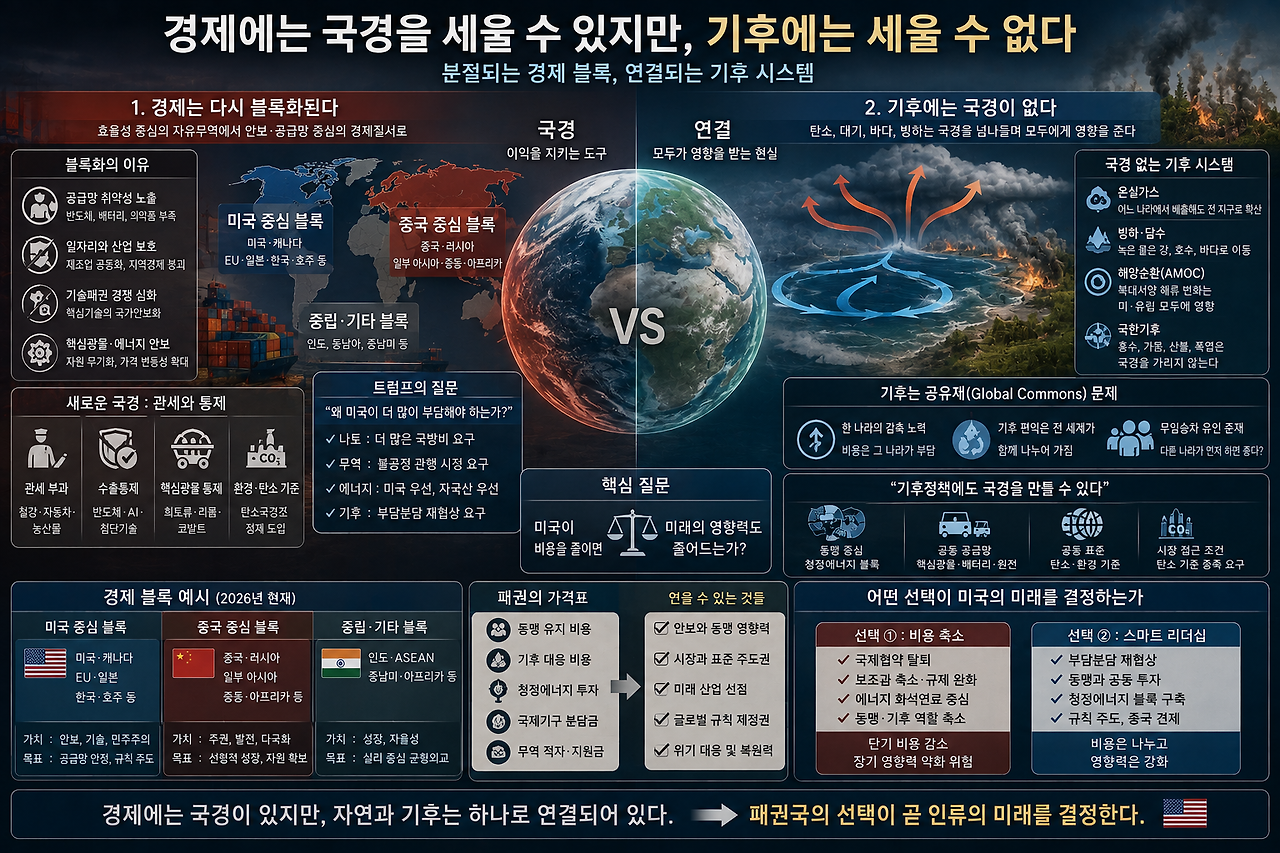
2011년 국제통상론 수업에서 들었던 이야기로 다시 돌아가 보자.
당시 교수님은 자유무역과 함께 민족주의, 그리고 세계경제가 다시 여러 개의 블록으로 나뉠 가능성을 이야기했다.
그때의 세계는 지금과 많이 달랐다.
세계화는 계속 확대될 것처럼 보였다.
기업은 생산비가 싼 곳을 찾아 공장을 옮겼고, 상품은 국경을 넘었으며, 자유무역협정은 계속 늘어났다.
중국에서 만든 제품을 미국에서 사고, 한국 기업이 베트남에서 생산하고, 독일 기업이 중국에 공장을 짓는 일이 너무도 자연스러워졌다.
효율성이 중요한 시대였다.
어느 나라에서 만드는가보다 얼마나 싸고 잘 만드는가? 가 더 중요해지는 것처럼 보였다.
15년이 지난 지금은 분위기가 완전히 달라졌다.
이제 다시 묻는다.
어느 나라에서 만들었는가?
원료는 어디에서 왔는가?
그 기업은 어느 국가의 통제를 받는가?
전쟁이 발생해도 공급받을 수 있는가?
반도체도 그렇고, 배터리도 그렇고, 희토류와 핵심광물도 그렇다.
경제에 다시 국적이 생기기 시작했다.
그리고 그 변화의 중심에 트럼프의 미국이 있다.
자유무역의 가격표가 다시 계산되기 시작했다
자유무역에는 강력한 논리가 있다.
가장 효율적으로 생산할 수 있는 곳에서 만들고, 국가들이 서로 교역하면, 모두가 더 싼 가격에 더 많은 상품을 사용할 수 있다.
오랫동안 미국은 이 질서를 만드는 데 중심적인 역할을 했다.
그런데 세계화를 충분히 경험하고 나자 다른 비용이 보이기 시작했다.
공장을 해외로 옮기면 제품은 싸졌다.
하지만 공장이 있던 지역의 일자리는 사라질 수 있었다.
반도체 생산을 몇몇 국가에 집중하면 효율적이었다.
그러나 공급망이 끊기자 자동차조차 만들기 어려웠다.
희토류와 핵심광물을 가장 싸게 정제하는 국가에 맡겼더니 어느 순간 그 나라가 전략적 경쟁국이 되어 있었다.
태양광 패널 역시 싸졌다.
그런데 지난 화에서 살펴본 것처럼 그 공급망의 상당 부분을 중국이 장악했다.
그러자 가격표의 항목이 달라졌다.
과거에는 '가격 + 품질' 정도였다면, 이제는 여기에 '안보 + 공급망 + 일자리 + 기술 + 국가의존도'가 붙기 시작했다.
트럼프는 이 변화에 가장 적극적으로 반응한 정치인이다.
관세는 새로운 국경이다
2026년 현재 미국은 실제로 여러 상품과 국가에 관세를 통해 새로운 경제적 경계를 만들고 있다.
캐나다와의 갈등에서도 자동차와 유제품 등에 추가관세를 발표했고, 시행일을 조정하면서 협상을 계속하고 있다. 미국 정부는 그 이유를 반복해서 미국 노동자와 생산자의 이익, 국가안보, 상호주의로 설명한다. (The White House)
여기서 중요한 것은 특정 관세율 하나가 아니다.
정바카라을 바라보는 방식이다.
트럼프에게 무역은 '가장 싼 물건을 어디에서 살 것인가' 만의 문제가 아니다.
'그 물건을 어느 나라가 만드는 것이 미국에 유리한가?'의 문제다.
그래서 철강에도 국적이 붙고, 자동차에도 국적이 붙으며, 광물에도 국적이 붙는다.
심지어 하나의 자동차 안에 들어 있는 부품 가운데 얼마가 미국산인지까지 계산하기 시작한다.
경제의 국경이 다시 선명해지는 것이다.
그런데 기후에는 원산지 표시가 없다
여기까지는 2011년 국제통상론에서 들었던 이야기의 연장선으로 이해할 수 있다.
경제가 다시 블록으로 나뉜다.
미국 중심의 공급망과 중국 중심의 공급망 그 사이에서 선택하는 국가들이다.
문제는 이번에는 새로운 변수가 하나 들어왔다는 것이다.
기후변화다.
탄소에는 원산지 표시가 없다.
미국에서 배출된 이산화탄소라고 미국 상공에만 머물지 않는다.
중국에서 나온 이산화탄소 역시 중국 국경에서 멈추지 않는다.
캐나다의 산불 연기도 국경검문소를 통과하지 않는다.
그린란드에서 녹아 나온 물에는 덴마크 국기가 붙어 있지 않다.
AMOC 역시 NATO 회원국과 비회원국을 구분하지 않는다.
우리가 지난 몇 편에서 따라온 자연은 계속 같은 이야기를 하고 있었다.
네팔의 빙하에서 시작했다.
캐나다의 빙하를 보았다.
오대호까지 내려왔다.
그리고 그린란드와 북대서양의 AMOC까지 갔다.
지역은 모두 달랐다.
그러나 공통점이 하나 있었다.
자연에는 우리가 만든 국경이 없었다.
이것이 기후문제를 어려운 경제문제로 만든다
기후변화는 환경문제이지만 동시에 매우 독특한 경제문제다.
IPCC도 기후변화를 전형적인 ‘글로벌 공유재(global commons)’ 문제로 설명한다.
한 국가가 온실가스를 줄이면 비용은 그 국가가 부담한다.
하지만 그렇게 줄인 온실가스로 얻는 기후 편익은 그 나라만 가져가는 것이 아니다.
전 세계가 나눠 가진다. (IPCC)
여기에 아주 골치 아픈 문제가 생긴다.
내가 돈을 들여 탄소를 줄이고 있는데, 옆 나라가 아무것도 하지 않아도, 옆 나라 역시 일부 혜택을 받는다.
그렇다면 이런 생각을 할 수 있다.
"다른 나라가 먼저 하면 되지 않을까?"
경제학에서는 이것을 무임승차 문제라고 부른다.
그리고 흥미롭게도 IPCC 역시 국제 기후협력에서 각 국가가 다른 나라의 감축노력에 무임승차하려는 유인이 존재한다고 명시적으로 설명한다. (IPCC)
나는 이 부분에서 트럼프의 문제의식 자체는 꽤 현실적이라고 생각한다.
왜 미국만 줄여야 하는가?
중국도 줄여야 하고, 인도도 줄여야 하며, 유럽도 부담해야 한다.
맞는 이야기다.
트럼프의 질문은 틀리지 않았다
2025년 트럼프는 다시 파리협정 탈퇴를 지시했다.
당시 행정명령의 논리는 아주 명확했다.
국제환경협정이 미국 경제를 부당하거나 과도하게 부담시켜서는 안 되며, 미국 국민의 이익을 우선해야 한다는 것이었다. (The White House)
미국의 탈퇴가 공식 발효된 2026년 1월 27일 이후 파리협정 당사국은 194개가 됐다. (UNFCCC)
이 역시 지금까지 우리가 봤던 트럼프의 사고방식과 놀라울 정도로 닮아 있다.
NATO에서는 묻는다.
왜 미국이 더 많이 내야 하는가?
무역에서는 묻는다.
왜 미국이 더 많이 수입해야 하는가?
태양광에서는 묻는다.
왜 미국이 중국 공급망에 의존해야 하는가?
기후에서도 묻는다.
왜 미국이 더 많은 비용을 부담해야 하는가?
질문은 일관되어 있다.
그래서 트럼프를 단순히 종잡을 수 없는 정치인으로 보는 것보다, 일관된 하나의 세계관을 가진 정치인으로 보는 편이 더 이해하기 쉽다.
그 세계관의 중심에는 '국가 간 거래에는 반드시 손익계산서가 있어야 한다'는 생각이 있다.
그런데 여기서 질문을 하나 바꿔보자
미국이 더 많이 부담할 이유가 없다면, 다른 나라에게 더 많이 부담하게 만들면 된다.
나는 이것이 동맹을 이야기했던 5화와 똑같다고 생각한다.
트럼프는 NATO를 없애기보다 동맹국에게 더 많은 국방비를 요구했다.
그리고 실제로 유럽의 국방비는 크게 증가했다.
그렇다면 기후에서도 같은 전략이 가능하지 않을까?
미국이 모든 비용을 떠안는 것이 아니라, 중국과 유럽, 인도와 한국, 일본과 다른 국가들에게 더 많은 바카라임을 요구한다.
미국은 기술과 시장, 금융과 동맹망을 이용해 다른 국가들이 함께 움직이도록 만든다.
그러면 미국은 기후대응을 하면서도 부담을 나눌 수 있다.
오히려 패권국다운 방식이다.
문제는 미국이 협상의 중심에서 비용분담을 요구하는 것과 협상장에서 빠지는 것은 전혀 다른 전략이라는 것이다.
테이블에서 떠나면 계산서는 없어질까
파리협정에서 미국이 빠졌다고 기후변화가 중단되는 것은 아니다.
다른 국가들의 태양광 투자가 멈추는 것도 아니다.
배터리 공장이 사라지지도 않는다.
탄소배출 기준이나 기후금융에 관한 국제논의도 계속된다.
실제로 미국이 탈퇴한 뒤에도 194개 당사국이 파리협정에 남아 있다. (UNFCCC)
여기에서 패권의 문제가 생긴다.
미국이 테이블에서 빠지면 비용을 줄일 수 있다.
하지만 동시에 규칙을 만드는 힘도 줄어들 수 있다.
이것은 우리가 태양광에서 이미 본 문제와 닮았다.
중국이 태양광을 많이 만들기 때문에 미국이 태양광 시장에서 멀어지면, 중국의 태양광 영향력은 줄어드는 것이 아니라 오히려 더 커질 수 있다.
국제기후질서도 비슷할 수 있다.
미국이 빠진다고 국제기후정바카라이 사라지는 것이 아니라면, 남은 국가들이 규칙을 만든다.
그리고 미래의 미국 기업이 그 규칙을 따라야 하는 상황이 생길 수도 있다.
패권에는 규칙을 만드는 힘이 있다
우리는 패권을 이야기할 때 군대를 먼저 생각한다.
항공모함, 핵무기, 해외기지 물론 중요하다.
그러나 패권에는 또 다른 힘이 있다.
표준을 만드는 힘이다.
달러가 그렇다.
금융규제가 그렇다.
반도체 기술규제가 그렇다.
항공안전 기준도 그렇고, 회계기준과 지식재산권도 그렇다.
세계 기업은 거대한 미국시장에 접근하기 위해 미국 규칙을 신경 쓸 수밖에 없다.
그래서 패권국의 가장 강력한 권력 가운데 하나는 다른 나라의 기업도 내가 만든 규칙을 계산하게 만드는 것
이다.
기후와 에너지에서도 앞으로 이런 규칙들이 계속 생길 가능성이 높다.
제품 하나를 생산할 때 얼마나 많은 탄소를 배출했는가?
배터리 원료는 어디에서 왔는가?
전기는 어떤 방식으로 생산됐는가?
공급망에 환경기준은 적용되었는가?
이런 기준이 무역규칙과 연결되면 기후는 더 이상 환경부의 이야기가 아니다.
통상정바카라이 된다.
국제통상을 공부했던 나에게 이 지점이 특히 재미있다.
세계화가 끝나는 것이 아니라 형태가 바뀌는 것일 수도 있다
세계가 다시 블록화된다고 해서 교역 자체가 사라지는 것은 아니다.
미국 블록 안에서는 여전히 엄청난 교역이 일어날 수 있다.
중국 역시 주변 국가들과 공급망을 만든다.
인도나 중동, 동남아시아도 자신의 위치를 계산한다.
세계화가 하나의 거대한 시장에서 여러 개의 연결된 시장으로 변할 수 있다는 뜻이다.
IMF도 최근 국제경제를 설명하면서 갈등과 안보위험, 불확실성이 높아지는 상황에서 지경학적 분절(geoeconomic fragmentation)이 무역 흐름을 재편하는 현상을 분석하고 있다. (IMF)
그렇다면 기후도 꼭 전 세계가 하나의 완벽한 협정 아래에서만 움직여야 하는 것은 아닐 수 있다.
흥미롭게도 IPCC도 이를 이야기한다.
모든 국가가 동시에 완벽하게 합의하지 못하더라도 몇몇 국가들이 ‘기후클럽(climate clubs)’과 같은 형태로 먼저 협력하고, 탄소시장이나 산업기준을 연결하는 것이 감축을 가속하는 방법이 될 수 있다고 평가한다. (IPCC)
여기에서 2011년의 경제 블록화와 2026년의 기후문제가 처음으로 만난다.
기후대응도 블록화될 수 있다
이것은 꽤 재미있는 역설이다.
경제 블록화가 기후협력의 적이라고만 생각했는데, 반대로 경제 블록이 기후대응의 도구가 될 수도 있다.
가령 미국과 캐나다, 유럽, 한국, 일본, 호주가 하나의 청정에너지 공급망을 만든다고 생각해보자.
서로 핵심광물을 공급하고, 배터리를 만들고, 원전을 건설하고, 태양광과 ESS의 기준을 맞춘다.
그리고 그 블록 안에서 생산되는 제품에는 낮은 관세를 적용하고, 탄소배출이 지나치게 높은 국가의 제품에는 더 높은 비용을 부과한다.
그러면 기후정바카라과 통상정바카라이 하나가 된다.
기업은 환경을 사랑해서가 아니라, 시장에 들어가기 위해 탄소를 줄인다.
이것이 패권국이 가진 시장의 힘이다.
그리고 어쩌면 미국은 이런 전략에서 세계에서 가장 유리한 국가일 수도 있다.
미국에는 이미 블록이 있다
왜냐하면 미국은 새로 친구를 찾아야 하는 국가가 아니기 때문이다.
캐나다가 있다.
유럽이 있다.
일본이 있다.
대한민국이 있다.
호주가 있다.
그리고 그 나라들은 공통점이 있다.
경제력이 크고, 기술력이 있으며, 자본이 있고, 상당수가 이미 기후대응을 위한 산업에 투자하고 있다.
지난 화들에서 우리는 미국의 약점을 계속 보았다.
태양광 공급망에서는 중국이 강하다.
배터리에서도 중국이 강하다.
핵심광물 정제에서도 중국이 강하다.
그러나 문제를 미국 혼자로 제한하지 않으면 그림이 달라질 수 있다.
호주에는 광물이 있다.
캐나다에도 광물이 있다.
한국과 일본에는 배터리와 소재기술이 있다.
유럽에는 산업기술과 거대한 시장이 있다.
미국에는 자본과 기술, 에너지, 그리고 세계 최대급 내수시장이 있다.
그러면 미국의 동맹망을 군사동맹에서 산업동맹으로 확장할 수도 있다.
이것이 가능하다면 미국은 중국의 태양광 패널을 따라잡기 위해 모든 공정을 혼자 만들 필요도 없다.
동맹 전체가 하나의 공급망이 되면 된다.
갑자기 5화에서 이야기했던 동맹의 가치가 에너지에서 다시 나타난다.
이것이 중국이 쉽게 가지지 못한 미국의 자산이다
중국의 장점은 제조업 집적이다.
규모가 크고, 공급망이 촘촘하며, 정부와 금융이 산업정바카라을 지원할 수 있다.
하지만 미국에는 다른 장점이 있다.
동맹망이다.
중국과 미국이 둘 다 모든 것을 자기 나라에서 만들려고 한다면 중국이 더 유리한 분야가 분명히 있다.
하지만 미국이 캐나다, 호주, 대한민국, 일본, 유럽과 하나의 경제·기술 블록을 만든다면 계산은 달라진다.
이것이 바로 미국이 가진 패권의 힘이다.
그래서 나는 트럼프의 경제 블록화 자체가 반드시 미국 패권의 쇠퇴를 의미한다고 생각하지 않는다.
오히려 잘 사용하면 중국을 견제하는 매우 강력한 전략이 될 수 있다.
문제는 무엇을 블록 안에 넣느냐다.
석유만 블록화한다면
미국이 동맹국에게 LNG를 판매한다.
좋다.
러시아 가스 의존도를 줄인다.
미국에도 이익이고 유럽의 에너지안보에도 도움이 될 수 있다.
하지만 여기서 끝난다면 문제가 있다.
중국은 태양광 패널을 팔고, 배터리를 팔고, 전기차를 팔고, 전력망 장비를 팔면서
다음 에너지 체제의 시장을 키울 수 있다.
반면 미국 블록은 석유와 LNG를 중심으로 남는다.
그렇다면 20년 후 어느 산업의 시장이 더 커질 것인가?
아무도 확신할 수 없다.
그래서 4화에서 했던 질문이 다시 나타난다.
미국은 현재의 비교우위를 지키고 있는 것인가? 아니면 현재의 비교우위를 지키느라 미래의 비교우위를 만들 기회를 놓치고 있는가?
기후정바카라은 중국에 좋은 일을 해주는 것일까
트럼프의 시각에서는 그렇게 보일 수도 있다.
미국이 태양광을 더 설치하면 중국 기업이 돈을 번다.
ESS를 늘리면 중국 배터리가 들어올 수 있다.
전기차를 확대하면 중국이 장악한 광물 공급망에 대한 의존이 커질 수 있다.
그러니 화석연료 사용을 줄이는 것이 중국에 산업적 이익을 준다고 볼 수 있다.
하지만 여기에는 또 다른 선택지가 있다.
중국 제품을 쓰지 않고 기후대응을 하는 것.
쉽지는 않다.
비싸다.
시간이 걸린다.
그러나 미국과 동맹국이 새로운 공급망을 만든다면 가능성은 있다.
그렇다면 기후정바카라은 중국에 패권을 넘겨주는 정바카라이 아니라, 오히려 중국이 먼저 차지한 산업을 다시 경쟁하는 정바카라이 될 수 있다.
결국 문제는 기후인가 중국인가가 아니다.
산업정바카라을 어떻게 설계하느냐다.
그리고 트럼프는 한 걸음 더 나갔다
2026년 1월 트럼프 행정부는 미국의 이익에 부합하지 않는다고 판단한 여러 국제기구·협약에서 탈퇴하도록 지시했다.
그 목록에는 IPCC도 포함됐다. (The White House)
이것은 상징적이다.
IPCC가 미국의 에너지정바카라을 결정하는 기관은 아니다.
각국 과학자들의 연구를 평가해 기후과학의 상태를 정리하는 국제기구다.
그러므로 이것은 단순히 발전소 몇 개를 허가하는 문제와 성격이 다르다.
미국이 국제기후질서 안에서 어떤 위치를 차지할 것인가의 문제다.
물론 미국의 대학과 연구기관, 주정부, 기업의 기후연구가 모두 사라지는 것은 아니다.
미국의 과학역량 역시 여전히 세계 최고 수준이다.
하지만 국가가 국제적 과학·정바카라 체계에서 한 발 물러나는 것과 안에서 영향력을 행사하는 것은 다른 일이다.
패권국에는 이상한 특징이 있다.
자신이 참여하는 제도는 자기 영향력을 받을 가능성이 높다.
그렇다면 스스로 빠지는 것은 영향력을 다른 국가에 나눠주는 선택일 수도 있다.
트럼프는 블록화를 이해하지만 기후의 블록화를 포기하고 있는가
여기서 나는 매우 묘한 모순을 본다.
트럼프는 국제경제가 더 이상 완전한 자유시장으로 움직이지 않는다는 사실을 누구보다 잘 이해한 정치인처럼 보인다.
반도체를 국가안보로 본다.
철강을 국가안보로 본다.
자동차를 국가안보로 본다.
핵심광물도 국가안보로 본다.
에너지도 국가안보다.
그래서 미국 중심의 경제 블록을 강화하려 한다.
그런데 기후와 청정에너지 산업으로 오면 미국이 그 블록을 주도하는 대신 상당 부분 거리를 두려고 한다.
나는 이것이 트럼프 전략의 가장 흥미로운 지점이라고 생각한다.
만약 기후와 청정에너지 산업이 앞으로 중요하지 않다면 문제가 없다.
미국은 불필요한 비용을 아낀 것이다.
그러나 그것들이 앞으로 에너지, 자동차, 전력망, 배터리, AI 전력공급, 신산업, 국제무역기준과 연결된다면 이야기가 완전히 달라진다.
미국은 자신이 가장 잘하는 블록정치에서 가장 큰 미래시장 하나를 상대방에게 내주는 것일 수도 있다.
경제에는 국경이 필요할지도 모른다
여기까지 쓰고 나면 내가 자유무역을 무조건 옹호한다고 생각할 수도 있다.
그렇지는 않다.
지난 몇 년은 지나치게 집중된 공급망의 위험을 충분히 보여줬다.
반도체도, 의약품도, 핵심광물도, 에너지도 국가가 최소한의 공급안보를 고려해야 한다.
시장가격 하나만 보고 모든 생산시설을 해외로 보내는 것이 항상 최적의 선택이라고 생각하지 않는다.
오히려 일정한 블록화는 불가피할 수도 있다.
미국과 중국이 전략산업의 공급망을 완전히 공유하던 시대가 다시 오지 않을 수도 있다.
그렇다면 중요한 것은 블록화를 막는 것이 아니다.
어떤 블록을 만들 것인가.
이 질문이 된다.
기후에는 국경이 없지만 기후정바카라에는 국경이 있을 수 있다
그리고 이것이 내가 이번 글을 쓰면서 새롭게 생각하게 된 부분이다.
처음에는 아주 단순하게 생각했다.
경제는 국경을 만들지만 기후에는 국경이 없다.
그러니 경제 내셔널리즘과 기후변화는 서로 충돌한다.
그런데 조금 더 생각해보니 꼭 그렇지만은 않았다.
기후 자체에는 국경이 없다.
하지만 기후정바카라에는 국경을 만들 수 있다.
미국과 동맹국이 하나의 청정에너지 시장을 만들 수 있다.
공동의 배터리 기준을 만들 수 있다.
광물 공급망을 함께 만들 수 있다.
원자력 기술을 공유할 수 있다.
공동으로 송전망 기술과 ESS를 개발할 수도 있다.
그리고 그 시장에 접근하고 싶은 국가에게 일정한 탄소기준과 환경기준을 요구할 수도 있다.
즉 경제 블록화를 기후대응과 결합할 수 있다.
IPCC도 국제협력이 실제 감축정바카라의 채택과 저탄소 기술의 확산에 도움을 주며, 지역적·부분적 협력 역시 감축비용을 낮추고 행동을 가속할 가능성이 있다고 평가한다. (IPCC)
그렇다면 미국에는 어쩌면 선택지가 하나 더 있었던 셈이다.
세계화를 유지할 것인가, 경제 내셔널리즘으로 돌아갈 것인가, 둘 중 하나만이 아니다.
동맹을 중심으로 새로운 에너지 블록을 만드는 것.
이것이 패권국의 방식 아닐까
미국은 2차 세계대전 이후 모든 것을 직접 생산하지 않았다.
오히려 동맹국을 세계경제에 편입시켰다.
일본이 성장했고, 독일이 성장했으며, 대한민국도 성장했다.
그 나라들이 강해진다고 곧바로 미국이 약해지는 것은 아니었다.
왜냐하면 상당수가 미국이 만든 질서 안에서 성장했기 때문이다.
달러를 사용하고, 미국 시장에 접근하며, 미국과 군사동맹을 맺고, 미국 중심의 금융·기술체계에 참여했다.
그래서 패권은 모든 것을 내가 만드는 것 과 반드시 같은 의미가 아니다.
다른 나라가 성장해도 나와 연결되어 있도록 만드는 것 일 수도 있다.
이 관점에서 보면 미국이 중국의 태양광 공급망을 견제하는 가장 강력한 방법은 모든 태양광을 미국에서 만드는 것이 아닐 수도 있다.
한국, 일본, 캐나다, 호주, 유럽과 함께 만드는 것이다.
그러면 비용도 나누고, 위험도 나누며, 시장도 키울 수 있다.
트럼프가 NATO에서 원하는 것과 놀랍도록 비슷하다.
동맹국도 돈을 내라.
그 논리를 기후와 산업에도 적용할 수 있는 것이다.
문제는 비용이 아니라 무엇을 얻느냐다
이 카지노 게임을 쓰면서 계속 같은 장소로 돌아오는 느낌이 든다.
동맹에도 비용이 든다.
청정에너지 공급망에도 비용이 든다.
기후대응에도 비용이 든다.
국제기구를 유지하는 데도 비용이 든다.
트럼프는 그 돈을 보며 묻는다.
미국이 왜 내야 하는가?
그리고 나는 이제 이렇게 묻고 싶다.
그 돈을 내고 미국은 무엇을 사고 있었는가?
동맹에 돈을 내고 영향력을 샀다.
해외기지에 돈을 내고 전략적 접근성을 샀다.
국제기구에 참여하면서 규칙을 만드는 자리를 샀다.
기후협력에 돈을 쓰면서 다른 나라를 움직일 가능성을 샀다.
청정에너지에 투자하면서 미래 산업에 들어갈 선택권을 샀다.
그렇다면 이 비용들은 단순한 지출일까? 아니면 미래의 패권을 위한 투자일까?
이 질문에 따라 트럼프의 정바카라에 대한 평가는 완전히 달라진다.
그렇다고 미국이 모든 비용을 계속 낼 필요는 없다
여기에서도 균형은 필요하다.
미국이 패권국이라는 이유만으로 언제까지나 다른 국가의 비용을 대신 지불해야 한다고 주장할 생각은 없다.
유럽은 더 많은 국방비를 지불할 수 있다.
중국도 더 많은 기후바카라임을 져야 한다.
한국과 일본 역시 자신들의 산업과 안보를 위한 비용을 부담해야 한다.
개발도상국이라고 해서 영원히 아무 바카라임도 지지 않을 수도 없다.
트럼프가 던진 부담분담이라는 질문 자체는 필요하다.
하지만 부담분담에는 두 가지 방법이 있다.
하나는 "나는 더 이상 내지 않겠다."이고, 다른 하나는 "너도 더 많이 내라. 그리고 우리는 계속 같이 간다."이다.
패권의 관점에서 보면 두 번째가 훨씬 어렵다.
그러나 성공한다면 훨씬 강력하다.
동맹에서도 우리는 이미 같은 답을 보았다
5화에서 트럼프의 NATO 정바카라을 보며 나는 아직 결론이 나지 않았다고 썼다.
동맹국들에게 더 많은 돈을 쓰게 하고도 미국 중심의 동맹을 유지한다면 트럼프의 전략은 성공이다.
미국은 더 적은 비용으로 더 강한 동맹을 가질 수 있다.
하지만 동맹국의 비용은 늘고 미국에 대한 신뢰는 줄어든다면 이야기가 달라진다.
돈은 아꼈지만 자산가치도 줄어든 것이다.
기후도 똑같다.
미국이 다른 국가들에게 더 많은 기후비용을 부담시키면서도 미국 중심의 기술·금융·산업질서를 만든다면 성공이다.
하지만 미국이 빠져 있는 동안 중국과 유럽이 규칙과 산업을 만들면, 미국은 비용을 줄였지만 영향력도 줄일 수 있다.
결국 모든 것은 같은 질문으로 돌아간다.
트럼프는 비용을 줄이고 있는가? 아니면 자산을 줄이고 있는가?
경제는 블록화될 것이다
나는 2011년 강의실에서 들었던 이야기를 다시 생각한다.
당시에는 세계가 정말 그렇게 될지 알지 못했다.
15년 후 지금을 보면 적어도 방향은 분명해 보인다.
세계경제는 다시 국가를 의식하기 시작했다.
공급망에는 안보가 붙었고, 기술에는 국적이 붙었으며, 무역에는 관세가 돌아왔다.
미국과 중국은 자신들을 중심으로 경제적 관계를 다시 구성하려 한다.
완전히 두 개의 세계로 나뉠지는 알 수 없다.
하지만 2000년대 초반처럼 “가장 싼 곳에서 만들면 된다”는 말만으로 국제통상을 설명하기는 어려워졌다.
교수님이 이야기했던 경제의 블록화가 이제 교과서 밖으로 나온 셈이다.
그런데 그때는 내가 생각하지 못했던 것이 있었다.
기후는 블록화되지 않는다
태평양을 미국 편과 중국 편으로 나눌 수 없다.
대기를 NATO와 비NATO로 나눌 수도 없다.
AMOC에 관세선을 그을 수도 없다.
오대호에 실제 국경은 있지만 물은 계속 섞인다.
그린란드의 얼음은 어느 경제블록에 가입할지 선택하지 않는다.
그래서 21세기의 국제질서는 아주 이상한 두 힘 사이에 놓이게 될지도 모른다.
한쪽에서는 경제가 다시 갈라진다. 다른 한쪽에서는 기후가 더 강하게 연결시킨다.
국가는 서로 떨어지려고 하는데, 자연은 우리가 하나의 시스템 안에 있다는 사실을 계속 보여준다.
나는 이 충돌이 앞으로 국제통상과 국제정치에서 굉장히 중요한 문제가 될 것이라고 생각한다.
그리고 이 문제 한가운데 미국이 있다.
세계에서 가장 큰 경제권 가운데 하나이고, 가장 강한 군사력을 가지고 있으며, 가장 넓은 동맹망을 가지고 있고, 석유와 천연가스도 풍부하며, 세계 자본과 기술에도 막강한 영향력을 가진 국가.
미국이 어떤 방향으로 움직이는가는 미국만의 문제가 되기 어렵다.
그리고 이제 마지막 질문만 남았다
이 카지노 게임을 시작할 때 나는 제목을 이렇게 정했다.
《패권의 가격표》
네팔의 빙하에서 시작했다.
트럼프가 왜 석유를 선택했는지 보았다.
태양광과 배터리에서 중국이 가진 공급망 패권을 살펴봤다.
현재의 비교우위와 미래의 비교우위 사이에서 미국의 선택을 생각했다.
동맹의 가격을 계산했고, 캐나다로 올라가 국경을 넘는 자연을 보았다.
오대호의 물을 따라갔고, 그린란드에서 북대서양의 AMOC까지 갔다.
그리고 결국 하나의 질문으로 돌아왔다.
트럼프는 많은 것을 비용으로 본다.
동맹 유지비, 기후대응 비용, 청정에너지 보조금, 국제기구 분담금, 무역적자 그것들을 줄이려고 한다.
어쩌면 맞을 수도 있다.
패권은 너무 비싸졌고, 미국 국민에게 더 이상 그 모든 비용을 요구할 수 없는 시대가 온 것인지도 모른다.
그렇다면 트럼프는 쇠퇴를 막으려는 대통령일 것이다.
하지만 반대일 수도 있다.
미국이 비용이라고 생각했던 바로 그것들이
동맹을 만들고, 시장을 만들고, 표준을 만들고, 미래 산업에 영향력을 행사하며,
다른 국가들이 미국과 함께 움직이도록 만들었던 것이라면, 그 돈을 아끼는 일이 다른 의미를 가질 수 있다.
패권 유지비를 줄이는 것이 아니라 패권 자체를 줄이는 일이다.
이제 마지막 편에서는 처음부터 제목으로 던져놓았던 질문에 답해보려고 한다.
마지막 화
미국은 왜 스스로 패권을 내려놓고 있는가
중국이 미국의 패권을 빼앗고 있는 것일까?
아니면 미국이 너무 비싸다고 생각한 패권의 유지비를 하나씩 줄이면서 스스로 그 자리를 내려오고 있는 것일까?
그리고 트럼프의 선택은 정말 미국을 약하게 만드는 선택일까?
아니면 기존 패권을 훨씬 효율적인 형태로 바꾸는 과정일까?
마지막 10화에서는 지금까지 붙여본 모든 가격표를 한 장의 장부에 올려놓으려고 한다.
동맹, 에너지, 공급망, 기후, 그리고 미국의 패권 그 장부를 다 합치고 나면 비로소 물을 수 있을 것이다.
미국이 아끼려는 돈보다, 그 돈으로 유지하고 있던 것이 더 비싼 것은 아니었을까?
Episode 9
Economies Can Build Borders. Climate Can't.
Back to that international trade class from 2011. My professor talked about free trade alongside nationalism, and the possibility that the world economy could fracture into blocs again. The world looked very different back then. Globalization seemed destined to keep expanding — companies chased the cheapest place to produce, goods crossed borders freely, and free trade agreements kept multiplying. Buying Chinese-made goods in America, Korean firms manufacturing in Vietnam, German firms building plants in China — all of it felt entirely natural. It was an era where efficiency mattered most. Which country made something seemed to matter less than how cheap and how good it was.
Fifteen years later, the mood has completely reversed. Now the questions have come back: Which country made this? Where did the raw materials come from? Which government controls that company? Can you still get it if war breaks out? Semiconductors face this question. So do batteries. So do rare earths and critical minerals. The economy is acquiring nationality again — and Trump's America sits at the center of that shift.
The Price Tag on Free Trade Is Being Recalculated
Free trade rests on powerful logic: produce wherever it's most efficient, trade freely across borders, and everyone ends up with more goods at lower prices. For a long time, America played the central role in building that order.
But once the world had lived through enough globalization, other costs started becoming visible. Moving factories overseas made products cheaper — but it could also erase the jobs those factories once supported. Concentrating chip production in a handful of countries was efficient — until a broken supply chain made it hard to build even a car. Refining rare earths and critical minerals through whichever country did it cheapest looked smart — until that country became a strategic rival. Solar panels got cheaper too — but, as the earlier episodes showed, China ended up controlling much of that supply chain.
Which means the line items on the price tag have changed. It used to be roughly price + quality. Now it's expanded to include security + supply chain + jobs + technology + dependence on a foreign government. Trump is the politician who has responded to this shift most aggressively.
Tariffs Are the New Borders
As of 2026, the US is actively building new economic boundaries around various goods and countries through tariffs. In its dispute with Canada, it announced additional tariffs on autos, dairy, and other goods, adjusting implementation timing while continuing to negotiate — justifying the moves, repeatedly, in terms of American workers' and producers' interests, national security, and reciprocity.
What matters here isn't any one specific tariff rate. It's the underlying logic. For Trump, trade isn't simply a question of where to buy the cheapest thing. It's a question of which country making that thing benefits America. Which is why steel now has a nationality, cars have a nationality, minerals have a nationality — and America is even starting to calculate what share of a single car's components were actually made domestically. The borders of the economy are becoming sharp again.
But Climate Carries No Country-of-Origin Label
Up to this point, everything fits neatly as an extension of that 2011 lecture: the economy fracturing into blocs, an American-centered supply chain, a Chinese-centered supply chain, and countries choosing between them. But this time, one entirely new variable has entered the equation.
Climate change.
Carbon carries no country-of-origin stamp. CO2 emitted in America doesn't stay confined to American skies. CO2 from China doesn't stop at China's border either. Smoke from Canadian wildfires doesn't pass through a customs checkpoint. Meltwater flowing off Greenland doesn't carry the Danish flag. AMOC doesn't distinguish NATO members from non-members.
Everything nature showed us in the last several episodes has been telling the same story, over and over. It began with Nepal's glacier. We looked at Canada's glaciers. We followed the water down to the Great Lakes. We traced it out to Greenland and AMOC in the North Atlantic. The locations were all different. But one thing was constant:
Nature never recognized the borders we built.
This Is What Makes Climate Such a Difficult Economic Problem
Climate change is an environmental issue, but it's also a remarkably distinctive economic one. The IPCC describes it as a textbook "global commons" problem: when one country cuts emissions, that country bears the cost — but the climate benefit that reduction produces isn't captured by that country alone. It's shared across the entire world.
That creates a genuinely thorny incentive problem. If I spend money cutting carbon while the country next door does nothing, that neighbor still enjoys part of the benefit. Which naturally invites the thought: why don't they go first? Economists call this a free-rider problem — and, notably, the IPCC itself explicitly acknowledges that in international climate cooperation, each country has an incentive to free-ride on others' mitigation efforts.
I think Trump's underlying concern here is fairly reasonable. Why should America be the only one cutting emissions? China needs to cut too. So does India. So does Europe. That's a fair point.
Trump's Question Isn't Wrong
In 2025, Trump again ordered the US withdrawal from the Paris Agreement. The reasoning in that executive order was blunt: international environmental agreements shouldn't unfairly or excessively burden the American economy, and American interests should come first. Following the withdrawal's official effect on January 27, 2026, 194 parties remained in the Paris Agreement.
This mirrors, almost exactly, the pattern of thinking we've traced throughout this series. On NATO, the question is: why should America pay more? On trade: why should America import more? On solar: why should America depend on China's supply chain? On climate: why should America bear more of the cost?
The question is remarkably consistent. Which is why it's more useful to understand Trump not as an unpredictable politician, but as one operating from a single, coherent worldview — one built around a core belief:
Every relationship between nations needs a profit-and-loss statement.
But Let's Flip the Question
If America has no reason to bear more of the burden, the answer is to make other countries bear more of it. I think this is exactly the same dynamic we examined with alliances in Episode 5. Trump didn't try to dismantle NATO — he demanded that allies spend more on defense. And European defense spending did, in fact, rise substantially.
Couldn't the same strategy work on climate? Instead of America absorbing the whole bill, demand more responsibility from China, Europe, India, South Korea, Japan, and everyone else. Use American technology, markets, capital, and alliance networks to get other countries moving alongside it. That way, America could pursue climate action while sharing the burden — arguably a genuinely hegemonic approach.
The problem is that demanding cost-sharing from the center of the negotiating table, and simply walking away from the table, are two entirely different strategies.
Does Leaving the Table Make the Bill Disappear?
America leaving the Paris Agreement doesn't stop climate change. It doesn't halt other countries' solar investments. Battery factories elsewhere don't vanish. International discussions on emissions standards and climate finance continue regardless — in fact, 194 parties remain in the Paris Agreement even after the US withdrawal.
This is where the hegemony problem emerges. America leaving the table cuts its costs. But it can also shrink its power to write the rules. This is the same dynamic we already saw with solar: if America pulls back from the solar market because China dominates it, China's influence over solar doesn't shrink — it grows. The international climate order could work the same way. If America's absence doesn't make international climate policy disappear, the remaining countries write the rules instead — and future American companies may find themselves having to comply with rules they had no hand in writing.
Hegemony Includes the Power to Set the Rules
When we talk about hegemony, we usually think of the military first — carriers, nuclear weapons, overseas bases. All genuinely important. But hegemony carries another kind of power too: the power to set standards. The dollar carries it. Financial regulation carries it. Semiconductor export controls carry it. So do aviation safety standards, accounting rules, and intellectual property law. Companies around the world have to pay attention to American rules simply to access the massive American market. Which means one of a hegemon's most powerful tools is getting foreign companies to factor your rules into their own calculations.
Climate and energy are very likely to keep generating new versions of exactly this kind of rule: how much carbon did a product's manufacturing emit? Where did the battery materials come from? How was the electricity generated? Did the supply chain meet environmental standards? Once rules like these get tied to trade policy, climate stops being purely an environmental-agency concern. It becomes trade policy. As someone who studied international trade, I find this connection genuinely fascinating.
Globalization May Not Be Ending — It May Be Changing Shape
A world re-fracturing into blocs doesn't mean trade itself disappears. Enormous trade can still happen within an American-centered bloc. China builds supply chains with its own neighbors. India, the Middle East, and Southeast Asia all calculate their own positioning. Which suggests globalization may be shifting from one giant unified market into several connected markets.
The IMF's recent analysis of the international economy explores exactly this — how rising conflict, security risk, and uncertainty are driving geoeconomic fragmentation that's reshaping trade flows.
If that's true, climate cooperation doesn't necessarily have to run through one single, perfect global agreement either. Interestingly, the IPCC makes a similar point: even without every country reaching perfect simultaneous consensus, a smaller group of countries forming something like "climate clubs" and linking carbon markets or industrial standards among themselves can still accelerate emissions reductions.
This is exactly where the economic blocization I learned about in 2011 and the climate problem of 2026 finally intersect.
Climate Response Can Be Organized Into Blocs Too
Here's a genuinely interesting paradox. I had assumed economic blocization was simply the enemy of climate cooperation. But it turns out an economic bloc can also become a tool for climate response.
Imagine America, Canada, Europe, South Korea, Japan, and Australia building a single clean-energy supply chain together — supplying each other's critical minerals, manufacturing batteries jointly, building nuclear plants together, aligning solar and storage standards. Apply low tariffs to products made within that bloc, and higher costs to products from countries with excessive carbon emissions. Suddenly, climate policy and trade policy merge into one. Companies don't cut carbon because they love the environment — they cut carbon because they need access to the market. That's the power a hegemon's market wields. And America may be the country best positioned in the world to run exactly this kind of strategy.
America Already Has a Bloc
Because America isn't a country that has to go looking for new friends. It already has Canada. Europe. Japan. South Korea. Australia. And these countries share something in common: large economies, strong technology, substantial capital — many of them already investing heavily in clean-energy industries.
Over the last several episodes, we kept running into America's weaknesses: China dominant in solar supply chains, dominant in batteries, dominant in critical-mineral refining. But limit the problem to America alone, and the picture only looks that bleak. Australia has minerals. So does Canada. South Korea and Japan have battery and materials technology. Europe has industrial capability and an enormous market. America has capital, technology, energy resources, and one of the largest domestic markets on Earth.
Which means America's alliance network could be extended from a purely military alliance into an industrial alliance. If that works, America doesn't need to build every stage of a solar supply chain on its own to catch up with China. The entire alliance can become one integrated supply chain. Suddenly, the value of alliances explored in Episode 5 reappears — this time inside the energy story.
This Is an Asset China Can't Easily Replicate
China's strength is manufacturing clustering — scale, tightly integrated supply chains, government and financial backing for industrial policy. But America has a different kind of strength: its alliance network.
If both China and America try to manufacture everything domestically, China clearly wins in certain sectors. But if America builds a single economic-technological bloc with Canada, Australia, South Korea, Japan, and Europe, the calculation changes entirely. That's precisely the power hegemony provides. Which is why I don't think Trump's economic blocization automatically means American decline — used well, it could become a remarkably powerful strategy for countering China. The real question is what gets put inside the bloc.
If the Bloc Only Contains Oil
Say America sells LNG to its allies. Good — it reduces dependence on Russian gas, benefits America, and helps European energy security. But if it stops there, there's a problem. China keeps selling solar panels, batteries, EVs, and grid equipment — growing the market for the next energy system in the process. Meanwhile the American bloc stays centered on oil and LNG.
Which industry's market will be bigger twenty years from now? No one can say with certainty. Which brings back the exact question from Episode 4: is America defending today's comparative advantage — or losing the chance to build tomorrow's while it defends today's?
Does Climate Policy Just Do China a Favor?
From Trump's vantage point, it might look that way. If America installs more solar, Chinese companies profit. If it expands storage, Chinese batteries flow in. If it expands EVs, dependence on China-dominated mineral supply chains grows. So cutting fossil-fuel use could be read as handing China an industrial windfall.
But there's another path available: pursue climate action without buying Chinese products. Not easy. Expensive. Time-consuming. But possible, if America and its allies build a new supply chain together. If that works, climate policy stops being a policy that hands hegemony to China — and becomes, instead, a policy that competes for an industry China got to first. In the end, the real question was never climate versus China. It's how you design the industrial policy.
And Trump Went a Step Further
In January 2026, the Trump administration ordered US withdrawal from a range of international organizations and agreements it judged contrary to American interests. The IPCC was on that list.
This is a genuinely symbolic move. The IPCC doesn't set American energy policy — it's an international body that synthesizes the state of climate science by evaluating research from scientists around the world. So this isn't comparable to simply permitting or denying a few power plants. It's a question of what position America will occupy within the international climate order.
To be clear, this doesn't mean climate research at American universities, research institutions, state governments, and companies disappears — US scientific capability remains world-class. But there's a real difference between a country stepping back from an international scientific-policy framework and a country exercising influence from inside it. Hegemons have a strange trait: the institutions they participate in tend to bend toward their influence. Stepping outside voluntarily may simply be a choice to share that influence with someone else.
Does Trump Understand Blocization, But Give Up on Climate Blocization?
Here I find a genuinely strange contradiction. Trump appears to understand, better than most politicians, that the international economy no longer runs on pure free-market logic. He treats semiconductors as national security. Steel as national security. Automobiles as national security. Critical minerals as national security. Energy as national security. Which is exactly why he's working to strengthen an American-centered economic bloc.
But when it comes to climate and clean-energy industries, America is largely stepping back rather than leading that same bloc. I think this is the most fascinating part of Trump's whole strategy. If climate and clean energy turn out not to matter much going forward, there's no problem — America simply saved itself an unnecessary expense. But if these industries end up connected to energy, automobiles, power grids, batteries, AI power supply, entire new industries, and international trade standards — the calculus flips entirely. America may be handing over one of the largest future markets to a rival, in exactly the kind of bloc politics it's otherwise best at.
The Economy May Genuinely Need Borders
Reading this far, you might assume I'm unconditionally defending free trade. I'm not. The last several years have shown, quite clearly, the risks of overly concentrated supply chains — in semiconductors, pharmaceuticals, critical minerals, and energy, states genuinely need to weigh at least a minimum level of supply security. I don't think chasing the lowest market price alone, and shipping every production facility overseas as a result, is always the optimal choice. Some degree of blocization may be genuinely unavoidable. The era when America and China shared strategic supply chains as freely as before may simply not return.
If that's true, the real question isn't whether to prevent blocization. It's:
What kind of bloc do you build?
Climate Has No Borders. Climate Policy Can.
And this is the part I found myself rethinking as I wrote this piece. At first, I thought about it simply: the economy builds borders, climate has none, so economic nationalism and climate change are fundamentally at odds. But looking closer, that's not quite right.
Climate itself has no borders. But climate policy can be given borders. America and its allies can build a single clean-energy market together. They can build shared battery standards. They can build mineral supply chains together. They can share nuclear technology. They can jointly develop transmission-grid technology and storage systems. And they can require certain carbon and environmental standards from any country that wants access to that market. In other words, economic blocization can be fused with climate response. The IPCC itself assesses that international cooperation helps drive the actual adoption of mitigation policy and the diffusion of low-carbon technology, and that regional or partial cooperation can also lower mitigation costs and accelerate action.
Which means America may have had one more option all along. It was never simply a binary choice between preserving globalization or retreating into economic nationalism.
A third path: build a new energy bloc centered on its alliances.
Isn't This Exactly What a Hegemon Does?
After World War II, America didn't try to manufacture everything itself. It brought its allies into the global economy instead. Japan grew. Germany grew. South Korea grew. Their growth didn't automatically weaken America — because much of that growth happened inside the order America itself had built. They used the dollar. They accessed American markets. They formed military alliances with America. They plugged into American-centered finance and technology systems.
Which means hegemony was never simply "I make everything myself." It could just as easily mean "I make sure other countries' growth stays connected to me." Seen this way, the most powerful way for America to counter China's solar supply chain may not be manufacturing every stage domestically. It may be building it together with South Korea, Japan, Canada, Australia, and Europe — sharing the cost, sharing the risk, and growing the market together. It's a strikingly close echo of exactly what Trump wants from NATO: allies should pay their share too. The same logic applies just as well to climate and industry.
The Real Question Isn't the Cost — It's What You're Buying With It
Writing this series, I keep arriving back at the same spot. Alliances cost money. Clean-energy supply chains cost money. Climate response costs money. Maintaining international institutions costs money. Trump looks at all of it and asks: why should America be the one paying?
And now I want to ask a different question:
What was America buying with that money?
It paid for alliances, and bought influence. It paid for overseas bases, and bought strategic access. It participated in international institutions, and bought a seat at the table where rules get written. It spent on climate cooperation, and bought the possibility of moving other countries alongside it. It invested in clean energy, and bought an option on future industries.
So are these costs simply expenses? Or investments in future hegemony? How you answer that question completely changes how you evaluate Trump's policies.
None of This Means America Should Pay Everything Forever
Balance still matters here. I'm not arguing America should indefinitely bankroll every other country's share simply because it's the hegemon. Europe can pay more for its own defense. China needs to shoulder more climate responsibility. South Korea and Japan should pay their share for their own industries and security. Developing countries can't remain permanently exempt from any responsibility either. Trump's underlying question — burden-sharing — is a legitimate one to raise.
But there are two different ways to pursue burden-sharing. One is: I'm simply not paying anymore. The other is: "you pay more too — and we keep moving forward together." From a hegemony standpoint, the second path is far harder to execute. But if it succeeds, it's far more powerful.
We've Already Seen the Same Answer With Alliances
In Episode 5, I wrote that the jury was still out on Trump's NATO strategy. If it gets allies spending more while keeping the alliance centered on America, Trump's strategy succeeds — America gets a stronger alliance at lower cost. But if allied spending rises while trust in America falls, the story flips: money saved, asset value lost.
Climate works exactly the same way. If America pushes more climate cost onto other countries while still building an American-centered technology, finance, and industrial order, that's success. But if China and Europe build the rules and the industries while America sits out, America may cut costs while losing influence right along with them. In the end, it all comes back to the same question:
Is Trump cutting costs?
Or
Is he cutting the asset itself?
The Economy Will Fracture Into Blocs
I keep coming back to that 2011 classroom. At the time, I had no idea whether the world would actually move this way. Fifteen years later, the direction, at least, looks unmistakable. The global economy has started paying attention to nation-states again. Supply chains have acquired security concerns. Technology has acquired nationality. Tariffs have returned to trade. America and China are each trying to reorganize economic relationships around themselves. Whether the world splits fully into two separate spheres remains uncertain. But it's become genuinely hard to explain international trade today with the early-2000s formula: "just make it wherever it's cheapest." The economic blocization my professor described has finally stepped out of the textbook.
But there was something I hadn't considered back then.
Climate Doesn't Fracture Into Blocs
You cannot split the Pacific into an American half and a Chinese half. You cannot divide the atmosphere into NATO and non-NATO air. You cannot draw a tariff line across AMOC. The Great Lakes have a literal border running through them, but the water keeps mixing regardless. Greenland's ice doesn't choose which economic bloc to join.
Which means 21st-century international order may find itself caught between two strange, opposing forces. On one side:
The economy is splitting apart again.
On the other:
Climate is binding everything together more tightly than ever.
Nations are trying to pull apart from each other, while nature keeps demonstrating, over and over, that we all sit inside the same single system. I think this collision is going to become one of the defining issues in international trade and politics going forward — and America sits squarely in the middle of it. One of the world's largest economies. The strongest military. The broadest alliance network. Abundant oil and gas. Enormous influence over global capital and technology. Wherever America moves, it's difficult for that to remain purely America's own problem.
Now only one question remains.
I gave this magazine its title at the very start: The Price of Hegemony. It began with Nepal's glacier. We looked at why Trump chose oil. We examined China's hegemony over the solar and battery supply chains. We weighed America's choice between today's comparative advantage and tomorrow's. We calculated the price of alliances, traveled up to Canada to watch nature cross borders, followed the water of the Great Lakes, and went from Greenland out to AMOC in the North Atlantic. And in the end, it all comes back to a single question.
Trump treats a great many things as costs: the price of maintaining alliances, the price of climate action, clean-energy subsidies, international dues, trade deficits. He wants to cut them all. Maybe he's right — maybe hegemony simply grew too expensive, and the era when America could ask its own citizens to keep footing that entire bill has genuinely ended. If so, Trump is a president trying to arrest a decline.
But the opposite may also be true. If the very things America has been counting as costs were actually what built its alliances, built its markets, built its standards, extended its influence over future industries, and got other nations to move alongside it — then cutting that spending means something else entirely:
Not reducing the overhead of hegemony, but reducing hegemony itself.
The final episode will try to answer the question this magazine's title posed from the very beginning.
Final Episode
Why Is America Giving Up Its Own Hegemony?
Is China taking American hegemony away? Or is America stepping down from that position on its own, cutting one line item at a time from a bill it decided was too expensive?
And is Trump's choice really one that weakens America — or is it a process of converting existing hegemony into a far more efficient form?
The final Episode 10 puts every price tag examined so far onto a single ledger — alliances, energy, supply chains, climate, and American hegemony itself.
Only once that ledger is totaled can we finally ask the question this magazine was built to ask:
Might what America was maintaining with that money have been worth more than the money itself?