빙하가 녹으면 바다도 움직인다
빙하가 녹으면 바다도 움직인다
지난 글에서 오대호의 물을 따라갔다.
미국과 캐나다는 서로 다른 국가지만 하나의 거대한 수계를 공유한다.
국경선을 그을 수는 있어도 물의 흐름까지 나눌 수는 없었다.
그런데 지도를 조금 더 북동쪽으로 움직이면 훨씬 더 거대한 물을 만나게 된다.
그린란드다.
그리고 그린란드 주변의 바다를 따라 남쪽으로 내려오면 북대서양이 나온다.
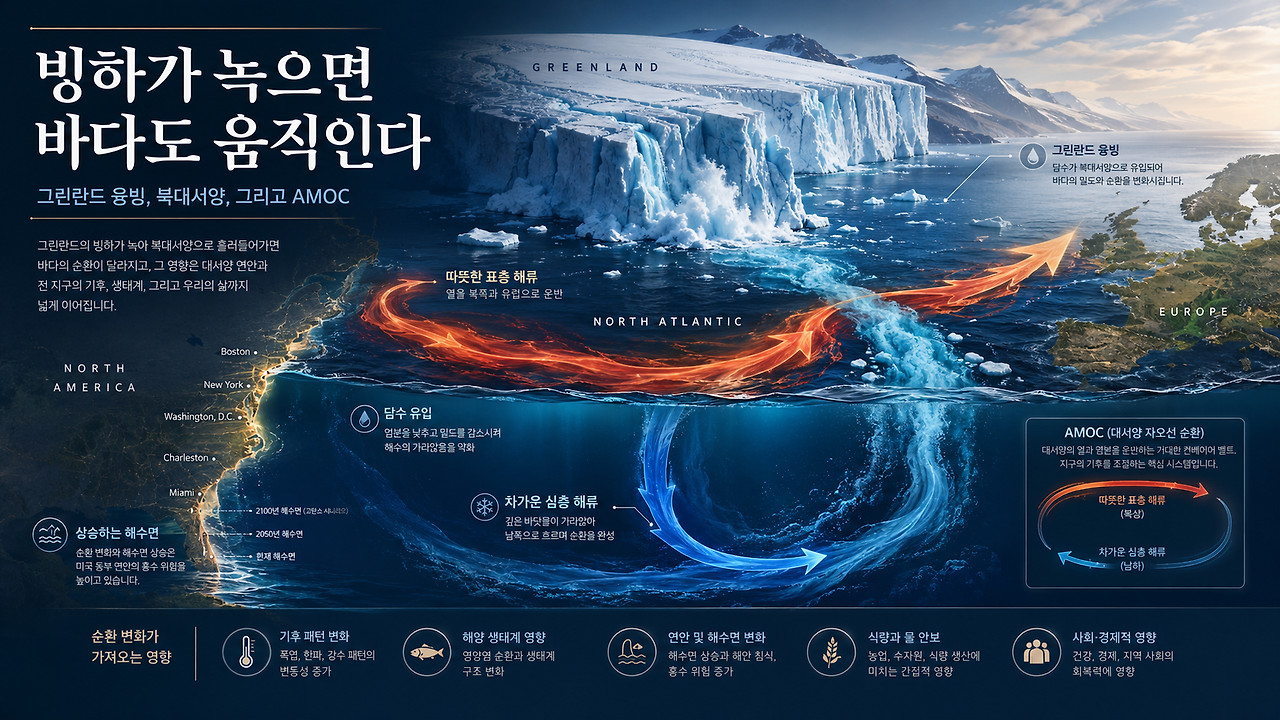
여기에는 지구의 열을 옮기는 거대한 해양순환이 있다.
대서양 자오선 역전순환 AMOC(Atlantic Meridional Overturning Circulation)다.
처음 네팔의 빙하 붕괴를 보았을 때 내가 생각했던 것은 얼음이었다.
그런데 얼음은 녹으면 물이 된다.
그리고 그 물이 바다로 들어가면 바닷물의 성질을 바꾼다.
바닷물의 성질이 달라지면, 바다가 움직이는 방식도 달라질 수 있다.
이제 빙하 이야기는 산을 떠나 바다로 들어간다.
바닷물은 왜 가라앉을까
AMOC를 이해하는 데 어려운 수식은 필요하지 않다.
찬물은 일반적으로 따뜻한 물보다 밀도가 높다.
그리고 바닷물은 염분이 많을수록 밀도가 높아진다.
북대서양으로 올라온 따뜻한 바닷물은 대기에 열을 내놓으면서 식는다.
수분이 증발하고 바닷물이 차가워지면서 밀도가 높아진다.
그 물 일부가 깊은 바다로 가라앉고, 다시 남쪽으로 이동한다.
반대로 상층에서는 따뜻한 물이 북쪽으로 이동한다.
이 거대한 순환은 열뿐 아니라 소금과 탄소, 영양분 등도 지구 곳곳으로 운반한다. NOAA는 AMOC를 열·염분·담수와 여러 해양 특성을 전 세계 기후시스템 안에서 이동시키는 거대한 해양순환으로 설명한다. (National Ocean Service)
쉽게 말하면 대서양 안에 거대한 컨베이어벨트가 놓여 있는 셈이다.
물론 실제 바다는 컨베이어벨트처럼 단순하지 않다.
바람도 영향을 주고, 해저지형도 영향을 주며, 남극 주변의 순환도 연결되어 있다.
하지만 한 가지는 이해하기 쉽다.
북쪽 바다가 충분히 무겁게 가라앉아야 순환의 중요한 부분이 유지된다.
그런데 여기에 엄청난 양의 담수가 들어오기 시작한다.
그린란드가 녹는다
그린란드는 작은 빙하 하나가 아니다.
거대한 빙상이다.
NASA의 위성관측에 따르면 2002년부터 2025년까지 그린란드 빙상은 연평균 약 2,640억 톤의 얼음 질량을 잃었다. 이 손실만으로도 매년 세계 평균 해수면을 약 0.8밀리미터 높이는 효과가 있었다. (NASA Scientific Visualization Studio)
2,640억 톤!
숫자가 너무 커서 잘 와닿지 않는다.
하지만 중요한 것은 단순히 바닷물의 양이 늘어난다는 사실만이 아니다.
그린란드의 얼음은 담수다.
바닷물은 짜다.
거기에 많은 담수가 들어오면 염분이 낮아진다.
염분이 낮은 물은 같은 온도라면 상대적으로 가볍다.
그리고 지구온난화로 표층 바닷물 자체가 따뜻해지는 효과까지 더해지면 북대서양 상층의 물은 아래로 가라앉기 어려워질 수 있다.
그래서 과학자들이 그린란드의 융빙과 북대서양의 담수 증가를 AMOC 변화와 연결해서 연구하는 것이다.
다만 여기에서도 조심해야 한다.
그린란드 빙하가 녹으니 AMOC가 곧 멈춘다.
이렇게 쓰면 안 된다.
AMOC는 그린란드 하나만으로 결정되는 시스템이 아니다.
북극의 담수수지와 강수, 해빙, 바람, 남대서양과 남빙양의 순환, 바닷물의 온도와 염분이 복잡하게 얽혀 있다.
2026년에도 과학계에서는 과거 AMOC 약화에서 북극권 담수 증가가 얼마나 큰 역할을 했는지를 놓고 연구와 반론이 계속되고 있다. 최근 Nature Geoscience에서도 역사적 담수 증가가 AMOC 약화의 주요 원인이었다는 연구에 대해 사용한 담수량과 공간분포가 비현실적이라는 비판이 제기됐다. (Nature)
그러니까 이 이야기는 이미 결론이 난 단순한 인과관계가 아니다.
그런데 한 가지는 훨씬 명확하다.
AMOC는 약해질 가능성이 매우 높다
IPCC의 결론은 꽤 분명하다.
21세기 동안 AMOC가 약화될 가능성은 매우 높다(very likely).
다만 얼마나 약해질지는 불확실성이 크다.
그리고 2100년 이전에 AMOC가 갑자기 완전히 붕괴하지 않을 것이라는 판단에는 ‘중간 정도의 확신(medium confidence)’을 두고 있다. (IPCC)
이 두 문장은 반드시 같이 읽어야 한다.
약화 가능성이 높다는 것과 곧 붕괴한다는 것은 전혀 다른 말이다.
2025년 Nature에 발표된 연구도 극단적인 온난화 시나리오에서도 남빙양의 바람과 전 지구 해양순환 때문에 북대서양에서 일정 수준의 침강이 유지될 가능성이 높다며, 이번 세기 AMOC가 완전히 붕괴할 가능성은 낮다고 평가했다.
하지만 같은 연구진 역시 AMOC가 상당히 약해질 가능성 자체는 부정하지 않았다. (Met Office)
그리고 연구는 계속되고 있다.
불과 2026년 8월 Nature Climate Change에 발표된 연구에서는 AMOC의 안정성을 단순히 “지구 평균기온이 몇 도를 넘으면 붕괴한다”는 하나의 임계온도로 판단하는 것만으로는 부족할 수 있다고 지적했다.
기후가 얼마나 빠르게 변화하느냐, 즉 변화의 속도도 AMOC가 안정된 상태를 따라갈 수 있는지를 결정하는 중요한 요소일 수 있다는 것이다. (Nature)
이것이 과학의 현실이다.
붕괴 시점을 정확히 안다고 말하는 쪽도 조심해야 하고, 아무 위험도 없다고 말하는 쪽도 조심해야 한다.
걸프스트림이 멈추는 것은 아니다
이 이야기가 나오면 흔히 영화 같은 장면이 등장한다.
걸프스트림이 멈춘다.
유럽이 갑자기 얼어붙는다.
빙하기가 온다.
하지만 이것도 정확하지 않다.
AMOC와 걸프스트림은 같은 것이 아니다.
걸프스트림에는 대규모 바람과 지구자전 등으로 움직이는 성분도 있다.
AMOC가 약해진다고 어느 날 갑자기 미국 동부 앞의 걸프스트림이 스위치를 끈 것처럼 사라지는 것은 아니다.
또 AMOC 약화가 곧바로 유럽 전체에 새로운 빙하기를 만든다는 것도 지나친 표현이다.
온실가스로 지구 전체가 따뜻해지는 상황에서 AMOC가 약해지면 북대서양과 일부 유럽지역은 다른 지역보다 덜 따뜻해지거나, 매우 큰 약화·붕괴의 경우에는 지역적 냉각이 나타날 수 있다는 의미에 더 가깝다. (Met Office)
그런데 ‘영화처럼 빙하기가 오지 않는다’고 해서 안심할 문제도 아니다.
AMOC는 완전히 멈추지 않아도 문제를 만들 수 있다.
바다가 조금 느려져도 가격표는 붙는다
여기에서 나는 이 카지노 게임에서 계속 사용해온 생각으로 돌아간다.
우리는 흔히 재난이 일어나야 비용이 발생한다고 생각한다.
빙하가 무너져 마을을 덮친다.
홍수가 나 도시가 잠긴다.
태풍이 공장을 파괴한다.
눈에 보인다.
그래서 가격을 계산하기 쉽다.
하지만 거대한 자연 시스템에서는 조금씩 움직이는 것 자체에도 비용이 붙는다.
AMOC가 약해지면 북쪽으로 전달되는 열이 달라진다.
북대서양의 해수면과 강수패턴이 달라질 수 있다.
열대강수대의 위치가 바뀌고,
아프리카와 아시아의 몬순에도 영향을 줄 수 있다.
IPCC는 AMOC가 만약 붕괴할 경우 열대강수대의 남하, 아프리카·아시아 몬순의 약화와 유럽의 건조화 같은 급격한 지역 기후변화가 나타날 가능성이 매우 높다고 평가한다. (IPCC)
완전 붕괴가 아니더라도 AMOC 변화는 해수면과 기후의 변동에 영향을 준다.
그리고 여기에서 아주 흥미로운 나라가 다시 등장한다.
미국이다.
AMOC가 약해지면 미국 동부의 바다가 높아질 수 있다
처음 AMOC를 들었을 때는 유럽의 문제라고 생각하기 쉽다.
따뜻한 물을 북유럽으로 옮기니까 유럽의 기후와 관계가 있다고 생각한다.
그런데 미국도 직접 연결돼 있다.
NOAA 연구에 따르면 AMOC가 약해지면 북대서양의 물과 열의 분포가 달라지면서 미국 동부 해안의 지역적 해수면 상승을 증폭시킬 수 있다.
미국 동부는 이미 세계 평균보다 빠른 해수면 상승이 나타나는 지역 가운데 하나이며, AMOC 변화는 그 지역차를 만드는 중요한 원인 중 하나로 연구되고 있다. (NOAA 기관 리포지토리)
NOAA 연구에서는 2010년대 북대서양의 열 재분배와 AMOC 변동이 미국 남동부 연안의 해수면을 높였고, 2015~2020년 일부 지역의 홍수 발생일 가운데 **30~50%**에 이러한 대규모 해양변동이 영향을 준 것으로 분석되기도 했다. (AOML)
여기서 나는 조금 묘한 생각이 들었다.
트럼프는 바다에서 아주 멀리 떨어진 히말라야 빙하를 미국의 문제라고 생각하지 않을 수 있다.
그린란드도 미국 영토가 아니다.
하지만 북대서양 해류가 변하면, 그 영향 가운데 하나는 미국 동부 해안으로 돌아온다.
뉴욕도 있고, 보스턴도 있고, 노퍽도 있고, 마이애미까지 이어지는 거대한 해안 경제권이 있다.
바다는 미국을 알아본다기보다 물리법칙을 따른다.
지구가 따뜻해지는데 북대서양 한곳은 차가워졌다
더 흥미로운 현상도 있다.
지구 평균기온은 상승하고 있는데 그린란드 남쪽 북대서양에는 주변보다 상대적으로 차가운 지역이 나타난다.
흔히 ‘North Atlantic warming hole’, 또는 ‘cold blob’이라고 불리는 곳이다.
2026년 6월 Nature가 소개한 최신 연구에서는 이 북대서양의 비정상적인 냉각 패턴이 AMOC 약화와 관련됐다는 증거가 제시됐다. (Nature)
물론 이 차가운 바다 하나가 “AMOC 붕괴가 시작됐다.” 는 증거는 아니다.
하지만 흥미롭다.
지구 전체가 따뜻해지고 있는데,
바다의 열을 운반하는 방식이 달라지면서 어떤 곳은 상대적으로 차가워질 수 있다.
기후변화라는 말 때문에 우리가 흔히 모든 지역이 똑같이 따뜻해지는 모습을 상상하지만 실제 지구는 그렇게 단순하지 않다.
어떤 곳은 더 빨리 뜨거워지고, 어떤 곳은 강수량이 크게 늘며, 어떤 지역에서는 오히려 상대적 냉각이 나타날 수 있다.
평균이 변하면 순환도 변하고, 순환이 변하면 지역의 결과는 서로 달라진다.
이것이 기후문제를 어렵게 만든다.
그래서 ‘미국만 잘하면 된다’는 말이 어려워진다
여기서 다시 America First를 생각해본다.
미국이 석유와 천연가스를 더 생산하는 것 자체만으로 AMOC가 약해진다고 말할 수는 없다.
그렇게 단순한 인과관계는 아니다.
중국도 엄청난 화석연료를 사용하고, 인도도 있고, 유럽도 있으며, 세계 모든 국가가 지금까지 배출해온 온실가스가 누적되어 현재의 기후를 만든다.
미국 혼자 화석연료를 사용하지 않는다고 AMOC가 원래 상태로 돌아가는 것도 아니다.
반대로 미국이 석유를 더 생산한다고 내일 AMOC가 멈추는 것도 아니다.
이 점은 분명히 해야 한다.
하지만 장기적인 관계는 존재한다.
온실가스가 증가하면 지구가 따뜻해지고,
그린란드와 북극의 얼음 손실과 수문순환이 변하며, 바닷물의 온도와 염분도 달라진다.
그리고 그 변화는 AMOC가 약해지는 방향으로 작용할 가능성이 높다는 것이 현재 과학의 큰 그림이다. (IPCC)
그렇다면 정바카라의 질문은 달라진다.
누가 이번 재난을 일으켰느냐가 아니다.
앞으로 위험을 어느 방향으로 밀고 갈 것이냐다.
위험을 모른다고 해서 가격이 0원이 되는 것은 아니다
경제에서는 불확실성을 굉장히 중요하게 생각한다.
어떤 손실이 반드시 일어날 것이라고 알아야만 비용으로 계산하는 것이 아니다.
발생확률이 낮아도 손실규모가 엄청나게 크다면 위험관리를 한다.
건물이 반드시 불타기 때문에 보험에 드는 것이 아니다.
불이 날 가능성이 낮더라도 한번 발생했을 때 잃는 것이 너무 크기 때문에 보험료를 낸다.
2025년 AMOC 연구를 설명하면서 영국 기상청 연구자도 비슷한 비유를 사용했다.
자신의 집이 곧 불탈 가능성은 매우 낮다고 생각하지만 그래도 화재보험에 가입한다는 것이다. (Met Office)
나는 이 비유가 패권에도 적용될 수 있다고 생각한다.
기후위험이 정확히 어느 해에 어떤 모습으로 나타날지 모른다고 해서 그 위험의 가격이 0이 되는 것은 아니다.
오히려 패권국이라면 이런 위험을 관리할 능력이 있어야 한다.
패권국은 재난이 발생한 뒤 돈을 쓰는 나라일까
미국은 세계 최대의 군사력을 가진 나라다.
왜 그렇게 많은 돈을 국방에 쓸까?
내년에 미국 본토가 반드시 침략받을 것이기 때문은 아니다.
가능성이 낮아도 피해가 너무 크기 때문에 준비한다.
미사일방어망을 만들고, 정보망을 운영하고, 동맹을 유지한다.
공격을 받지 않는 해에도 돈을 쓴다.
그 돈이 낭비라고만 말하지 않는다.
위험관리 비용이기 때문이다.
그러면 기후에는 왜 같은 논리를 적용하지 못할까?
AMOC가 이번 세기에 완전히 붕괴할 가능성이 낮다면 아무 준비도 하지 않아도 되는가?
빙하가 정확히 몇 년에 얼마나 녹을지 모르니 기다리면 되는가?
오대호가 언제 다시 최고수위를 기록할지 모르니 인프라 투자를 미뤄도 되는가?
국가안보에서는 불확실성을 이유로 준비를 하지 않는 경우가 드물다.
오히려 불확실하기 때문에 준비한다.
그렇다면 기후안보도 비슷하게 볼 수 있지 않을까?
여기서 패권의 가격표가 다시 나온다
기후대응에는 돈이 든다.
재생에너지 공급망을 새로 만들려면 돈이 든다.
전력망을 바꿔야 한다.
ESS를 설치해야 한다.
원전과 송전망에도 투자해야 한다.
해안도시의 방재시설도 보강해야 한다.
캐나다와 수자원을 공동관리해야 하고, 기후관측에도 돈을 써야 한다.
국제협력에도 비용이 들어간다.
그래서 트럼프는 묻는다.
왜 미국이 그 비용을 더 많이 내야 하는가?
나는 이 질문에 이제 조금 다른 답을 할 수 있을 것 같다.
미국이 착한 나라여서가 아니다.
다른 나라를 구해줘야 해서만도 아니다.
미국도 같은 지구 안에 있기 때문이다.
그린란드에서 녹은 얼음은 미국 동부의 해수면과 무관하지 않다.
캐나다의 수자원은 미국과 연결된다.
오대호는 두 국가가 공유한다.
북대서양의 해양순환은 미국의 연안과 유럽의 기후에 동시에 영향을 준다.
그러니까 기후대응에 쓰는 미국의 돈 가운데 일부는 외국을 위한 원조가 아니다.
미국 자신이 가진 자산을 보호하기 위한 보험료이기도 하다.
그런데 패권국에는 보험료 이상의 역할이 있다
그래도 질문 하나가 남는다.
미국이 자기 나라만 잘 준비하면 되지 않을까?
해안방벽을 만들고, 오대호를 관리하고, 산불에 대비하고, 농업을 바꾸면 된다.
이론적으로 어느 정도는 가능하다.
하지만 기후변화의 원인은 전 세계에 분산되어 있다.
미국이 배출량을 줄여도 중국과 인도가 계속 늘리면 효과가 제한된다.
반대로 중국만 줄여도 미국과 다른 나라가 계속 배출하면 마찬가지다.
그래서 기후는 집단행동 문제다.
누군가 다른 나라까지 움직여야 한다.
바로 여기에서 패권이 필요하다.
5화에서 나는 패권을 이렇게 생각했다.
"필요한 순간 다른 나라를 함께 움직이게 하는 능력" 기후에서도 다르지 않다.
미국은 세계 최대급 시장을 가진다.
금융시장도 가지고 있다.
기술표준에 영향력을 행사한다.
한국, 일본, 캐나다, 유럽이라는 거대한 동맹 네트워크도 있다.
미국이 탄소기준을 바꾸면 세계 기업들의 투자가 달라질 수 있다.
미국이 새로운 에너지기술에 자본을 넣으면 세계시장도 움직인다.
그러니까 미국의 기후정바카라에는 미국의 배출량 이상으로 큰 의미가 있을 수 있다.
다른 나라의 선택을 바꾸는 힘이다.
미국이 빠지면 중국이 들어올 수도 있다
그리고 이것은 에너지 패권 문제와도 다시 연결된다.
기후대응의 산업에는 시장이 있다.
태양광이 있고, 배터리가 있고, 원전이 있고, 송전망이 있고, ESS가 있고, 전기차와 수소도 있다.
누군가 이 장비를 만들어 세계에 팔 것이다.
누군가는 국제표준을 만들 것이다.
누군가는 개발도상국의 발전소와 전력망에 금융을 제공할 것이다.
미국이 이 시장에서 빠진다고 시장 자체가 사라지는 것은 아니다.
3화에서 보았듯 중국은 이미 태양광과 배터리 제조에서 압도적인 위치를 만들었다.
그렇다면 미국이 기후질서에서 물러나는 것은 단순히 환경규제를 줄이는 문제가 아닐 수도 있다.
다음 산업질서에서 누가 규칙을 만들 것인가의 문제일 수도 있다.
이것이 내가 트럼프의 선택을 계속 흥미롭게 바라보는 이유다.
단기적으로는 비용을 줄이는 선택처럼 보인다.
그런데 장기적으로는 새로운 시장과 영향력을 경쟁국에 넘겨주는 선택이 될 수도 있다.
빙하에는 국적이 있지만 녹은 물에는 국적이 없다
그린란드는 덴마크 왕국의 자치지역이다.
캐나다의 빙하는 캐나다에 있다.
미국의 빙하는 미국에 있다.
네팔의 빙하는 네팔에 있다.
지도에서는 그렇게 나눌 수 있다.
하지만 얼음이 녹는 순간 이야기가 달라진다.
물은 강을 따라 움직이고, 바다로 들어가며, 해수면을 바꾸고, 염분을 바꾸며, 대기의 열과 수분 이동까지 다시 영향을 준다.
어디에서 시작된 물인지 바다는 묻지 않는다.
여기에 경제 내셔널리즘의 한계가 있다.
생산기지는 국경 안으로 가져올 수 있다.
공급망도 블록으로 나눌 수 있다.
관세도 세울 수 있다.
하지만 해양순환은 경제블록으로 나눌 수 없다.
가장 강한 나라조차 바다와 협상할 수 없다
트럼프는 협상을 잘한다고 말해왔다.
관세를 올려 상대국을 협상장으로 끌어낼 수 있다.
동맹국에 압력을 넣어 국방비를 올릴 수도 있다.
기업에 미국에서 공장을 지으라고 요구할 수도 있다.
그런데 바다에는 그런 협상이 통하지 않는다.
AMOC에게 미국 동부의 해수면은 올리지 말라고 요구할 수 없다.
그린란드에 미국 경제에 피해가 없을 만큼만 녹으라고 할 수도 없다.
바다는 거래하지 않는다.
물리법칙대로 움직인다.
그렇다면 정치가 할 수 있는 것은 그 원인을 줄이고, 변화의 속도를 낮추며, 다가오는 위험에 적응하는 것뿐이다.
그리고 그것은 어느 한 국가가 혼자 할 수 없다.
처음 네팔의 빙하가 무너졌을 때 나는 미국을 생각했다.
그때는 단순한 직관이었다.
왜 히말라야의 재난을 보며 미국이 떠올랐는지 나도 정확히 설명하기 어려웠다.
그런데 여기까지 따라오고 나니 조금 알 것 같다.
네팔의 빙하와 미국 사이에 하나의 직선이 있는 것은 아니다.
네팔 빙하가 무너져 미국에 홍수를 만든다는 이야기도 아니다.
내가 보고 있었던 것은 연결된 시스템이었다.
빙하, 담수, 강, 호수, 바다, 해류, 대기 그리고 그 위에 인간이 만든 국경, 무역, 산업, 동맹, 패권이 올라가 있다.
인간이 만든 시스템에는 국경이 있다.
자연이 만든 시스템에는 없다.
그래서 이제 이 카지노 게임의 처음부터 따라왔던 질문을 정면으로 다뤄볼 때가 된 것 같다.
2011년 국제통상론에서 나는 세계경제가 다시 블록으로 나뉠 수 있다는 이야기를 들었다.
15년 뒤 실제 세계는 그렇게 움직이고 있다.
미국과 중국은 공급망을 나누고, 관세를 세우고, 동맹국을 자기편으로 묶는다.
경제에는 다시 국경이 생기고 있다.
그런데 그와 정확히 반대 방향에서 움직이는 것이 하나 있다.
기후다.
다음 화
경제에는 국경을 세울 수 있지만 기후에는 세울 수 없다
미국은 중국과 공급망을 분리할 수 있다.
캐나다에 관세를 부과할 수 있고, 동맹국에게 더 많은 비용을 요구할 수도 있다.
경제는 다시 여러 블록으로 나뉠 수 있다.
하지만 대기와 바다, 강과 빙하는 그 블록에 참여하지 않는다.
9화에서는 이 카지노 게임의 출발점이었던 경제 내셔널리즘과 기후변화가 왜 서로 정반대의 방향으로 움직이고 있는지 본격적으로 살펴보려고 한다.
Episode 8
When Glaciers Melt, the Ocean Moves With Them
The last episode followed the water of the Great Lakes. America and Canada are separate nations, but they share a single vast watershed — a border can be drawn on a map, but the flow of water can't be split along it. Move the map further northeast, though, and you run into something on an entirely different scale: Greenland. Follow the seas around Greenland south, and you reach the North Atlantic — home to a massive ocean circulation system that redistributes heat across the entire planet.
The Atlantic Meridional Overturning Circulation.
AMOC, for short.
When I first watched Nepal's glacier collapse, what I thought about was ice. But ice, once it melts, becomes water. And water entering the ocean changes the ocean's properties. Change the ocean's properties, and you can change the way the ocean itself moves. From here, the glacier story leaves the mountains behind and heads out to sea.
Why Does Seawater Sink?
Understanding AMOC doesn't require complicated equations. Cold water is generally denser than warm water. Saltier water is also denser. Warm water traveling north into the North Atlantic releases heat into the atmosphere and cools down; as it cools and loses moisture to evaporation, it grows denser. Some of that water sinks into the deep ocean and travels back south, while warm water at the surface continues moving north to replace it.
This enormous circulation carries far more than heat — it moves salt, carbon, nutrients, and other ocean properties around the globe. NOAA describes AMOC as a massive circulation system that redistributes heat, salt, freshwater, and other ocean characteristics throughout the entire global climate system.
Think of it, loosely, as a giant conveyor belt running through the Atlantic. The real ocean is more complicated than any conveyor belt — wind, seafloor topography, and circulation around Antarctica all play a role too. But one thing is straightforward to grasp: the system depends on water in the north growing heavy enough to sink. And that's exactly where an enormous volume of freshwater has started arriving.
Greenland Is Melting
Greenland isn't a single glacier — it's a massive ice sheet. NASA satellite observations show that between 2002 and 2025, the Greenland ice sheet lost an average of roughly 264 billion metric tons of ice mass per year. That loss alone raised global average sea level by about 0.8 millimeters annually.
264 billion tons is a number too large to feel intuitively. But the volume of water isn't the only thing that matters here. Greenland's ice is freshwater. Seawater is salty. Pour enough freshwater into it, and salinity drops. Less-salty water is relatively lighter at the same temperature — and add in the fact that global warming is heating the ocean's surface layer directly, and the surface water of the North Atlantic can find it harder to sink at all. That's why scientists study Greenland's melt and rising freshwater input to the North Atlantic in connection with changes to AMOC.
But caution is warranted here too. It would be wrong to simply write: "Greenland's glaciers are melting, so AMOC is about to shut down." AMOC isn't a system determined by Greenland alone — Arctic freshwater balance and precipitation, sea ice, wind, circulation in the South Atlantic and Southern Ocean, and seawater temperature and salinity are all tangled together in a complex web. As of 2026, scientists are still actively debating exactly how large a role rising Arctic freshwater played in past AMOC weakening. A recent paper in Nature Geoscience even challenged an earlier study's conclusion that historical freshwater increases were the primary driver of AMOC weakening, arguing the freshwater volumes and spatial distribution used were unrealistic.
So this isn't a settled, simple cause-and-effect story. But one thing is much clearer.
AMOC Weakening Is Very Likely
The IPCC's conclusion is fairly unambiguous: it is very likely that AMOC will weaken over the course of the 21st century. How much it will weaken remains highly uncertain. And the judgment that AMOC won't suddenly collapse entirely before 2100 carries only "medium confidence."
Those two statements have to be read together. "Likely to weaken" and "about to collapse" are two very different claims. A 2025 study published in Nature assessed that even under extreme warming scenarios, Southern Ocean winds and global ocean circulation would likely keep some level of sinking going in the North Atlantic, judging the probability of a complete AMOC collapse this century to be low. But the same research team didn't rule out the possibility of AMOC weakening substantially.
The research keeps evolving. A study published in Nature Climate Change as recently as August 2026 pointed out that judging AMOC stability purely by a single threshold temperature — "collapse once global average temperature crosses X degrees" — may not be sufficient. How fast the climate changes, the study suggests, may itself be a critical factor in whether AMOC can keep tracking a stable state at all.
That's the reality of the science here. Claiming to know precisely when a collapse will happen deserves skepticism — and so does claiming there's no risk at all.
The Gulf Stream Isn't Shutting Down
This topic tends to summon a familiar cinematic image: the Gulf Stream stops, Europe suddenly freezes, an ice age arrives. That picture isn't accurate either. AMOC and the Gulf Stream aren't the same thing — the Gulf Stream is driven partly by large-scale wind patterns and the Earth's rotation. AMOC weakening doesn't mean the Gulf Stream off the US East Coast simply switches off overnight. And it's an overstatement to claim AMOC weakening would trigger a new ice age across all of Europe.
In a world already warming from greenhouse gases, a weaker AMOC more realistically means the North Atlantic and parts of Europe warm less than surrounding regions — or, in a very severe weakening or collapse scenario, could see localized cooling.
But "no Hollywood ice age" isn't the same as "nothing to worry about." AMOC doesn't have to stop completely to cause real problems.
Even a Slower Ocean Carries a Price Tag
This brings me back to a theme running throughout this magazine. We tend to assume costs only appear once disaster strikes — a glacier collapses onto a village, a flood submerges a city, a typhoon destroys a factory. Visible events, easy to price.
But in a massive natural system, the gradual shift itself carries a cost, long before anything looks like a disaster. A weaker AMOC changes how much heat reaches the north. It can alter sea levels and rainfall patterns across the North Atlantic. It can shift the position of the tropical rain belt and affect monsoons across Africa and Asia. The IPCC assesses that if AMOC were to collapse, it would very likely trigger abrupt regional climate shifts — a southward shift of the tropical rain belt, weakened African and Asian monsoons, and drying across Europe.
Even short of full collapse, changes in AMOC affect sea level and climate variability. And here, a genuinely interesting country reappears: the United States.
A Weaker AMOC Could Raise Sea Levels on the US East Coast
At first mention, AMOC sounds like a European problem — it carries warm water toward Northern Europe, so naturally it seems tied to European climate. But America is directly connected too. NOAA research finds that a weaker AMOC, by changing the distribution of water and heat across the North Atlantic, can amplify regional sea-level rise specifically along the US East Coast. The East Coast is already one of the regions experiencing faster-than-average sea-level rise globally, and AMOC variability is being studied as one of the key factors driving that regional disparity.
One NOAA study found that heat redistribution in the North Atlantic and AMOC variability during the 2010s raised sea levels along the US Southeast coast, and that large-scale ocean variability of this kind contributed to somewhere between 30% and 50% of coastal flooding days in parts of that region between 2015 and 2020.
There's something almost strange in this. Trump might reasonably think Himalayan glaciers, thousands of miles from any ocean, aren't America's problem. Greenland isn't US territory either. But when North Atlantic ocean currents shift, part of that effect comes right back to the American East Coast — New York, Boston, Norfolk, all the way down to the massive coastal economy stretching to Miami. The ocean doesn't recognize America. It simply follows the laws of physics.
While the Planet Warms, One Patch of the North Atlantic Has Cooled
There's an even stranger phenomenon at play. Global average temperature is rising, yet a region of the North Atlantic south of Greenland has grown relatively cooler than its surroundings — commonly called the "North Atlantic warming hole" or "cold blob." A study covered in Nature in June 2026 presented evidence linking this anomalous cooling pattern to AMOC weakening.
That cold patch, on its own, isn't proof that "AMOC collapse has begun." But it's a striking illustration nonetheless: even as the planet warms overall, changes in how the ocean transports heat can make certain places relatively cooler. The phrase "climate change" tends to conjure a picture of uniform warming everywhere, but the real planet is far less simple. Some places heat up faster. Some see rainfall surge. Some can even experience localized cooling. Change the average, and you change the circulation. Change the circulation, and outcomes diverge by region. That's part of what makes climate such a hard problem to reason about.
Which Makes "America Just Needs to Do Well" Harder to Sustain
This brings me back to America First. It would be a stretch to say American oil and gas production alone weakens AMOC — the causality isn't that direct. China burns enormous amounts of fossil fuel too. So does India. So does Europe. The current climate is the cumulative product of greenhouse gases emitted by every country on Earth over a long span of time. America alone stopping fossil fuel use wouldn't restore AMOC to its original state, either. Nor would America producing more oil suddenly shut AMOC down tomorrow — that much needs to be stated plainly.
But a longer-term relationship does exist. Rising greenhouse gases warm the planet; that warming reshapes ice loss and hydrology across Greenland and the Arctic; and that, in turn, changes ocean temperature and salinity. The current scientific consensus is that this chain of effects likely pushes AMOC toward weakening, even if the magnitude and timing remain uncertain.
Which changes the policy question. It's no longer "who caused this disaster." It's "which direction are we pushing the risk from here."
Not Knowing the Risk Doesn't Make Its Price Zero
Economics takes uncertainty very seriously. You don't need certainty that a loss will occur to treat it as a cost — if the probability is low but the magnitude of potential loss is enormous, risk management still makes sense. You don't buy fire insurance because your house is guaranteed to burn down. You buy it because, even with a low probability, the loss would be devastating if it happened.
Explaining the 2025 AMOC research, a UK Met Office scientist used almost exactly this analogy: thinking your house is very unlikely to catch fire soon doesn't stop you from carrying fire insurance anyway.
I think that logic extends to hegemony too. Not knowing precisely when or how a climate risk will materialize doesn't make the price of that risk zero. If anything, a hegemon ought to be the country most capable of managing exactly this kind of risk.
Is a Hegemon a Country That Only Spends After Disaster Strikes?
America has the largest military in the world. Why does it spend so much on defense? Not because an invasion of the homeland is guaranteed next year — it prepares because, even with low probability, the potential damage is enormous. It builds missile defense. It runs intelligence networks. It maintains alliances. It spends money in years when nothing happens. No one calls that spending pure waste — it's understood as the cost of managing risk.
So why doesn't the same logic get applied to climate? If a full AMOC collapse this century is judged unlikely, does that mean no preparation is needed at all? If we don't know exactly when or how fast glaciers will melt, is waiting an acceptable strategy? If we can't say precisely when the Great Lakes will next hit record-high water, can infrastructure investment simply wait? In national security, uncertainty is rarely treated as a reason to skip preparation — if anything, uncertainty itself is the reason to prepare. Shouldn't climate security be viewed the same way?
Which Brings Back the Price Tag on Hegemony
Responding to climate change costs money. Building new renewable-energy supply chains costs money. Grids need to be rebuilt. Storage systems need to be installed. Nuclear power and transmission infrastructure need investment. Coastal cities need stronger flood defenses. Water resources need joint management with Canada. Climate monitoring costs money. International cooperation costs money.
Which is why Trump keeps asking: why should America pay more of this bill? I think I can offer a slightly different answer to that question now. It isn't because America is a uniquely generous country. It isn't purely about rescuing other nations, either.
It's because America is on the same planet as everyone else.
Ice melting in Greenland isn't unrelated to sea levels on the US East Coast. Canada's water resources are tied to America's. The Great Lakes are shared by both countries. North Atlantic ocean circulation affects American coastlines and European climate simultaneously. Which means part of the money America spends on climate response isn't foreign aid at all. It's an insurance premium protecting America's own assets.
But a Hegemon's Role Goes Beyond Just Paying Premiums
One question still remains, though. Couldn't America simply prepare itself and leave it there — build coastal seawalls, manage the Great Lakes, prepare for wildfires, adapt agriculture, and call it done?
In theory, that's possible to some degree. But the causes of climate change are distributed across the entire world. If America cuts emissions while China and India keep increasing theirs, the effect is limited. The reverse is equally true. Climate is fundamentally a collective-action problem — someone has to get other countries moving too. And that's exactly where hegemony becomes necessary.
Episode 5 defined hegemony this way: the ability to get other countries to move together when it matters. The same logic applies to climate. America has one of the largest markets in the world. It has deep capital markets. It shapes global technology standards. It has a vast alliance network spanning South Korea, Japan, Canada, and Europe. When America changes its carbon standards, corporate investment decisions shift worldwide. When America puts capital behind new energy technology, global markets respond.
Which means American climate policy can matter far beyond America's own emissions total. Its real significance may be its power to change other countries' choices.
If America Steps Back, China Can Step In
And this connects right back to the energy-hegemony question from earlier episodes. There's a real market underlying the climate-response industry — solar, batteries, nuclear, transmission grids, storage, EVs, hydrogen. Someone is going to manufacture that equipment and sell it to the world. Someone is going to set the international standards. Someone is going to finance power plants and grids in developing countries.
America exiting this market doesn't make the market disappear. As Episode 3 showed, China has already built an overwhelming position in solar and battery manufacturing. Which means America stepping back from the global climate order may not just be a story about relaxed environmental regulation. It may be a story about who writes the rules of the next industrial order.
That's exactly why I keep finding Trump's choices worth examining closely. In the short run, it looks like a cost-cutting decision. In the long run, it could turn into a decision that hands new markets and influence to a rival.
Glaciers Have a Nationality. Meltwater Doesn't.
Greenland is an autonomous territory of the Kingdom of Denmark. Canada's glaciers sit in Canada. America's glaciers sit in America. Nepal's glaciers sit in Nepal. On a map, you can draw those distinctions cleanly.
But the moment ice melts, that changes. The water moves down rivers, enters the ocean, changes sea level, changes salinity, and even feeds back into how heat and moisture move through the atmosphere. The ocean doesn't ask where the water started out.
This is the limit of economic nationalism. You can bring manufacturing back inside your borders. You can split supply chains into blocs. You can build tariff walls. But you cannot organize ocean circulation into economic blocs.
Even the Strongest Country on Earth Can't Negotiate With the Ocean
Trump is known as a skilled negotiator. Raise tariffs, and you can pull a rival to the table. Pressure allies, and defense spending goes up. Demand that companies build factories in America, and many will comply.
None of that negotiating leverage works on the ocean. You can't tell AMOC, "don't raise sea levels on the East Coast." You can't tell Greenland, "only melt as much as won't hurt the American economy." The ocean doesn't make deals. It follows the laws of physics. Which leaves politics with exactly three tools: reduce the underlying causes, slow the pace of change, and adapt to the risks already arriving. And none of the three can be done by any single country alone.
When Nepal's glacier first collapsed, I thought of America. At the time, it was pure intuition — I couldn't have fully explained why a disaster in the Himalayas made me think of the United States. Having followed the thread this far, I think I understand a little better now.
There's no single straight line connecting Nepal's glacier to America. This was never a story of a Himalayan collapse causing a flood in the US. What I was actually looking at was a connected system — glaciers, freshwater, rivers, lakes, oceans, currents, atmosphere — with a human-built layer sitting on top of it: borders, trade, industry, alliances, hegemony.
The systems humans build have borders. The systems nature builds don't. Which means it's finally time to confront, head-on, the question this magazine has been circling since the very first episode.
Back in 2011, in that international trade class, I heard that the global economy might fracture into blocs again. Fifteen years later, that's exactly what's happening. America and China are splitting supply chains, raising tariffs, and pulling allies into their respective camps. The economy is acquiring borders again.
But one thing is moving in exactly the opposite direction.
Climate.
Next Episode
Economies Can Build Borders. Climate Can't.
America can decouple its supply chains from China's. It can tariff Canada. It can demand allies pay more. The economy can fracture into blocs all over again.
But the atmosphere and the ocean, the rivers and the glaciers, don't participate in any of those blocs.
Episode 9 finally turns directly to the question this magazine started with: why economic nationalism and climate change are moving in exactly opposite directions.