오대호의 물은 누구의 것인가
오대호의 물은 누구의 것인가
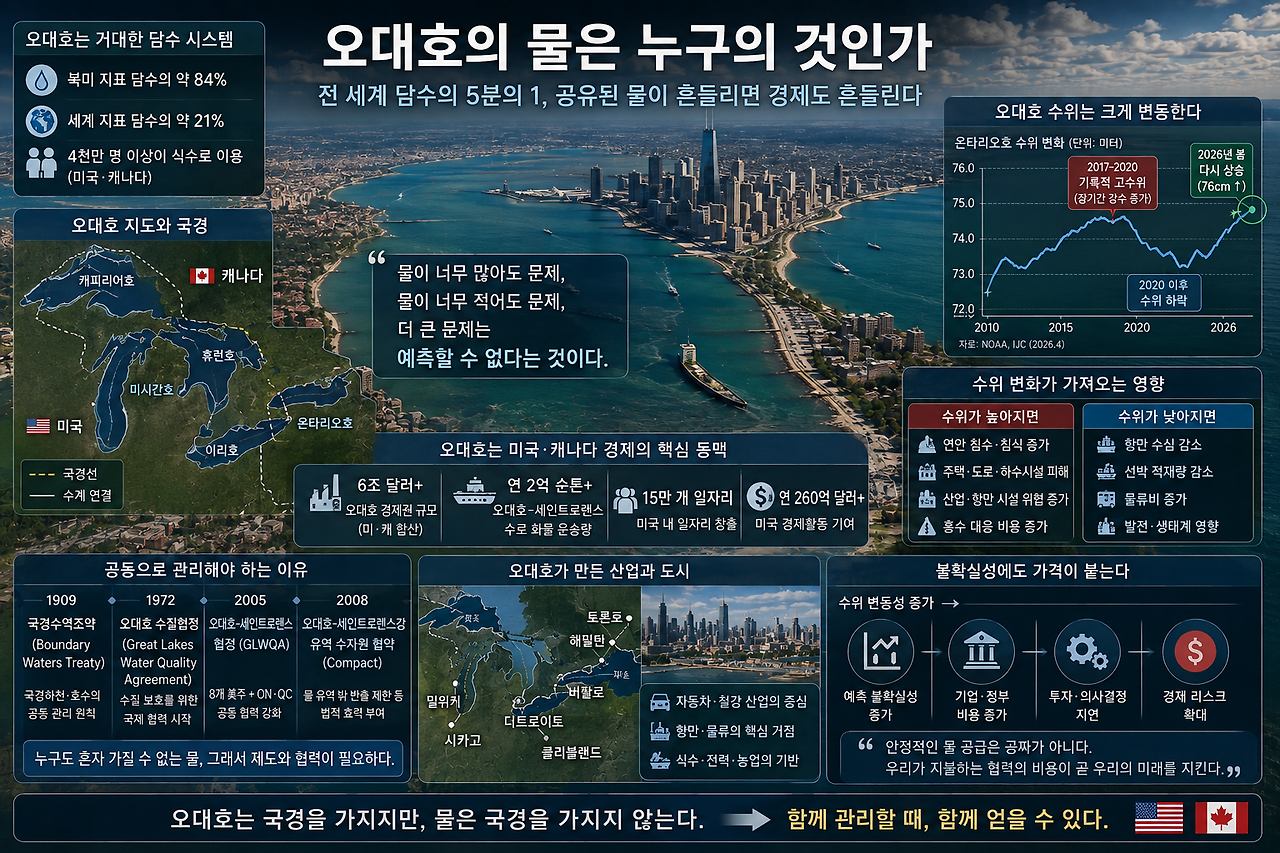
지난 글에서 미국과 캐나다의 국경을 따라가다 오대호 앞에 멈췄다.
슈피리어호, 미시간호, 휴런호, 이리호, 온타리오호 지도에서는 다섯 개의 호수다.
하지만 직접 규모를 생각해보면 호수라는 말이 조금 어색해진다. 미국 환경보호청은 오대호에 북미 지표 담수의 약 84%, 세계 지표 담수의 약 21%가 들어 있다고 설명한다. 동서로 1,200킬로미터가 넘게 펼쳐져 있고, 미국과 캐나다 두 나라에 걸쳐 있다. (US EPA)
그래서 영어권에서 오대호를 종종 ‘내륙의 바다’처럼 표현하는 이유를 이해할 수 있다.
물이 너무 많다.
그런데 이 엄청난 물 위에도 국경선이 그어져 있다.
미시간호는 미국 안에 있지만 나머지 네 호수에는 미국과 캐나다의 국경이 지나간다.
여기서 아주 단순한 질문 하나가 떠오른다.
이 물은 누구의 것일까?
미국의 것일까?
캐나다의 것일까?
대답은 당연히 둘 다다.
그런데 기후변화가 시작되면 이 간단한 대답이 복잡해진다.
물이 많다고 물 걱정이 없는 것은 아니다
오대호를 처음 보면 물 부족을 걱정하는 것이 우습게 느껴질지도 모른다.
세계 지표 담수의 5분의 1이다.
그렇게 많은 물이 있는데 무엇이 문제가 될까?
하지만 물의 문제는 항상 양만으로 결정되지 않는다.
언제, 어디에, 얼마나, 어떤 상태로 존재하는지가 중요하다.
물이 너무 적어도 문제지만 너무 많아도 문제다.
그리고 오대호가 최근 보여준 것이 바로 이것이다.
2017년부터 2020년 사이 오대호의 각 호수에서는 차례로 기록적인 고수위가 나타났다. NOAA에 따르면 이 시기 높은 수위로 연안지역의 침수와 침식, 재산피해가 발생했다. 특히 2020년까지 이어진 고수위의 주요 원인은 장기간 계속된 많은 강수였다. 2020년 4월까지의 5년은 1890년대 후반 이후 오대호 유역에서 가장 습한 5년이었다. (GLERL)
그런데 몇 년이 지나자 상황이 다시 변했다.
2020년 이후 강수량이 줄면서 일부 호수의 수위는 장기평균 근처 또는 그 아래로 내려왔다.
불과 몇 년 사이에 “물이 너무 많다” 에서 “물이 줄어들고 있다” 로 걱정거리가 바뀐 것이다.
이 변화가 오대호의 특징을 잘 보여준다.
오대호의 문제는 앞으로 물이 계속 차오른다는 단순한 이야기가 아니다.
수위가 얼마나 크게 흔들릴 것인가의 문제다.
오대호는 욕조가 아니다
처음에는 나도 아주 단순하게 생각했다.
지구온난화로 얼음이 녹고, 비가 더 많이 오면, 오대호의 물도 계속 늘어나는 것이 아닐까?
하지만 오대호는 그렇게 단순한 물통이 아니다.
NOAA가 설명하는 오대호의 수위를 결정하는 핵심은 크게 세 가지다.
호수 위에 직접 내리는 비와 눈, 주변 유역에서 강을 통해 들어오는 물, 그리고 호수 표면에서 증발해 빠져나가는 물이다.
이를 합쳐 순유역공급량(Net Basin Supply)이라고 부른다. (GLERL)
비가 많이 내리고 증발이 적으면 수위가 오른다.
반대로 비가 적고 증발이 많으면 수위가 내려간다.
여기에 겨울철 적설량과 봄철 눈이 녹는 시기, 바람과 수온까지 영향을 준다.
그래서 기온 상승은 아주 묘한 결과를 만든다.
따뜻한 공기는 더 많은 수증기를 머금을 수 있기 때문에 강한 비가 내릴 가능성을 키울 수 있다.
그런데 동시에 호수의 수온이 높아지고 얼음으로 덮이는 기간이 줄면 증발도 늘어날 수 있다.
즉 온난화는 한쪽에서는 물을 더 넣고, 다른 한쪽에서는 물을 더 빼낼 수 있다.
그래서 국제공동위원회도 기후변화 시대의 오대호에서는 단순히 높은 수위 또는 낮은 수위 하나만 보는 것이 아니라 극단적인 고수위와 저수위가 모두 더 중요한 문제가 될 가능성을 연구하고 있다. (International Joint Commission)
나는 이 지점이 흥미로웠다.
기후위기는 항상 한 방향으로 움직이지 않는다.
물이 부족해질 수도 있고,
물이 너무 많아질 수도 있다.
문제는 안정적이던 범위에서 벗어나는 것이다.
2026년에도 물은 다시 올라왔다
이것은 미래 예측만의 이야기도 아니다.
올해 봄에도 오대호-세인트로렌스 유역에서는 다시 물이 크게 늘었다.
국제공동위원회에 따르면 2026년 3월 1일부터 4월 30일까지 불과 두 달 동안 온타리오호의 수위는 74.54미터에서 75.30미터로 약 76센티미터 상승했다.
같은 기간 지속적인 강우와 봄철 눈 녹은 물 때문에 여러 지류에서는 홍수 상황이 발생했고, 세인트로렌스강 하류에도 높은 유량의 영향이 이어졌다. (International Joint Commission)
그렇다고 이것을 “기후변화 때문에 2026년에 오대호가 범람했다.” 라고 쓰면 안 된다.
특정한 한 해의 강수와 수위를 곧바로 기후변화의 결과라고 단정할 수는 없다.
국제공동위원회 역시 2017년과 2019년의 기록적인 강수가 당시 높은 수위의 직접적인 원인이었지만, 개별적인 몇 달이나 몇 년의 습한 날씨를 기후변화 하나로 귀속시키는 것은 어렵다고 설명한다. 다만 미래 기후모델에서는 매우 높은 수위와 매우 낮은 수위가 나타나는 시기가 더 빈번해질 가능성이 제시되고 있다. (International Joint Commission)
이 구분은 중요하다.
이번 카지노 게임에서 기후를 이야기하면서 내가 피하고 싶은 것이 바로 이런 식의 연결이다.
재난이 발생했다.
그러므로 기후변화 때문이다.
그렇게 단순하게 쓰면 오히려 우리가 정말 봐야 할 위험을 놓친다.
진짜 중요한 것은 시스템의 변동성이 커지고 있다는 가능성이다.
물이 30센티미터 높아지는 것이 그렇게 큰 문제일까
호수의 수위가 몇십 센티미터 변한다고 하면 처음에는 별것 아닌 것처럼 느껴진다.
수영장에서 물이 30센티미터 높아졌다고 도시가 무너지지는 않는다.
그런데 오대호는 수영장이 아니다.
해안선의 길이가 수천 킬로미터에 이르고 그 주변에 도시와 공장, 항만, 도로와 철도가 붙어 있다.
물이 높아지면 파도가 닿는 위치가 달라진다.
폭풍이 올 때 침수되는 범위가 넓어진다.
해안 침식이 커지고, 주택과 도로, 하수처리시설, 항만시설이 영향을 받을 수 있다.
반대로 수위가 지나치게 낮아지면 전혀 다른 문제가 생긴다.
항구의 수심이 얕아진다.
배는 좌초하지 않으려면 화물을 덜 실어야 한다.
NOAA도 저수위가 지속될 경우 상업선박의 흘수 제한으로 운송능력이 줄어들고, 습지와 생태계에도 변화가 나타날 수 있다고 설명한다. (GLERL)
즉 같은 호수에서 물이 많으면 홍수가 문제고, 물이 적으면 물류가 문제가 된다.
여기에 발전과 식수까지 들어간다.
이제 물의 높이 몇십 센티미터가 경제의 숫자로 변하기 시작한다.
오대호는 미국 제조업의 한가운데에 있다
오대호 주변 지도를 보면 왜 미국이 이 물을 중요하게 생각해야 하는지 금방 이해할 수 있다.
시카고, 디트로이트, 클리블랜드, 밀워키, 버펄로, 그리고 캐나다 쪽에는 토론토와 해밀턴이 있다.
미국 제조업의 역사를 이야기할 때 빼놓기 어려운 도시들이 이 호수를 둘러싸고 있다.
우연이 아니다.
물이 있었고, 항로가 있었으며, 철광석과 석탄, 곡물을 배로 옮길 수 있었다.
공장에 필요한 물도 얻을 수 있었다.
자동차와 철강산업이 이곳에 모인 데에는 여러 이유가 있지만 오대호라는 거대한 물류망 역시 중요한 기반이었다.
현재도 오대호-세인트로렌스 수로는 대서양에서 오대호 깊숙한 곳까지 약 3,700킬로미터를 연결한다. 연간 2억 순톤 이상의 화물이 이 시스템을 통해 이동하고 있다. (Seaway)
2025년에도 미국 교통부는 오대호 항만을 미국 공급망의 핵심 동맥이라고 표현했다. 이 수로는 미국에서만 약 15만 개의 일자리와 연간 260억 달러 규모의 경제활동을 뒷받침한다. (Seaway)
그러니까 오대호의 수위는 환경부서만의 문제가 아니다.
산업정바카라의 문제다.
배가 화물을 얼마나 싣느냐가 달라지고, 항만을 얼마나 높게 만들어야 하는지가 달라지고, 철강과 곡물의 물류비가 달라진다.
기후변화가 여기까지 들어오면 환경과 경제를 나누는 것이 점점 어려워진다.
만약 오대호 지역이 하나의 나라라면
이 지역의 규모를 조금 다른 방식으로 생각해볼 수 있다.
미국의 오대호 주들과 캐나다의 온타리오·퀘벡을 포함한 오대호-세인트로렌스 지역의 경제규모는 6조 달러를 넘는다.
관련 기관의 추산대로 이것을 하나의 국가라고 가정한다면 미국과 중국 다음에 놓일 정도의 경제규모다. (Great Lakes St. Lawrence Seaway System)
4천만 명 이상이 오대호를 식수원으로 이용한다. (Great Lakes Commission)
이 숫자를 보고 나는 조금 다른 생각이 들었다.
우리는 기후변화를 이야기할 때 종종 북극곰이나 사라지는 빙하를 먼저 떠올린다.
중요한 문제다.
하지만 경제학적으로 보면 기후변화는 결국 자산에 충격을 주는 사건이다.
6조 달러가 넘는 경제권의 한가운데 있는 물 시스템이 예측하기 어려워진다는 것은 그 자체로 거대한 경제적 리스크다.
그리고 이 경제권은 미국과 캐나다로 나뉘어 있다.
기후위기가 여기에서도 다시 국경의 문제를 건드린다.
미국 쪽 물과 캐나다 쪽 물을 따로 관리할 수 있을까
오대호의 지도에는 국경선이 있다.
그러나 물속에는 없다.
슈피리어호에서 시작한 물은 휴런호와 미시간호 체계로 이어지고, 이리호를 지나, 나이아가라강과 나이아가라폭포를 통과해, 온타리오호로 들어간다.
그리고 다시 세인트로렌스강을 따라 대서양으로 흘러간다.
하나의 거대한 연결 시스템이다.
상류의 변화는 시간이 지나 하류에 영향을 준다.
그래서 미국이 미국 쪽 물만 관리하고 캐나다가 캐나다 쪽 물만 관리하는 방식으로는 제대로 작동하기 어렵다.
사실 양국은 이미 오래전에 그 사실을 인정했다.
1909년 국경수역조약을 맺었고, 1972년부터 오대호 수질협정을 운영했다.
그리고 2005년에는 미국 오대호 8개 주와 캐나다 온타리오·퀘벡이 다시 협정을 만들었다.
이후 미국에서는 오대호-세인트로렌스강 유역 수자원 협약(Compact)이 2008년 연방법으로 확정됐다.
핵심 가운데 하나는 오대호 물을 유역 밖으로 새롭게 돌려 쓰는 행위를 원칙적으로 금지하고, 아주 제한적인 예외만 허용하는 것이다. (오대호-세인트로렌스 물관리 기구)
왜 이렇게까지 하는 걸까?
물이 너무 많아서 아무렇게나 사용해도 되는 자원이라면 필요하지 않은 규칙이다.
두 나라는 이미 알고 있는 것이다.
많은 물과 무한한 물은 같은 말이 아니다.
물에도 내셔널리즘이 생길 수 있다
이 부분에서 조금 섬뜩한 생각도 가능하다.
기후가 더 불안정해지고 다른 지역의 물 부족이 심해진다면, 세계 지표 담수의 5분의 1을 가진 오대호의 전략적 가치는 어떻게 될까?
지금은 물을 수도꼭지에서 틀면 나오는 흔한 자원처럼 생각한다.
하지만 기후변화와 인구증가, 농업용수와 산업용수의 수요가 겹치면 물은 점점 더 전략적인 자원이 될 수 있다.
석유와 조금 닮아간다.
그렇다면 언젠가는 이런 정치적 언어가 등장하지 않을까?
미국의 물은 미국인이 먼저 써야 한다.
캐나다에서도 마찬가지일 것이다.
캐나다의 물은 캐나다인의 것이다.
그런데 오대호에서는 이 논리가 곧바로 충돌한다.
누가 어느 만큼의 물을 소유하는지를 단순하게 나누기 어렵기 때문이다.
한쪽이 유역에서 대규모로 물을 빼내면 다른 쪽에도 영향을 줄 수 있다.
그래서 오대호를 둘러싼 제도가 애초부터 공동관리라는 형태로 만들어졌다.
여기서 나는 다시 2011년에 배웠던 경제 블록화를 생각한다.
국가는 다시 자기 것을 구분하려 한다.
상품에도 국적을 붙이고, 광물에도 국적을 붙이며, 공장에도 국적을 붙인다.
그런데 물은 그렇게 나누기 어렵다.
물을 둘러싼 진짜 가격표
높은 수위에도 비용이 있다.
낮은 수위에도 비용이 있다.
높으면 연안보호시설을 다시 만들어야 한다.
주택과 도로를 이전해야 할 수도 있다.
하수시설을 보강해야 한다.
낮아지면 항만을 준설해야 하고, 배가 화물을 덜 싣는다.
수력발전량도 영향을 받을 수 있다.
그리고 어느 쪽으로 움직일지 예측하기 어려워질수록 기업과 정부는 더 큰 안전마진을 가져야 한다.
불확실성 자체에도 가격이 붙는다.
이것은 경제에서 아주 중요한 문제다.
어떤 공장의 전기요금이 매년 정확히 5%씩 오를 것이라는 사실보다, 내년에 20% 오를지 10% 떨어질지 모르는 상황이 기업에는 더 어려울 수 있다.
예측할 수 없기 때문이다.
기후변화가 오대호에 주는 가장 큰 위험 역시 단순히 물이 늘어나는 것이 아니라 이런 예측가능성을 떨어뜨리는 것일지도 모른다.
그렇다고 모든 것을 통제할 수 있는 것도 아니다
여기에는 인간에게 조금 불편한 사실도 있다.
우리는 댐을 만들었고, 수문을 만들었고, 온타리오호와 슈피리어호의 유출량을 어느 정도 조절한다.
그래서 거대한 호수도 인간이 필요하면 물높이를 마음대로 조절할 수 있을 것처럼 생각하기 쉽다.
하지만 실제로는 그렇지 않다.
국제공동위원회는 오래전부터 오대호 수위의 주요 원인은 자연의 수문조건이며, 인공적인 조절로 수위 변동폭을 줄이는 능력에는 한계가 있다고 설명해왔다. (International Joint Commission)
2017년과 2019년처럼 엄청난 양의 물이 들어오면 자연 하천과 인공시설이 내보낼 수 있는 물의 양을 넘어설 수 있다.
물을 더 빼고 싶다고 마음대로 빼는 것도 불가능하다.
저 아래에 다른 도시가 있고, 또 다른 항만이 있고, 또 다른 국가가 있기 때문이다.
이 장면이 상징적으로 느껴진다.
패권국 미국도 자연 앞에서는 마음대로 명령할 수 없다.
세계에서 가장 강한 나라에도 통제할 수 없는 것이 있다
트럼프의 정치에서는 통제가 중요한 단어다.
국경을 통제한다.
무역을 통제한다.
중국으로 넘어가는 기술을 통제한다.
공급망을 통제한다.
에너지를 자국에서 생산해 외국 의존도를 통제한다.
이런 전략은 국가안보의 관점에서 이해할 수 있다.
실제로 지난 몇 년 동안 코로나19와 전쟁, 반도체 부족을 겪으면서 공급망을 완전히 시장에 맡기는 것이 위험할 수 있다는 사실도 확인했다.
그런데 기후와 물을 바라보면 통제라는 개념에 한계가 생긴다.
비가 어디에 얼마나 내릴지 미국 대통령이 정할 수 없다.
캐나다에서 내린 비를 국경에서 되돌려 보낼 수도 없다.
호수의 증발량에 관세를 부과할 수도 없다.
그래서 기후대응에는 조금 다른 종류의 권력이 필요하다.
협력할 수 있는 힘이다.
지난 화에서 동맹을 이야기했다.
나는 미국의 패권이 단순한 군사력에서 나오지 않는다고 했다.
다른 국가가 미국과 함께 움직여준다는 것 역시 미국의 힘이라고 했다.
오대호를 보면 그것이 환경에서도 똑같이 나타난다.
캐나다를 적으로 만들 수는 있어도 이웃이 아니게 만들 수는 없다
미국은 캐나다에 관세를 부과할 수 있다.
협정을 폐기할 수도 있고, 새 협정을 요구할 수도 있다.
미국 대통령이 캐나다 총리를 좋아할 필요도 없다.
하지만 미국은 캐나다를 다른 위치로 옮길 수 없다.
캐나다는 계속 미국 북쪽에 있을 것이다.
두 국가는 계속 오대호를 공유할 것이다.
그래서 미국과 캐나다의 관계는 단순한 외교관계보다 복잡하다.
친하면 협력하고, 싫으면 헤어지는 관계가 아니다.
헤어질 수 없는 관계다.
어쩌면 이런 관계야말로 국제정치에서 가장 어려운 관계일지도 모른다.
상대방을 좋아하지 않아도 함께 관리해야 하는 것이 있기 때문이다.
물이 그렇다.
공기가 그렇다.
북극이 그렇다.
그리고 기후가 그렇다.
패권은 다른 나라를 움직이는 능력이라고 했다
5화에서 나는 미국 패권의 중요한 자산 가운데 하나가 동맹이라고 썼다.
미국이 세계에서 가장 강한 이유는 자기 혼자 모든 것을 할 수 있어서가 아니다.
필요할 때 함께 움직여주는 나라가 많기 때문이다.
그 생각을 오대호에 가져오면 패권의 의미가 조금 달라진다.
세계 최강국이라고 해서 비를 멈출 수는 없다.
빙하를 다시 얼릴 수도 없다.
해수면을 명령할 수도 없다.
그렇다면 기후의 시대에 필요한 패권은 무엇일까.
다른 국가에 명령할 수 있는 힘만으로 충분할까.
아니면 다른 국가와 함께 행동하도록 만드는 능력
이 더 중요해질까?
미국은 그것을 할 수 있는 거의 유일한 국가 가운데 하나다.
유럽과 동맹이 있고, 캐나다가 있고, 한국과 일본이 있고, 세계 금융과 기술에 엄청난 영향력을 가지고 있다.
미국이 움직이면 시장이 움직인다.
미국이 규칙을 만들면 기업이 계산을 바꾼다.
그러므로 미국이 기후대응에 비용을 지불했던 것은 단순히 미국의 탄소배출량 몇 퍼센트를 줄이는 문제가 아니었다.
다른 국가를 함께 움직이게 하는 비용이기도 했다.
여기에서 다시 《패권의 가격표》가 나타난다.
그런데 트럼프는 그 비용을 왜 내야 하느냐고 묻는다
파리협정에서도 그렇고, 동맹에서도 그렇고, 무역에서도 그렇다.
트럼프는 반복해서 묻는다.
미국이 왜 더 많이 부담해야 하는가?
나는 이 질문 자체가 잘못됐다고 생각하지 않는다.
패권국이라고 해서 무한정 손실을 감수해야 하는 것은 아니다.
중국 역시 엄청난 온실가스를 배출한다.
유럽도 바카라임이 있다.
인도도 있고, 전 세계 모든 국가가 있다.
미국 혼자 기후변화를 막을 수 없다.
그렇다면 부담을 나누라고 요구하는 것은 충분히 합리적이다.
하지만 동맹에서와 마찬가지로 중요한 것은 방법이다.
다른 국가에게 더 많은 바카라임을 지게 만들면서도 미국을 중심으로 계속 움직이게 할 수 있다면 성공이다.
반대로 “나는 비용을 내지 않겠다.”
고 먼저 나가버리면 미국이 가지고 있던 규칙을 만드는 힘 역시 다른 곳으로 이동할 수 있다.
에너지에서 우리가 보았던 문제와 똑같다.
중국이 태양광을 만들고 있다고 미국이 태양광 시장에서 빠져버리면 중국의 힘이 더 커질 수 있다.
기후에서도 미국이 국제질서에서 물러나면 그 빈자리가 그냥 비어 있을 것이라고 장담할 수 없다.
누군가는 채울 것이다.
그리고 오대호는 미국에게 아주 가까운 경고다
네팔의 빙하는 멀다.
그린란드도 멀게 느껴진다.
남태평양의 작은 섬나라가 해수면 상승을 걱정한다는 이야기도 미국인에게는 먼 이야기일 수 있다.
하지만 오대호는 다르다.
미국 한가운데 있다.
시카고 옆이고, 디트로이트 옆이고, 미국 제조업의 역사적 중심지 옆이다.
4천만 명 이상의 사람들이 이 물을 마신다.
항만과 철강, 농업과 제조업, 전력과 도시가 연결되어 있다.
그래서 나는 오대호가 기후문제를 설명하기에 굉장히 중요한 장소라고 생각한다.
기후변화는 ‘환경을 사랑하느냐’의 문제가 아니다.
경제 시스템이 얼마나 안정적으로 유지될 수 있는가의 문제이기도 하다.
오대호의 물은 누구의 것인가
처음 질문으로 돌아가보자.
오대호의 물은 누구의 것일까?
미국의 것이기도 하고, 캐나다의 것이기도 하다.
그러나 그 답만으로는 부족하다.
어쩌면 더 정확한 표현은 이것일지도 모른다.
누구도 혼자 가질 수 없는 물이다.
미국이 세계 최강국이어도 혼자 관리할 수 없다.
캐나다가 세계적인 담수국가여도 마음대로 사용할 수 없다.
상류와 하류가 있고, 도시와 도시가 연결되어 있으며, 두 국가가 하나의 수계에 묶여 있기 때문이다.
그래서 오대호에는 이미 경제 내셔널리즘과 반대되는 질서가 존재한다.
공동의 자원은 공동으로 관리해야 한다는 질서다.
그 질서는 이상주의 때문에 만들어진 것이 아니다.
서로 착해서도 아니다.
각자의 국익을 지키려다 보니 협력하는 편이 더 이익이었기 때문에 만들어졌다.
나는 이것이 중요하다고 생각한다.
기후협력도 반드시 희생이나 선의로만 설명할 필요는 없다.
협력하는 것이 자국에 더 이익이기 때문에 협력할 수도 있다.
어쩌면 이것이 America First와 기후대응이 반드시 모순일 필요가 없는 이유일지도 모른다.
그런데 이제 물은 호수에서 끝나지 않는다.
오대호의 물은 세인트로렌스강을 지나 대서양으로 간다.
더 북쪽에서는 캐나다 북극의 얼음이 녹고, 그린란드에서는 훨씬 거대한 양의 얼음이 바다로 들어간다.
물의 양만 변하는 것이 아니다.
바닷물의 염분과 밀도가 변한다.
그리고 북대서양에는 지구의 열을 옮기는 거대한 해양순환이 있다.
AMOC.
빙하 이야기를 시작하면서 나는 처음에는 얼음이 무너지는 것만 생각했다.
그런데 얼음이 녹으면 물이 되고, 물이 바다로 들어가면 바다의 성질을 바꾸며, 바다의 성질이 달라지면 해류까지 영향을 받을 수 있다.
이제 이야기는 호수에서 바다로 간다.
그리고 이번에는 미국뿐 아니라 유럽까지 함께 움직인다.
다음 화
빙하가 녹으면 바다도 움직인다
그린란드의 얼음이 녹아 북대서양으로 들어가면 바닷물은 조금 더 싱거워진다.
그 작은 변화가 왜 지구 규모의 해양순환인 AMOC와 연결되는가?
AMOC는 정말 멈출 수 있는가?
그리고 만약 크게 약해진다면 미국과 유럽에는 어떤 일이 생길까?
8화에서는 빙하가 물이 되고, 그 물이 패권국들의 기후와 경제를 다시 흔드는 과정을 따라가 보려고 한다.
Episode 7
Who Owns the Water of the Great Lakes?
The last episode ended at the edge of the Great Lakes — Superior, Michigan, Huron, Erie, and Ontario. Five lakes on a map. But think about their actual scale, and the word "lake" starts to feel inadequate. The EPA reports that the Great Lakes hold roughly 84% of North America's surface freshwater and about 21% of the world's — stretching more than 1,200 kilometers east to west, straddling two countries. It's easy to see why English speakers sometimes call them an "inland sea." There's simply an enormous amount of water there.
And a border line runs straight across most of it. Lake Michigan sits entirely within the US, but the other four all carry the US-Canada boundary through them. Which raises a deceptively simple question: who owns this water? America? Canada? The obvious answer is both. But once climate change enters the picture, that simple answer gets a lot more complicated.
Having a Lot of Water Doesn't Mean Water Isn't a Worry
At first glance, worrying about water scarcity near the Great Lakes might sound absurd — a fifth of the world's surface freshwater sits right there. What could possibly go wrong?
But water problems are never just about quantity. What matters is when, where, how much, and in what condition. Too little water is a problem. So is too much. And the Great Lakes have recently demonstrated exactly that. Between 2017 and 2020, one lake after another hit record-high water levels. According to NOAA, those high levels caused coastal flooding, erosion, and property damage, driven largely by an extended stretch of unusually heavy rainfall — the five years ending in April 2020 were the wettest five-year stretch in the Great Lakes basin since the late 1890s.
Then, just a few years later, the picture flipped. As rainfall eased after 2020, water levels on several lakes dropped back toward or below their long-term averages. In the space of a few short years, the region's anxiety flipped from "there's too much water" to "the water is disappearing."
That swing captures the real character of the problem. This isn't a simple story of ever-rising water. It's a story about how violently the levels can swing.
The Great Lakes Aren't a Bathtub
My first instinct, too, was oversimplified: if global warming melts ice and increases rainfall, shouldn't the Great Lakes just keep filling up? But they aren't that simple a container.
NOAA identifies three main drivers of Great Lakes water levels: precipitation falling directly on the lakes, inflow from surrounding rivers and streams, and evaporation off the lake surface — together called the Net Basin Supply. More rain and less evaporation raises levels; less rain and more evaporation lowers them. Winter snowpack, spring melt timing, wind, and water temperature all factor in too.
Which makes warming produce a genuinely strange effect. Warmer air holds more moisture, which can make intense rainfall more likely. But warmer lake temperatures and shorter periods of ice cover can also increase evaporation. In other words, warming can add water on one side of the ledger while removing it on the other simultaneously. That's why the International Joint Commission is now studying whether both extreme highs and extreme lows could become more significant problems in a changing climate — not just one or the other.
I found this genuinely interesting: a climate crisis doesn't always move in one direction. Water can grow scarce, or it can grow excessive. The actual problem is departing from the stable range altogether.
The Water Rose Again in 2026
This isn't purely a future projection, either. This past spring, water surged again across the Great Lakes-St. Lawrence basin. According to the International Joint Commission, between March 1 and April 30, 2026 — just two months — Lake Ontario's level rose from 74.54 meters to 75.30 meters, a jump of roughly 76 centimeters. Sustained rain and spring meltwater during that period pushed several tributaries into flood conditions, with effects carrying downstream into the St. Lawrence River as well.
That said, it would be inaccurate to write: "Climate change flooded the Great Lakes in 2026." Attributing a single year's rainfall and water levels directly to climate change isn't something you can responsibly assert. The IJC itself has noted that while record rainfall in 2017 and 2019 was the direct cause of high water levels at the time, tying a few months or years of wet weather squarely to climate change is difficult. What future climate models do suggest is that periods of both very high and very low water levels may become more frequent going forward.
That distinction matters. It's exactly the kind of connection I've tried to avoid throughout this magazine: a disaster happened, therefore it was climate change. Writing it that simply obscures the risk that actually deserves attention — which is the growing possibility of volatility in the system itself.
Is 30 Centimeters of Extra Water Really That Big a Deal?
A shift of a few dozen centimeters in a lake's level sounds trivial at first — a swimming pool doesn't collapse a city just because the water rose 30 centimeters. But the Great Lakes aren't a swimming pool. Their shoreline runs thousands of kilometers, lined with cities, factories, ports, roads, and rail lines. Higher water changes where waves reach. It widens the area flooded during storms. It accelerates coastal erosion and can affect homes, roads, sewage systems, and port infrastructure.
Too-low water creates an entirely different set of problems: shallower harbors, ships forced to carry lighter loads to avoid running aground. NOAA notes that sustained low water levels can reduce commercial shipping capacity through draft restrictions and can also disrupt wetlands and ecosystems.
So in the very same lake, too much water means flooding, and too little means a logistics crisis. Add power generation and drinking water into the mix, and a swing of a few dozen centimeters starts translating directly into economic numbers.
The Great Lakes Sit at the Heart of American Manufacturing
Look at a map of the region, and it's immediately obvious why America has to take this water seriously. Chicago. Detroit. Cleveland. Milwaukee. Buffalo. On the Canadian side, Toronto and Hamilton. These are cities that are hard to leave out of any history of American manufacturing, and that's no coincidence — there was water, there were shipping routes, and iron ore, coal, and grain could all move by boat. Factories had the water they needed. Auto and steel industries clustered here for many reasons, but the Great Lakes' massive logistics network was a foundational one.
Even today, the Great Lakes-St. Lawrence Seaway connects the Atlantic to the deep interior of the Great Lakes across roughly 3,700 kilometers, moving more than 200 million metric tons of cargo a year. In 2025, the US Department of Transportation described Great Lakes ports as a core artery of the American supply chain — a system supporting roughly 150,000 jobs and about $26 billion in annual economic activity in the US alone.
Which means Great Lakes water levels aren't purely an environmental agency's concern. They're an industrial policy issue. How much cargo a ship can carry, how high a port needs to be built, shipping costs for steel and grain — all of it shifts. Once climate change enters this picture, the line between environmental policy and economic policy gets harder and harder to draw.
If the Great Lakes Region Were a Country
It's worth thinking about the scale of this region a different way. The combined economy of the American Great Lakes states plus Ontario and Quebec — the Great Lakes-St. Lawrence region as a whole — exceeds $6 trillion. By relevant estimates, if you treated that as a single country, it would rank roughly third in the world, behind only the US and China. More than 40 million people draw their drinking water from the lakes.
That number changed how I thought about this. When people discuss climate change, they usually picture polar bears or a distant, disappearing glacier — important, but distant. Economically speaking, though, climate change is ultimately a shock to an asset. A water system sitting at the center of a $6-trillion-plus economy becoming harder to predict is, on its own, an enormous economic risk. And that economy happens to be split between two countries — which means the climate crisis touches the border question here too.
Can American Water and Canadian Water Really Be Managed Separately?
A border runs across the map of the Great Lakes. It doesn't run through the water itself. Water starting in Lake Superior flows into the Huron-Michigan system, passes through Lake Erie, runs over Niagara Falls into Lake Ontario, and finally flows down the St. Lawrence River to the Atlantic. It's one massive, connected system — changes upstream eventually reach downstream. Which means a system where the US manages "its" water and Canada manages "its" water separately simply can't work in practice.
The two countries recognized this a long time ago. They signed the Boundary Waters Treaty in 1909 and have run the Great Lakes Water Quality Agreement since 1972. In 2005, the eight American Great Lakes states and the provinces of Ontario and Quebec signed a further agreement. In the US, that became the Great Lakes-St. Lawrence River Basin Water Resources Compact, made federal law in 2008. One of its core provisions bars new diversions of Great Lakes water out of the basin, with only very narrow exceptions.
Why go this far? If water were so abundant it could be used however anyone liked, none of this would be necessary. But both countries already understood something important: abundant water and infinite water are not the same thing.
Even Water Can Acquire Nationalism
Here's a slightly unsettling thought. As climate becomes more unstable and water scarcity worsens elsewhere in the world, what happens to the strategic value of a body holding a fifth of the world's surface freshwater? Right now, we treat water as an ordinary resource — turn the tap, and it's there. But as climate change, population growth, and rising agricultural and industrial demand for water all converge, water could increasingly resemble a strategic resource — not unlike oil.
If that happens, could political rhetoric eventually shift toward: "America's water should go to Americans first"? Presumably Canada would say the mirror version: "Canada's water belongs to Canadians." But in the Great Lakes, that logic collides with itself almost immediately — because it's genuinely hard to cleanly divide who owns how much water. If one side draws heavily from the shared basin, it can affect the other. Which is exactly why the entire governing framework around the Great Lakes was built as joint management from the start.
This brings me back, again, to the economic blocization I first learned about in 2011. Nations keep trying to redraw what belongs to whom — assigning nationality to goods, to minerals, to factories. Water resists that kind of division.
The Real Price Tag Attached to Water
High water carries costs. So does low water. Rising water means rebuilding coastal protection, possibly relocating homes and roads, reinforcing sewage systems. Falling water means dredging harbors, ships carrying lighter loads, hydropower output taking a hit. And the harder it becomes to predict which direction things will move, the larger a safety margin businesses and governments have to carry. Uncertainty itself carries a price.
That's a critical point in economics generally. A factory facing a guaranteed 5% annual increase in electricity costs is in an easier position than one that has no idea whether next year's bill rises 20% or falls 10% — because it can't plan around unpredictability. The biggest risk climate change poses to the Great Lakes may not be "more water" at all, but simply the erosion of predictability itself.
Even So, Not Everything Can Be Controlled
There's an uncomfortable truth buried here. Humans built dams. We built control structures. We regulate outflow from Lake Ontario and Lake Superior to some degree — which makes it easy to assume that even a body of water this massive can simply be dialed to whatever level people need.
In practice, it can't. The International Joint Commission has long explained that natural hydrologic conditions are the dominant driver of Great Lakes water levels, and that engineered regulation has real limits on how much it can dampen those swings. When enormous volumes of water arrive, as in 2017 and 2019, they can exceed what natural channels and man-made structures can discharge. And you can't simply release more water whenever you want to, either — there are other cities downstream, other harbors, another country.
There's something symbolic in that. Even the most powerful nation on Earth cannot simply command nature to obey.
Even the Strongest Country in the World Can't Control Everything
"Control" is a central word in Trump's politics: control the border, control trade, control the technology flowing to China, control supply chains, control energy dependence by producing more domestically. As a national-security strategy, this is understandable — and the last several years, through Covid, war, and the chip shortage, have genuinely confirmed that leaving supply chains entirely to the market carries real risk.
But climate and water expose the limits of that concept. No US president can decide how much rain falls where. No one can turn rainfall that fell in Canada back at the border. No one can tariff evaporation off a lake. Which means responding to climate change requires a different kind of power altogether: the power to get others to cooperate.
The previous episode was about alliances — I argued that American hegemony isn't built on military strength alone, that other countries choosing to move alongside America is itself a form of American power. The Great Lakes show the same dynamic playing out in the environmental sphere.
You Can Make Canada an Adversary, But You Can't Make It Not Your Neighbor
America can tariff Canada. It can tear up agreements, demand new ones. An American president doesn't have to like a Canadian prime minister. But America cannot move Canada somewhere else. Canada will keep sitting north of the US border. The two countries will keep sharing the Great Lakes regardless.
Which is why the US-Canada relationship is more complicated than ordinary diplomacy. It isn't a relationship where you cooperate if you're friendly and split if you're not. It's a relationship you cannot leave. That may make it one of the hardest kinds of relationships in international politics — because some things have to be jointly managed whether or not you like the other party. Water is one. The air is one. The Arctic is one. And climate is one.
Hegemony as the Power to Move Other Countries
In Episode 5, I argued that alliances are one of America's key hegemonic assets — that America's real strength isn't its ability to do everything alone, but that so many countries choose to move with it when it matters. Bring that idea to the Great Lakes, and the meaning of hegemony shifts slightly.
Being the world's strongest country doesn't let you stop the rain. It doesn't let you refreeze a glacier. It doesn't let you command the sea level. So what kind of hegemony does the climate era actually require? Is the power to give orders to other nations still enough? Or does the ability to get other nations to act together matter more?
America is one of the only countries on Earth genuinely capable of that — allied with Europe, sharing a continent with Canada, allied with South Korea and Japan, and wielding enormous influence over global finance and technology. When America moves, markets move. When America sets a rule, companies recalculate. Which means the money America has historically spent on climate cooperation was never simply about shaving a few percentage points off its own emissions. It was also the cost of getting other countries to move together. And there, once again, is The Price of Hegemony.
And Yet Trump Keeps Asking Why America Should Pay
Whether it's the Paris Agreement, alliances, or trade, Trump keeps circling back to the same question: why should America bear more of the burden? I don't think that question is inherently wrong. Being a hegemon doesn't mean accepting unlimited losses forever. China emits enormous amounts of greenhouse gas too. So does Europe. So does India. So does every country on Earth. America alone cannot stop climate change — asking others to share the burden is entirely reasonable.
But as with alliances, the method matters more than the impulse. If America can push more responsibility onto other countries while still keeping them oriented around American leadership, that's a genuine success. If instead it walks away first — "we're simply not paying" — the rule-making power America has held may migrate elsewhere. It's the exact same dynamic we saw with energy: if China dominates solar and America simply exits the market, China's position only grows stronger. The same risk applies to climate diplomacy. If America steps back from the international order, there's no guarantee that vacuum just sits empty. Someone else will fill it.
The Great Lakes Are a Warning Close to Home
Nepal's glacier feels distant. Greenland feels distant too. A small Pacific island nation worrying about sea-level rise can feel like someone else's problem to most Americans. But the Great Lakes are different — they sit right in the middle of the country. Next to Chicago. Next to Detroit. Next to the historic heart of American manufacturing. More than 40 million people drink this water. Ports and steel, agriculture and manufacturing, power and cities are all tied to it.
Which is why I think the Great Lakes are such an important place to explain climate change through. This was never a question of "do you love the environment." It's also a question of how stable the economic system underneath it all can remain.
So Who Owns the Water of the Great Lakes?
Back to where this started. Who owns the water of the Great Lakes? It belongs to America. It belongs to Canada. But that answer isn't quite complete on its own. Maybe the more accurate description is this: it's water no one can own alone. Even the world's strongest nation can't manage it unilaterally. Even a global freshwater superpower like Canada can't use it however it pleases — because there's an upstream and a downstream, cities linked to other cities, and two countries bound into a single watershed.
Which means an order already exists in the Great Lakes that runs directly counter to economic nationalism: shared resources have to be managed jointly. That order wasn't built out of idealism, and it wasn't built because the two countries are simply kind to each other. It was built because, in pursuit of their own respective interests, cooperation turned out to be the more profitable path. I think that's an important point. Climate cooperation doesn't have to be explained purely through sacrifice or goodwill. Sometimes countries cooperate simply because cooperating serves their own interest better. That may be exactly why America First and climate action don't have to be contradictions after all.
But the water doesn't stop at the lakes. It flows down the St. Lawrence and out into the Atlantic. Further north, ice is melting across the Canadian Arctic, and a far larger volume of ice is entering the ocean from Greenland. It isn't only the amount of water that changes — the salinity and density of seawater change too. And running through the North Atlantic is an enormous system that moves heat around the planet.
AMOC.
When I started writing about glaciers, I was only thinking about ice collapsing. But melting ice becomes water; that water entering the ocean changes the ocean's properties; and changes in the ocean's properties can reach all the way to its currents. The story now moves from the lake to the sea — and this time, it isn't just America that gets pulled in. Europe does too.
Next Episode
When Glaciers Melt, the Ocean Moves With Them
When Greenland's ice melts into the North Atlantic, the seawater grows slightly less salty. Why does that small change connect to something as vast as the AMOC, the planet-spanning ocean circulation system?
Can the AMOC really shut down? And if it weakens significantly, what happens to America and Europe?
Episode 8 follows the path from melting glaciers to seawater, and from seawater to the climate and economies of the world's leading powers.