동맹은 비용인가, 자산인가
동맹은 비용인가, 자산인가
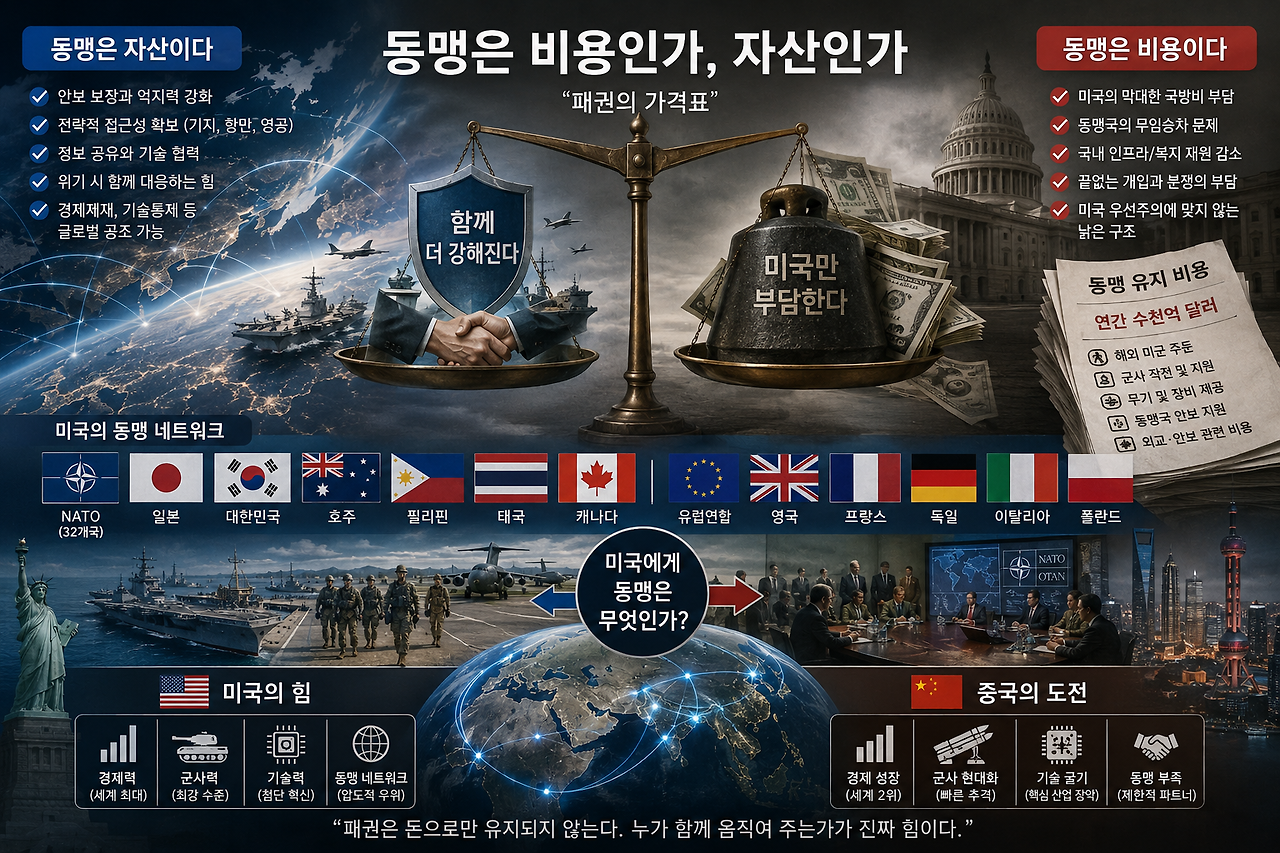
트럼프의 말을 듣고 있으면 동맹에도 가격표가 붙어 있는 것처럼 느껴질 때가 있다.
누가 얼마를 부담하는가?
미군은 왜 그 나라에 주둔해야 하는가?
왜 미국이 유럽의 방위를 더 많이 바카라임져야 하는가?
왜 경제력이 충분한 한국이나 일본이 자신의 방위를 위해 더 많은 돈을 내지 않는가?
트럼프가 처음 이런 이야기를 꺼냈을 때만 해도 많은 사람은 그것을 동맹을 이해하지 못하는 사업가의 언어라고 생각했다.
하지만 질문 자체는 그렇게 이상하지 않다.
미국의 국방비는 막대하다.
2024년 미국의 국방지출은 NATO의 다른 모든 회원국을 합친 것보다 약 1.7배 많았고, 미국은 NATO 전체 장비·연구개발 지출에서도 약 64%를 차지했다. 미국이 오랫동안 유럽 안보에서 훨씬 큰 부담을 져왔다는 트럼프의 문제제기에 전혀 근거가 없는 것은 아니다. (The White House)
그리고 트럼프는 실제로 결과도 만들어냈다.
2025년 헤이그 정상회의에서 NATO 회원국들은 2035년까지 GDP의 5%를 국방과 안보 관련 분야에 투자하기로 합의했다. 이 가운데 최소 3.5%는 직접적인 국방비, 최대 1.5%는 핵심 인프라와 회복력, 방위산업 등에 사용한다. 2026년 NATO는 유럽 회원국과 캐나다의 관련 투자가 이미 GDP의 약 4% 수준까지 올라왔다고 밝혔다. (나토)
트럼프의 입장에서 보면 성공이다.
미국이 말하니 동맹국들이 돈을 더 쓰기 시작했다.
그렇다면 이렇게 물을 수도 있다.
무엇이 문제인가?
오히려 미국이 지금까지 너무 많이 부담했던 것이 아닌가?
나는 이 질문에서 출발해보고 싶다.
다만 계산법을 조금 바꿔볼 생각이다.
패권국의 국방비는 정말 국방비일까
한 기업이 비용을 줄이면 보통 좋은 일이다.
100원을 쓰던 일을 70원으로 할 수 있다면 30원을 아낀 것이다.
그런데 국가의 패권은 조금 복잡하다.
예를 들어 미국이 유럽 방위에 쓰는 돈을 생각해보자.
단순한 손익계산서에서는 미국 세금이 유럽을 지키는 데 들어가는 비용이다.
그러나 그 돈을 다른 방향에서 보면, 미국 군대가 유럽에 있고, 미국 무기가 유럽군의 표준이 되고, 미국과 유럽의 군사정보가 연결되고, 유럽 각국의 군대가 미국군과 함께 훈련하고, 전쟁이 발생했을 때 미국군이 사용할 수 있는 기지와 항만과 영공이 확보되는 비용이기도 하다.
즉 미국은 돈을 지불하면서 단순히 다른 나라를 지켜준 것이 아니다.
자신을 중심으로 움직이는 군사체계를 만든 것이다.
이 차이가 중요하다.
패권국이 사용하는 돈에는 언제나 두 개의 장부가 있을 수 있다.
하나는 비용의 장부다.
다른 하나는 영향력의 장부다.
중국과 미국의 가장 큰 차이
미국과 중국의 국력을 비교할 때 우리는 흔히 GDP를 본다.
국방비를 보고, 항공모함을 세고, 핵무기와 미사일을 비교한다.
하지만 지도 한 장을 펼쳐놓으면 전혀 다른 숫자가 보인다.
미국에는 NATO가 있다.
현재 NATO에는 미국을 포함해 32개 회원국이 있다.
아시아·태평양으로 오면 일본, 대한민국, 호주, 필리핀, 태국과도 오래된 동맹 관계를 가지고 있다. 미국 국방부는 인도·태평양에서 이 동맹·파트너 네트워크를 중국이 갖지 못한 미국의 비대칭적 우위라고 표현해왔다. (U.S. Department of War)
물론 중국에도 북한과의 조약 관계가 있고, 러시아·이란 등과 매우 긴밀한 전략적 관계를 구축하고 있다.
그러므로 중국에 ‘친구가 없다’고 말하는 것은 지나친 표현이다.
하지만 제도화된 동맹망의 범위와 깊이에서 미국은 여전히 독특한 위치에 있다.
흥미로운 것은 트럼프 2기 행정부도 이 사실을 정확하게 알고 있다는 점이다.
2026년 미국 국가방위전략은 미국의 동맹과 파트너십을 유라시아를 둘러싼 일종의 ‘방어선(defensive perimeter)’이라고 표현한다.
더 중요한 문장도 있다.
미국의 동맹망을 경제적으로 합치면 잠재적 적국들을 합친 것보다 훨씬 부유하기 때문에, 동맹국들이 제대로 국방에 투자한다면 그것 자체가 미국에 엄청난 전략적 우위가 된다는 것이다. (U.S. Department of War)
아이러니하다.
트럼프 정부가 만든 국방전략 자체가 말하고 있다.
미국의 동맹은 미국의 힘이라고.
그렇다면 문제는 동맹의 존재 자체가 아니다.
누가 그 가격을 낼 것인가다.
내 편이 많다는 것
전쟁을 아주 단순하게 생각하면 병력과 무기의 싸움처럼 보인다.
그러나 현대전에서는 위치가 중요하다.
중국을 생각해보자.
미국 본토와 중국은 태평양을 사이에 두고 있다.
그런데 일본에는 미군기지가 있다.
대한민국에도 미군이 있다.
필리핀과는 상호방위조약이 있고, 호주와는 오래된 군사동맹이 있다.
즉 미국은 태평양 건너편에서 중국을 바라보는 나라가 아니다.
동맹을 통해 중국 주변 가까이에 존재하는 나라다.
이것은 돈으로 단순 환산하기 어려운 자산이다.
공항을 사용할 수 있다.
항만을 사용할 수 있다.
연료와 탄약을 보급할 수 있다.
정보를 공유할 수 있다.
평소부터 합동훈련을 해왔기 때문에 전쟁이 벌어졌을 때 처음 만나는 군대처럼 움직이지 않아도 된다.
그리고 동맹의 힘은 군사에만 존재하지 않는다.
경제제재를 하더라도 여러 나라가 함께해야 효과가 커진다.
첨단기술의 수출을 통제해도 미국 혼자 참여하는 것과 일본·한국·유럽이 함께 움직이는 것은 전혀 다르다.
반도체도, 금융도, 선박도, 항공도, 에너지 공급망도 마찬가지다.
패권은 상대방을 혼자 압도하는 힘만을 의미하지 않는다.
필요한 순간 다른 나라를 함께 움직이게 할 수 있는 능력
역시 패권의 일부다.
NATO의 제5조가 사용된 단 한 번
NATO의 집단방위조항인 제5조는 흔히 유럽을 미국이 지켜주기 위한 조항처럼 생각된다.
유럽의 어느 나라가 러시아의 공격을 받으면 미국이 도와주는 구조라고 생각하기 쉽다.
그런데 NATO 역사에서 제5조가 실제로 발동된 것은 지금까지 단 한 번이다.
공격받은 나라는 독일도, 프랑스도, 폴란드도 아니었다.
미국이었다.
2001년 9·11 테러 다음 날 NATO 회원국들은 미국에 대한 공격이 외부에서 이루어진 것으로 확인될 경우 제5조의 적용 대상이라고 결정했고, 10월 이를 공식 확인했다. 이후 NATO 동맹국들은 정보공유, 공중감시, 군사작전 등에서 미국을 지원했다. (나토)
아프가니스탄에서는 유럽과 캐나다를 포함한 수많은 동맹국 군인들이 미군과 함께 복무했다. (나토)
이 사례가 중요한 이유는 동맹의 본질을 보여주기 때문이다.
동맹은 미국이 다른 나라에 제공하는 서비스만이 아니다.
미국이 위기에 빠졌을 때 사용할 수 있는 보험이기도 하다.
보험료를 낼 때는 돈이 아깝다.
사고가 나지 않으면 더욱 그렇다.
하지만 사고가 난 뒤 보험의 가치를 계산하면 숫자가 달라진다.
동맹도 조금 비슷하다.
그렇다고 트럼프가 틀렸다는 이야기는 아니다
여기서 트럼프의 문제제기를 무조건 틀렸다고 해버리면 중요한 부분을 놓치게 된다.
동맹이 자산이라고 해서 미국이 모든 비용을 부담해야 한다는 결론이 자동으로 나오는 것은 아니다.
오히려 동맹국이 더 많은 국방비를 쓰면 미국의 동맹망은 더 강한 자산이 될 수도 있다.
유럽이 스스로 더 많은 탄약을 만들고, 더 많은 전차와 미사일을 확보하고, 자국의 군사력을 강화한다면, 미국은 유럽에 투입하던 자원의 일부를 인도·태평양이나 본토방위에 사용할 수 있다.
실제로 2026년 미국 국가방위전략도 이런 방향을 공식적으로 제시한다.
유럽과 다른 지역의 동맹국들이 자기 방위를 더 많이 바카라임지고 미국은 중국 억제와 본토방위에 집중한다는 것이다. (U.S. Department of War)
그리고 트럼프의 압박으로 NATO 국방비가 증가한 것은 현실이다.
게다가 동맹국의 군비 증가는 미국 방산업에도 이익이 된다.
백악관에 따르면 NATO 동맹국들은 2025년에만 540억 달러 이상의 미국산 방산장비를 구매했고, 유럽의 국방지출은 미국 내 상당한 고용과 연결돼 있다. 물론 이것은 현 행정부가 자신의 정바카라성과를 설명하기 위해 제시한 수치라는 점은 감안해야 한다. (The White House)
그렇게 본다면 트럼프의 전략은 전혀 다른 모습이 된다.
동맹을 해체하는 것이 아니라 더 싸게 유지하는 전략.
미국의 돈은 덜 쓰면서, 동맹국의 군사력은 키우고, 그 과정에서 미국 무기까지 판매한다.
여기까지 성공한다면 트럼프가 맞는 것이다.
어쩌면 미국은 패권을 내려놓는 것이 아니라 패권의 운영비를 줄이고 있는 것일 수도 있다.
그러나 여기에는 아주 중요한 조건이 하나 붙는다.
동맹은 돈으로만 유지되지 않는다
동맹에는 군사력이 필요하다.
돈도 필요하다.
그러나 하나가 더 필요하다.
신뢰다.
만약 어느 국가가 공격받았을 때 미국이 실제로 움직일 것이라는 믿음이 없다면, 동맹조약 한 장만으로는 충분하지 않다.
반대로 미국도 필요할 때 동맹국이 함께 움직일 것이라고 믿어야 한다.
그래서 동맹은 이상한 자산이다.
공장을 지었다고 바로 만들어지지 않는다.
돈을 썼다고 다음 날 생기지도 않는다.
십 년, 오십 년, 때로는 전쟁을 함께 치르는 시간을 통해 만들어진다.
한국과 미국의 상호방위조약은 1953년에 체결됐다.
미·일 안보체제의 현재 토대가 된 조약은 1960년에 만들어졌다.
미국과 필리핀의 상호방위조약은 1951년으로 거슬러 올라간다. (State Department)
그러니까 미국이 가지고 있는 동맹망은 오늘 대통령이 취임해서 만든 것이 아니다.
수십 년 동안 여러 행정부가 비용을 지불해 쌓아온 자산이다.
바로 그래서 패권국의 손익계산은 기업보다 어려워진다.
이번 분기에 비용이 줄었다고 자산가치까지 올라가는 것은 아니기 때문이다.
가격을 올리면 고객은 떠날 수 있다
사업에서는 가격을 올리면 고객이 다른 상품을 찾을 수 있다.
동맹도 완전히 다르지는 않다.
미국이 더 많은 돈을 내라, 미국산 무기를 사라, 미국의 전략에 맞춰라, 그렇지 않으면 안보를 보장할 수 없다고 계속 압박한다면, 처음에는 동맹국이 요구를 받아들일 수 있다.
실제로 지금 유럽은 국방비를 크게 늘리고 있다.
그러나 아주 장기적으로는 다른 계산도 시작될 수 있다.
유럽은 미국 없이 자신을 방어할 방법을 찾을 수 있다.
한국과 일본은 스스로 군사력을 더 키울 수 있다.
각 국가는 미국뿐 아니라 여러 국가와 동시에 관계를 관리하는 전략을 택할 수도 있다.
이것이 곧바로 미국과의 동맹을 버린다는 뜻은 아니다.
오히려 대부분의 동맹국에게 미국과의 관계는 쉽게 대체할 수 없는 자산이다.
하지만 중요한 것은 의존도의 변화다.
100을 미국에 의존했던 국가가 80만 의존하기 시작하고, 80이 60이 되고, 미국이 없어도 대응할 수 있는 분야를 하나씩 늘린다면, 미국은 국방비를 줄이는 데 성공하면서 동시에 자신이 가진 영향력의 일부도 줄일 수 있다.
그때부터 계산이 복잡해진다.
패권국은 왜 더 많이 내는가
여기에서 나는 다시 처음 질문으로 돌아간다.
왜 미국이 더 많이 내야 하는가?
트럼프가 묻는 질문이다.
그런데 답은 어쩌면 아주 단순할 수도 있다.
미국이 더 많은 것을 얻기 때문이다.
동맹국들도 분명 이익을 얻는다.
한국은 북한을 억제하고, 유럽은 집단방위를 얻고, 일본은 안보를 확보한다.
그래서 동맹국 역시 당연히 적절한 비용을 부담해야 한다.
하지만 미국이 얻는 것은 조금 다르다.
대서양과 태평양 양쪽에 군사적 접근성을 확보한다.
세계 각 지역에 자국 군대가 사용할 수 있는 기지를 가진다.
자국의 무기체계가 동맹국의 표준이 된다.
동맹국의 정보와 군사력이 미국의 전략과 연결된다.
그리고 무엇보다 국제위기가 발생할 때 “미국은 이렇게 하겠다.” 라고 말했을 때 함께 움직여줄 국가들이 존재한다.
이 힘은 GDP 통계에는 나오지 않는다.
그러나 패권에서는 엄청나게 중요하다.
중국이 돈으로 쉽게 살 수 없는 것
중국은 세계 2위의 경제대국이다.
군사력도 빠르게 성장했다.
조선산업에서는 미국을 크게 앞서고 있고, 핵심광물과 배터리, 태양광 공급망에서는 우리가 지난 화에서 본 것처럼 압도적인 위치를 구축했다.
돈도 있다.
공장도 있다.
기술도 있다.
그런데 미국이 가지고 있는 것 가운데 중국이 단기간에 만들기 어려운 것이 바로 이 동맹의 시간이다.
미국과 일본이 수십 년 동안 축적한 군사협력, 미국과 한국이 한반도에서 함께 만든 지휘·훈련 체계,
NATO가 수십 년 동안 맞춘 군사규격과 작전절차, 호주·미국 간의 정보협력. 이것들은 중국이 내년에 국방비를 두 배로 늘린다고 바로 얻을 수 있는 것이 아니다.
그래서 미국이 동맹을 가지고 있다는 것은 중국보다 군함 몇 척을 더 가지고 있다는 것과 성격이 다르다.
시간이 축적된 자산이다.
그리고 그런 자산은 한번 손상되면 돈만으로 즉시 복구하기 어렵다.
그러면 트럼프의 전략은 위험한가
아직 그렇게 결론내릴 필요는 없다.
오히려 지금까지의 결과만 보면 트럼프는 상당한 성과를 냈다고 평가할 부분도 있다.
NATO 회원국들은 국방비를 크게 늘렸고, 유럽은 자국 방위의 바카라임을 더 많이 부담하고 있으며, 그 과정에서 미국 방산업 역시 혜택을 얻고 있다.
NATO도 2026년 이를 ‘NATO 3.0’, 즉 유럽과 캐나다가 더 큰 바카라임을 지는 새로운 균형이라고 설명하고 있다. (나토)
그러니까 성공 시나리오는 분명하다.
미국은 돈을 덜 쓴다.
동맹국은 더 강해진다.
미국산 무기를 더 산다.
중국을 견제할 때는 여전히 미국과 함께한다.
그러면 미국은 이전보다 싼 비용으로 더 강한 동맹망을 가진다.
이 경우 트럼프의 전략은 패권 포기가 아니라 패권의 구조조정이다.
문제는 실패 시나리오다.
동맹국들이 돈은 더 쓰는데 미국에 대한 신뢰는 낮아진다.
스스로 방어할 능력이 커질수록 미국과 다른 외교노선을 선택할 여지도 커진다.
미국이 언제든 거래조건에 따라 안보보장을 바꿀 수 있다고 믿게 된다.
그 순간 미국은 비용을 줄이는 것과 동시에 동맹의 결속력까지 줄일 수 있다.
그래서 앞으로 봐야 하는 것은 국방비 숫자만이 아니다.
동맹국이 더 많은 돈을 쓰면서도 미국을 더 필요로 하는가?
그게 핵심이다.
비용을 줄이는 것과 자산을 파는 것은 다르다
회사가 불필요한 관리비를 줄이는 것은 좋은 경영이다.
하지만 관리비라고 생각했던 돈이 사실 핵심 고객을 유지하는 비용이었다면 이야기가 달라진다.
단기적으로 이익은 올라간다.
그러나 고객이 떠난 뒤 매출이 떨어질 수도 있다.
나는 트럼프의 동맹정바카라을 볼 때 바로 이 질문이 떠오른다.
미국은 관리비를 줄이고 있는 것일까? 아니면 자산을 조금씩 팔고 있는 것일까? 아직 답은 나오지 않았다.
오히려 지금은 트럼프의 실험이 진행 중이라고 보는 편이 맞다.
그리고 이 실험은 중요하다.
미국이 성공한다면 앞으로 패권국의 새로운 모델이 될 수도 있다.
모든 곳에 직접 군대를 투입하는 대신 동맹국이 스스로 무장하게 한다.
미국은 핵전력과 정보, 첨단기술, 지휘체계 같은 핵심 능력을 제공한다.
동맹국의 국방비로 미국 방산업도 키운다.
그리고 미국은 가장 중요한 지역에 힘을 집중한다.
훨씬 효율적인 패권이다.
하지만 실패하면 역사적 평가는 완전히 달라질 것이다.
미국은 중국에 패해서 패권을 잃은 것이 아니라, 자신의 패권을 유지하던 비용을 너무 비싸다고 생각하면서 그 기반을 스스로 약화시킨 국가가 될 수도 있다.
여기서 캐나다를 보게 된다
그리고 나는 이 문제를 생각하다가 아주 흥미로운 나라 하나를 만나게 됐다.
캐나다다.
캐나다는 미국의 NATO 동맹국이다.
북쪽 국경을 공유한다.
경제적으로도 깊이 연결되어 있다.
군사적으로는 북미항공우주방위사령부, NORAD를 함께 운영할 정도로 안보체계가 연결되어 있다.
그런데 트럼프의 세계관에서는 캐나다조차 거래의 대상이 될 수 있다.
관세를 부과할 수 있고, 방위비를 문제 삼을 수 있으며, 누가 누구에게 더 많은 이익을 주는지 계산할 수 있다.
경제적으로는 가능하다.
정치적으로도 가능하다.
그러나 지도를 조금 다르게 보면 문제가 생긴다.
미국과 캐나다 사이에는 사람이 만든 국경선이 있다.
하지만 로키산맥은 국경에서 멈추지 않는다.
강도 멈추지 않는다.
오대호도 두 나라가 공유한다.
대기도 공유한다.
그리고 캐나다에는 미국보다 훨씬 많은 빙하가 있다.
바로 여기에서 동맹보다 훨씬 더 어려운 문제가 나타난다.
동맹이라면 협상을 할 수 있다.
돈을 더 내라고 요구할 수도 있다.
필요하다면 조약을 바꿀 수도 있다.
하지만 자연은 협상하지 않는다.
미국은 캐나다산 상품에 관세를 매길 수 있다.
그러나 캐나다에서 시작된 강물이 국경을 넘지 못하게 관세를 매길 수는 없다.
그래서 다음 편에서는 조금 다른 패권의 가격표를 보려고 한다.
군사도 아니고, 무역도 아니다. 지리다.
다음 화
캐나다와 미국 사이에는 국경이 있지만 자연에는 없다
미국과 캐나다는 서로 다른 국가다.
그러나 로키산맥과 강, 오대호, 대기와 북극은 두 국가를 하나의 자연 시스템 안에 묶어놓았다.
그렇다면 경제 내셔널리즘은 자연 앞에서 어디까지 가능한가.
6화에서는 트럼프가 거래의 대상으로 바라보는 캐나다와, 미국이 결코 분리할 수 없는 캐나다를 함께 살펴보려고 한다.
Episode 5
Are Alliances a Cost, or an Asset?
Listen to Trump long enough, and it starts to sound as though even alliances come with a price tag. Who's paying their share? Why should US troops be stationed there? Why does America carry so much of the burden for European defense? Why don't wealthy allies like South Korea or Japan pay more for their own security?
When Trump first raised these questions, plenty of people dismissed them as the language of a businessman who didn't understand alliances. But the questions themselves aren't unreasonable. American defense spending is enormous: in 2024, US defense spending was roughly 1.7 times that of every other NATO member combined, and the US accounted for about 64% of NATO's total equipment and R&D spending. Trump's underlying claim — that America has long shouldered a disproportionate share of European security — isn't baseless.
And he's actually produced results. At the 2025 Hague summit, NATO members agreed to invest 5% of GDP in defense and security-related spending by 2035 — at least 3.5% in direct defense spending, up to 1.5% in critical infrastructure, resilience, and the defense industrial base. By 2026, NATO reported that European members and Canada had already pushed related investment to roughly 4% of GDP.
From Trump's perspective, that's a win. America spoke, and its allies started spending more. Which raises an obvious question: what's the problem? Hadn't America been overpaying all along?
I want to start from that question — but change the accounting.
Is a Hegemon's Defense Spending Really Just "Defense Spending"?
When a company cuts costs, that's usually good news: spend 70 instead of 100, and you've saved 30. But a hegemon's ledger is more complicated than that.
Take American spending on European defense. On a simple profit-and-loss statement, US tax dollars pay to protect Europe. But flip the frame, and that same money buys something else: American troops stationed on European soil, American weapons systems becoming the European standard, US-European intelligence sharing, joint training between American and European militaries, and guaranteed access to bases, ports, and airspace the moment a war breaks out. America wasn't just paying to protect other countries. It was building a military system organized around itself.
That distinction matters. A hegemon's spending always runs on two ledgers at once — one for cost, and one for influence.
The Biggest Gap Between America and China
When people compare US and Chinese power, they usually reach for GDP, defense budgets, carrier counts, missile inventories. But unfold a map, and an entirely different number appears.
America has NATO — currently 32 member states, including itself. In the Asia-Pacific, it has long-standing alliances with Japan, South Korea, Australia, the Philippines, and Thailand. The Pentagon has described this alliance-and-partner network in the Indo-Pacific as an asymmetric advantage China simply doesn't have.
China isn't friendless — it has a treaty relationship with North Korea and deep strategic ties with Russia and Iran. But in the scope and depth of institutionalized alliances, America remains in a category of its own.
What's striking is that Trump's own second-term administration knows this perfectly well. The 2026 National Defense Strategy describes America's alliances and partnerships as a kind of defensive perimeter ringing Eurasia. And it goes further: because America's combined alliance network is economically far wealthier than any group of potential adversaries, allies making adequate defense investments becomes, in itself, an enormous strategic advantage for the United States.
There's real irony here. The Trump administration's own defense strategy is saying, in plain language: America's alliances are America's power.
Which means the real issue was never whether alliances are worth having. It's who pays for them.
The Value of Having Friends
Reduce war to its simplest terms, and it looks like a contest of troops and weapons. But in modern warfare, position matters just as much.
Consider China. The American mainland and China face each other across the Pacific — but the US has bases in Japan, troops in South Korea, a mutual defense treaty with the Philippines, and a decades-old military alliance with Australia. America isn't a country peering at China from across an ocean. Through its alliances, it's already present near China's periphery.
That's an asset that's hard to translate directly into dollars: access to airports and ports, fuel and munitions resupply, shared intelligence, and — because allied forces have trained together for years — militaries that don't need to learn how to work with each other on day one of a war.
The value of alliances isn't purely military, either. Economic sanctions hit harder when multiple countries impose them together. Controlling exports of advanced technology means something very different when America acts alone versus when Japan, South Korea, and Europe move in step with it. The same logic runs through semiconductors, finance, shipping, aviation, and energy supply chains. Hegemony was never just the power to overwhelm a rival single-handedly — the ability to mobilize other nations when it matters is part of hegemony too.
The One Time NATO's Article 5 Was Invoked
NATO's collective-defense clause, Article 5, is usually imagined as a promise that America will protect Europe — that if Russia attacks some European country, the US comes to help. In NATO's entire history, though, Article 5 has been invoked exactly once. The country under attack wasn't Germany, France, or Poland. It was the United States.
The day after the September 11 attacks in 2001, NATO members determined that the attack qualified for Article 5 if it was confirmed to have originated externally, formally confirming this the following month. NATO allies subsequently supported the US through intelligence sharing, airborne surveillance, and military operations. In Afghanistan, troops from dozens of allied nations — across Europe and Canada — served alongside American forces.
That episode reveals something essential about what an alliance actually is. It isn't only a service America provides to others. It's also an insurance policy America itself can draw on in a crisis. Paying the premium always feels like wasted money — especially when nothing bad happens. But calculate the value of that insurance after the disaster, and the math changes completely. Alliances work much the same way.
None of This Means Trump Is Wrong
It would be a mistake to conclude from all this that Trump's questions are simply misguided. Calling alliances an asset doesn't automatically mean America should keep footing the entire bill. In fact, allies spending more on defense could make America's alliance network an even stronger asset. If Europe manufactures more of its own munitions, fields more tanks and missiles, and strengthens its own forces, the US can redirect resources it once poured into Europe toward the Indo-Pacific or homeland defense instead.
That's exactly the direction the 2026 National Defense Strategy officially charts: European and other allies taking greater responsibility for their own defense, while America concentrates on deterring China and protecting the homeland. And it's simply a fact that Trump's pressure has driven up NATO defense spending. Allied rearmament also benefits American defense manufacturers directly — the White House reports that NATO allies purchased more than $54 billion in US-made defense equipment in 2025 alone, with European defense spending tied to substantial US employment (a figure worth noting comes from the current administration touting its own results, so take it with appropriate caution).
Seen this way, Trump's strategy looks completely different: not dismantling alliances, but running them more cheaply. Spend less American money, grow allied military strength, and sell American weapons in the process. If it works, Trump is right. Rather than surrendering hegemony, America may simply be cutting the overhead cost of maintaining it.
But one critical condition attaches to that success story.
Alliances Aren't Held Together by Money Alone
Alliances need military strength. They need money. But they need one more thing: trust. If a country under attack doesn't genuinely believe America will actually show up, a treaty document alone isn't enough. And America, in turn, has to trust that its allies will show up when it needs them.
That makes alliances a strange kind of asset. You can't build one the way you build a factory. It doesn't appear the day after you write a check. It's built over ten years, fifty years — sometimes through fighting wars together. The US-South Korea mutual defense treaty dates to 1953. The current foundation of the US-Japan security arrangement was laid in 1960. The US-Philippines mutual defense treaty goes back to 1951.
America's alliance network wasn't built by whoever happens to be president today. It's an asset that multiple administrations paid to accumulate, decade after decade — which is exactly why a hegemon's balance sheet is so much harder to read than a corporation's. Cutting this quarter's costs doesn't automatically raise the value of the underlying asset.
Raise the Price, and Customers Can Walk
In business, raise your prices and customers may go elsewhere. Alliances aren't entirely different. If America keeps pressuring allies — pay more, buy American weapons, fall in line with American strategy, or security guarantees aren't assured — allies may accept those terms at first. Europe, in fact, is ramping up defense spending substantially right now.
But over a much longer horizon, a different calculation can start. Europe may look for ways to defend itself without America. South Korea and Japan may build up their own military capacity further. Each nation might start managing relationships with multiple powers simultaneously, rather than relying on the US alone. None of this necessarily means abandoning the American alliance — for most allies, the relationship with the US remains an asset nothing else can easily replace. But what matters is the shift in dependence. A country that once relied on America for 100% of something starts relying on it for 80%, then 60%, gradually expanding the areas where it can act without the US. If that happens, America may succeed in cutting its defense costs while simultaneously shrinking a slice of its own influence. That's where the math gets complicated.
Why Does the Hegemon Pay More?
Which brings me back to the original question: why should America pay more? That's Trump's question. And the answer might actually be simple.
Because America gets more out of it.
Allies clearly benefit too — South Korea deters North Korea, Europe gets collective defense, Japan secures its own safety — and allies should absolutely bear a fair share of the cost. But what America gets is different in kind. It secures military access across both the Atlantic and the Pacific. It has bases its forces can use in nearly every region of the world. Its weapons systems become the standard for its allies. Allied intelligence and military capability plug directly into American strategy. And above all, when a crisis erupts and Washington says "here's what we're going to do," there are countries ready to move with it.
None of that shows up in GDP statistics. But in the currency of hegemony, it matters enormously.
The Thing China Can't Simply Buy
China is the world's second-largest economy. Its military power has grown rapidly. It leads the US decisively in shipbuilding, and as the previous episodes showed, it has built an overwhelming position across critical minerals, batteries, and solar supply chains. It has money. It has factories. It has technology.
But there's one thing America has that China can't manufacture on a short timeline: decades of alliance-building. Military cooperation the US and Japan built up over generations. The command-and-training systems the US and South Korea developed together on the Korean Peninsula. Military standards and operating procedures NATO spent decades aligning. Intelligence cooperation between Australia and the US. China cannot acquire any of this simply by doubling its defense budget next year.
Having allies isn't the same kind of advantage as having a few more warships than a rival. It's an asset built out of accumulated time — and once damaged, that kind of asset can't be rebuilt with money alone, or quickly.
So Is Trump's Strategy Risky?
It's too early to conclude that. Judged purely on results so far, there's a strong case that Trump has achieved something real: NATO members have raised defense spending substantially, Europe is shouldering more responsibility for its own defense, and American defense manufacturers are benefiting along the way. NATO itself has described this in 2026 as "NATO 3.0" — a new balance in which Europe and Canada carry greater responsibility.
The success scenario is clear enough: America spends less, allies grow stronger, they buy more American weapons, and they still stand with the US when it comes to countering China. If that holds, America ends up with a cheaper, stronger alliance network than before — and Trump's strategy looks less like abandoning hegemony than restructuring it.
The risk lies in the failure scenario: allies spend more money but trust America less. As their capacity to defend themselves grows, so does their room to pursue an independent foreign policy. They come to believe US security guarantees can shift with the terms of any given deal. At that point, America could end up cutting costs and eroding alliance cohesion at the same time.
Which means the number to watch isn't just defense spending. The real question is:
Do allies, even as they spend more, still need America more — or less?
That's the crux of it.
Cutting a Cost Is Not the Same as Selling an Asset
A company trimming unnecessary overhead is good management. But if the money it thought was overhead turns out to have been the cost of retaining its most important customers, the story changes — profits rise in the short term, but revenue can collapse once those customers walk away.
That's the question Trump's alliance policy keeps raising for me: is America cutting overhead? Or is it slowly selling off an asset?
We don't have the answer yet. It's more accurate to say Trump's experiment is still running — and it's a consequential one. If it succeeds, it could become a new model for hegemony: instead of deploying troops everywhere directly, let allies arm themselves, while America supplies the capabilities only it can provide — nuclear deterrence, intelligence, advanced technology, command architecture — growing its own defense industry off allied spending, and concentrating its power where it matters most. That's a considerably more efficient version of hegemony.
But if it fails, the historical verdict will look very different. America won't have lost its hegemony to China in a straight fight. It may instead go down as a nation that judged the cost of maintaining its own hegemony too expensive — and quietly weakened the foundation holding it up.
Which Brings Me to Canada
Thinking through all this, I found myself landing on an oddly interesting case: Canada.
Canada is a NATO ally. It shares America's northern border. The two economies are deeply intertwined. Militarily, their security systems are fused tightly enough that they jointly operate NORAD, the North American Aerospace Defense Command.
And yet in Trump's worldview, even Canada can become a subject of negotiation — tariffs to impose, defense spending to question, a running calculation of who's getting the better deal from whom. Economically, that's possible. Politically, that's possible too.
But look at the map a little differently, and a problem appears. There's a human-drawn border between the US and Canada. The Rocky Mountains don't stop at that border. Neither do the rivers. The two countries share the Great Lakes. They share the atmosphere. And Canada holds far more glaciers than the United States does.
This is where a problem emerges that's harder than any alliance question. Alliances can be negotiated — you can demand more money, or even rewrite the treaty if you have to. Nature doesn't negotiate. America can put tariffs on Canadian goods. It cannot put a tariff on a river that starts in Canada and refuses to stop at the border.
So the next episode looks at a different kind of price tag on hegemony altogether. Not military. Not trade. Geography.
Next Episode
There's a Border Between Canada and America — Nature Doesn't Recognize It
The US and Canada are separate nations. But the Rocky Mountains, the rivers, the Great Lakes, the atmosphere, and the Arctic bind them into a single natural system regardless.
So how far can economic nationalism really go when it runs up against nature itself?
Episode 6 sets side by side the Canada Trump treats as a negotiating partner, and the Canada America can never actually separate itself from.