석유를 버리면 패권도 중국에 넘겨주는가
석유를 버리면 패권도 중국에 넘겨주는가
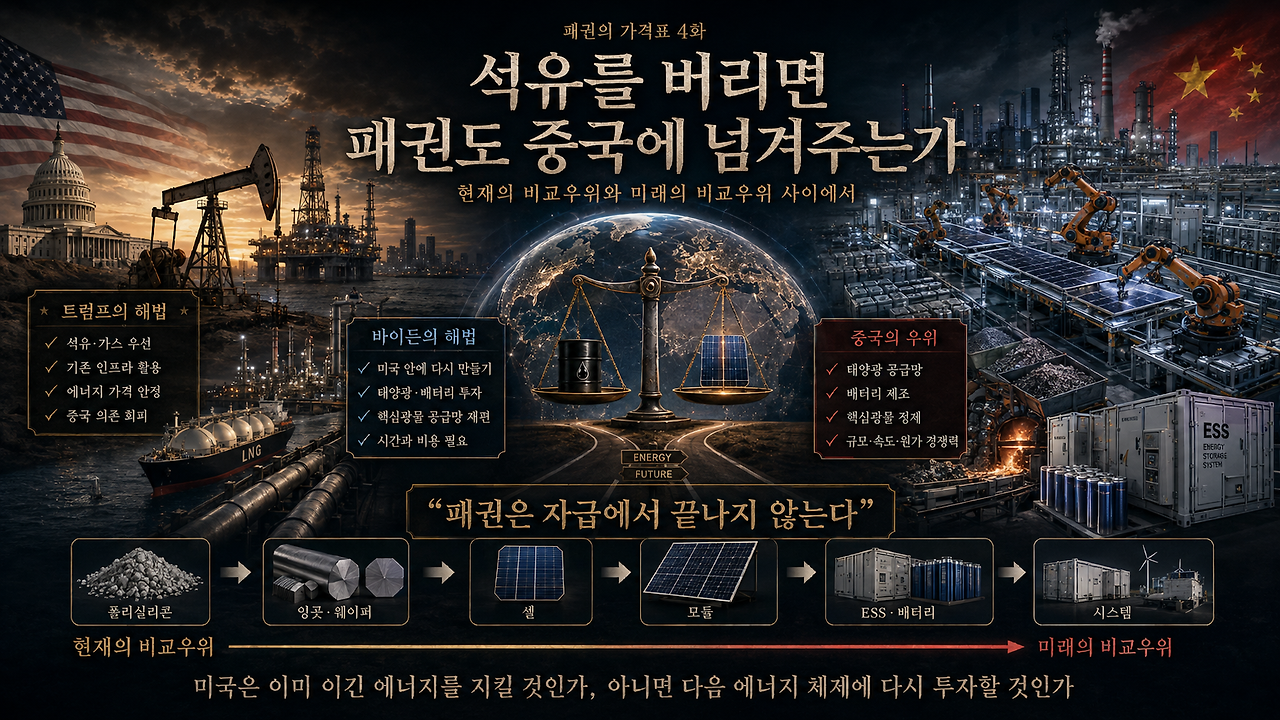
지난 두 편에서 나는 조금 이상한 질문을 따라왔다.
미국은 왜 기후변화의 시대에 다시 석유와 천연가스를 국가전략의 중심으로 가져왔을까?
그리고 미국처럼 태양과 바람이 풍부한 나라가 왜 태양광과 배터리 산업에서는 중국을 경계해야 할까?
답의 일부는 분명해졌다.
미국은 석유와 천연가스에서 강하다.
땅속에 자원이 있고, 그것을 꺼낼 기술이 있고, 파이프라인과 정유시설이 있으며, LNG 터미널과 세계적인 에너지 기업까지 가지고 있다.
반면 태양광과 배터리로 가면 지도가 달라진다.
중국은 세계 태양광 공급망 생산능력의 약 85%, 리튬이온 배터리 공급망 생산능력의 약 80%를 차지한다. 웨이퍼와 음극재처럼 특정 공정으로 들어가면 중국 비중은 95%를 넘어가기도 한다. 핵심광물의 정제와 가공에서도 중국의 영향력은 압도적이다. (IEA)
그러면 미국의 선택은 생각보다 어렵다.
기후변화에 대응하려면 에너지 전환을 서둘러야 한다.
그런데 전환을 서두를수록 자신이 가장 강한 석유·가스 산업의 비중은 줄어들고, 경쟁국이 더 강한 태양광·배터리 공급망의 중요성은 커진다.
그렇다면 이런 질문이 가능하다.
미국이 석유를 버리는 것은 에너지 패권까지 중국에 넘겨주는 일일까?
트럼프는 그렇게 생각하는 것처럼 보인다.
하지만 미국에는 사실 다른 선택지도 있었다.
그리고 미국은 이미 그 선택을 한번 시도했다.
바이든도 중국이 무서웠다
바이든과 트럼프의 에너지정바카라은 매우 달라 보인다.
바이든은 기후변화를 강조했고, 트럼프는 석유와 천연가스를 강조한다.
바이든은 전기차를 지원했고, 트럼프는 전기차 의무화를 비판한다.
바이든은 태양광과 풍력에 막대한 지원을 했고, 트럼프는 그런 보조금을 줄이고 있다.
그래서 두 사람의 정바카라을 흔히 이렇게 나눈다.
친환경 대 반환경
하지만 국제통상의 관점에서 보면 두 사람 사이에는 의외로 큰 공통점이 하나 있다.
둘 다 중국을 믿지 않았다.
바이든 정부가 만든 인플레이션감축법, 이른바 IRA를 단순한 기후법으로만 보면 이 점을 놓치기 쉽다.
IRA에는 미국에서 배터리를 만들고, 미국에서 태양광 부품을 생산하고, 미국 또는 미국과 협력하는 국가에서 핵심광물을 조달하도록 유도하는 수많은 장치가 들어갔다.
미국에서 생산된 철강과 부품을 사용하는 청정에너지 사업에는 추가 혜택을 주고, 태양광 셀과 배터리 셀, 핵심광물 등을 미국에서 생산하면 세제지원을 받을 수 있도록 했다. (The Department of Energy's Energy.gov)
이것은 기후정바카라인 동시에 명백한 산업정바카라이었다.
조금 더 노골적으로 말하면, 중국이 가져간 청정에너지 제조업을 미국으로 다시 가져오려는 정바카라이었다.
바이든 정부 시절 미국 재무부는 2024년까지 태양광·풍력·배터리·에너지저장장치·핵심광물을 대상으로 한 제조 세액공제와 관련해 1,260억 달러 이상의 미국 내 청정에너지 제조투자가 발표됐다고 설명했다. (U.S. Department of the Treasury)
배터리와 전기차 공급망에서도 같은 현상이 나타났다.
2024년 당시 미국 정부가 집계한 민간투자 발표액은 배터리와 청정차량 공급망에서 1,730억 달러에 달했다. (U.S. Department of the Treasury)
그러니까 바이든의 선택은 단순히 석유를 버리고 태양광을 쓰자.가 아니었다.
오히려 이렇게 보는 편이 정확하다.
태양광과 배터리의 시대가 온다면 그 공장을 중국에만 둘 수 없다. 미국에도 만들어야 한다.
이것 역시 경제 내셔널리즘이다.
같은 문제, 다른 해법
여기서 트럼프와 바이든의 차이가 선명해진다.
두 사람 모두 이런 문제를 본다.
중국이 새로운 에너지 공급망을 지나치게 많이 장악하고 있다.
하지만 해법이 다르다.
바이든의 해법을 아주 단순하게 줄이면 이렇다.
그 산업을 미국으로 가져온다.
태양광을 설치하면서 미국산 태양광도 키우고, 전기차를 늘리면서 미국산 배터리를 만들고, 핵심광물도 미국과 우방국 중심으로 재편한다.
시간과 돈이 많이 들더라도 새로운 산업생태계를 미국에 다시 만드는 것이다.
반면 트럼프의 해법은 조금 다르다.
우리가 이미 잘하는 것을 먼저 쓴다.
석유, 천연가스, 석탄, 원자력, 수력, 지열 그리고 핵심광물은 미국 안에서 다시 캐고 정제한다.
트럼프가 2025년 만든 국가에너지지배위원회는 미국의 석유와 천연가스뿐 아니라 우라늄, 석탄, 바이오연료, 지열, 수력, 핵심광물까지 미국의 전략자산으로 열거했다. (The White House)
그러니까 트럼프의 전략을 단순히 “과거로 돌아가자.” 라고만 설명하기도 어렵다.
좀 더 정확하게 표현한다면, 미국이 통제할 수 있는 에너지를 우선하자 에 가깝다.
시간이라는 문제가 있다
여기에는 현실적인 이유가 있다.
석유산업은 이미 존재한다.
오늘 허가를 완화하면 시추가 늘어날 수 있고, 파이프라인도 있고, 정유공장도 있고, LNG 터미널도 있다.
하지만 태양광 공급망을 미국에 다시 만드는 일은 다르다.
모듈 조립공장을 세우는 것만으로 끝나지 않는다.
폴리실리콘, 잉곳, 웨이퍼, 셀, 유리, 인버터, 전력전자, 배터리, 양극재와 음극재, 핵심광물 정제까지 따라와야 한다.
미국 에너지부도 IRA 이후 미국의 태양광 모듈 생산능력이 빠르게 늘었지만, 웨이퍼와 셀 같은 상류공정은 설계와 건설, 가동 안정화에 더 많은 시간이 필요해 당분간 수입 의존이 불가피하다고 평가했다. (The Department of Energy's Energy.gov)
그러니까 트럼프 입장에서 보면 이런 계산도 가능하다.
왜 수십 년 동안 중국이 만든 제조 생태계를 미국이 비싼 돈을 들여 처음부터 다시 만들어야 하는가?
그 기간 동안 미국 소비자는 더 높은 가격을 부담해야 할 수도 있다.
그런데 미국 땅 아래에는 지금 바로 사용할 수 있는 석유와 가스가 있다.
그것을 쓰면 에너지를 싸게 공급할 수 있고, LNG를 수출할 수 있고, 제조업을 유치할 수도 있다.
특히 AI와 데이터센터가 엄청난 전력을 요구하기 시작한 지금, 시간 자체가 경쟁력이 된다.
이 논리는 생각보다 강하다.
그래서 트럼프도 공급망을 포기한 것은 아니다
그런데 재미있는 점이 있다.
트럼프 역시 중국의 핵심광물 공급망을 그대로 두려고 하지는 않는다.
2026년 7월 트럼프 행정부는 국방생산법을 이용해 미국 내 회수 가능한 핵심광물과 소재의 공급을 확대하는 조치를 내놓았다.
백악관은 미국이 특정 핵심광물을 외국에 지나치게 의존하는 상황 자체를 국가안보 위험이라고 명시했다. (The White House)
같은 달에는 미국 군사장비에 들어가는 핵심 소재와 부품을 미국 또는 동맹국에서 공급받도록 하는 방향도 강화했다. (The White House)
이것을 보면 트럼프의 전략이 더 명확해진다.
그는 공급망의 중요성을 모르는 것이 아니다.
오히려 굉장히 중요하게 생각한다.
문제는 어떤 산업의 공급망에 얼마만큼의 국가자원을 투입할 것이냐다.
석유·가스에서는 이미 미국이 우위에 있다.
핵심광물에서는 중국 의존을 줄이려 한다.
하지만 풍력과 태양광에 대해서는 상황이 다르다.
트럼프는 2025년 7월 풍력·태양광에 대한 세제지원을 빠르게 종료하도록 지시하면서 이들 에너지원이 외국이 지배하는 공급망에 대한 의존을 높인다고 주장했다. (The White House)
그러니까 이 정바카라에는 두 가지 움직임이 동시에 존재한다.
중국 공급망에는 의존하기 싫다.
그런데 동시에 '그 공급망과 경쟁하기 위해 미국 정부가 막대한 보조금을 투입하는 것도 싫다.' 바로 여기에서 나는 의문이 생긴다.
중국의 패권을 줄이려면 미국의 산업을 키워야 하지 않을까
중국산 태양광이 문제라면, 가장 직관적인 해결바카라은 미국산 태양광을 만드는 것이다.
중국산 배터리가 문제라면, 미국에서 배터리를 만들면 된다.
말은 쉽다.
문제는 중국 기업과 같은 가격으로 만들기가 어렵다는 것이다.
중국은 이미 수십 년 동안 설비와 인력, 협력업체와 원료공급망을 쌓았다.
IEA는 중국의 청정에너지 제조 경쟁력이 단순히 값싼 노동력 때문이 아니라 대규모 생산, 높은 제조효율, 숙련인력, 통합 공급망, 저렴한 자원과 지속적인 정바카라·금융지원이 누적된 결과라고 분석한다. (IEA)
따라잡으려면 처음에는 비쌀 수밖에 없다.
그리고 바로 여기에서 국가의 역할을 둘러싼 철학 차이가 생긴다.
시장이 알아서 선택하게 둘 것인가? 아니면 미래에 전략산업이 될 가능성이 높은 산업에 국가가 돈을 넣을 것인가?
바이든은 후자를 선택했다.
트럼프는 훨씬 더 전자에 가까워 보이지만, 철강이나 반도체, 핵심광물처럼 국가안보와 직결된 분야에서는 관세와 국가개입을 적극적으로 사용한다.
그래서 이것은 순수한 자유시장 대 정부개입의 싸움도 아니다.
결국 어떤 산업을 국가가 보호할 가치가 있는 산업으로 판단하는가의 차이다.
그리고 여기서 아주 묘한 숫자가 나온다
IEA의 2026년 전망에는 흥미로운 내용이 하나 있다.
현재 정바카라과 프로젝트가 유지된다는 가정에서 미국은 2030년경 태양광 모듈에서 거의 자급 가능한 수준에 도달할 수 있다고 전망한다. (IEA)
얼핏 보면 좋은 소식이다.
중국 의존도를 줄이는 데 성공하는 것처럼 보인다.
하지만 그 내용을 조금 더 보면 묘하다.
그 이유에는 미국 내 제조능력 증가뿐 아니라 미국의 태양광 수요 증가세가 약해지는 것도 들어 있다. (IEA)
이것은 아주 중요한 차이다.
자급률에는 두 가지 방식이 있다.
생산을 많이 늘려서 자급할 수도 있다.
반대로 수요가 줄어서 자급할 수도 있다.
둘 다 숫자로는 ‘자급’이다.
하지만 패권의 관점에서는 완전히 다르다.
시장이 작아져서 자급하는 것과 세계시장에 제품을 팔 정도로 산업을 키우는 것은 같은 일이 아니다.
이게 내가 걱정하는 지점이다.
패권은 자급에서 끝나지 않는다
미국이 석유에서 패권국인 이유는 미국에서 미국이 쓸 석유만 생산하기 때문이 아니다.
남는 것을 세계에 판매한다.
가격에 영향을 미치고,
동맹국에 공급하며,
LNG 계약을 통해 다른 국가의 에너지안보와 연결된다.
달러로 거래되고,
미국 기업이 세계 곳곳에서 사업을 한다.
패권은 단순한 자급을 넘어선다.
다른 나라가 나를 필요로 하게 만드는 것이다.
그렇다면 태양광과 배터리에서도 같은 질문을 해야 한다.
미국이 중국 제품을 사용하지 않는 것만으로 충분할까.
아니면 세계가 미국의 태양광 기술과 배터리, 전력망 기술을 사게 만들어야 할까.
전자가 경제안보다.
후자가 패권이다.
그리고 그 차이는 엄청나다.
중국이 정말 원하는 것은 미국 시장뿐일까
중국 청정에너지 산업의 목표가 미국에 태양광 패널을 파는 것뿐이라면 미국이 관세를 높이고 시장을 닫는 것으로 상당 부분 대응할 수 있다.
하지만 세계는 미국만 있는 것이 아니다.
동남아시아가 있고, 인도가 있고, 아프리카가 있고, 중남미가 있다.
중동에도 막대한 재생에너지 투자가 이루어지고 있다.
세계 전력수요는 계속 늘어난다.
IEA는 현재의 정바카라 흐름을 기준으로 하더라도 2030년 중국이 세계 태양광 모듈 수요의 70% 이상을 공급할 것으로 전망한다. 상류공정에서는 그 비중이 80% 이상으로 예상된다. (IEA)
그러니까 미국이 자국 시장에서 중국을 막는다고 중국의 태양광 산업이 사라지는 것은 아니다.
다른 시장으로 간다.
그리고 그 과정에서 중국 기업들은 더 많은 공장을 돌리고, 더 많은 경험을 쌓고, 가격을 더 낮춘다.
제조업에는 이런 특성이 있다.
많이 만들수록 잘 만들게 된다.
잘 만들수록 싸진다.
싸질수록 더 많이 팔린다.
그리고 더 많이 팔수록 다음 세대 기술에 투자할 돈이 생긴다.
이것이 반복되면 산업의 격차는 줄어드는 것이 아니라 오히려 커질 수도 있다.
현재의 비교우위와 미래의 비교우위
국제통상을 공부하면서 비교우위라는 말을 정말 많이 들었다.
각 국가는 자신이 상대적으로 잘하는 것에 집중하고, 다른 상품은 교역하면 모두가 더 부유해질 수 있다는 논리다.
그 원칙대로라면 미국의 선택은 꽤 합리적이다.
미국은 석유와 천연가스를 잘한다.
중국은 태양광 패널과 배터리를 잘한다.
미국은 에너지를 생산하고, 중국은 패널을 만들면 된다.
그런데 현실의 국제통상은 그렇게 단순하지 않다.
특히 국가안보와 패권이 들어가면 더 그렇다.
왜냐하면 비교우위는 영원히 고정되어 있는 것이 아니기 때문이다.
오늘 잘하는 산업에만 집중하다 보면, 내일 중요해질 산업을 잃을 수도 있다.
반대로 지금은 비싸고 비효율적이더라도 오랫동안 투자하면 어느 순간 새로운 비교우위를 만들 수도 있다.
중국의 태양광 산업이 바로 그런 사례일지도 모른다.
처음부터 중국이 태양광 패널을 가장 잘 만들었던 것은 아니다.
정바카라을 만들었고, 공장을 지었으며, 생산량을 늘렸고, 가격을 낮췄다.
그 결과 비교우위를 만들어냈다.
그러니까 패권국에는 조금 다른 질문이 필요하다.
지금 "내가 무엇을 가장 잘하는가?" 뿐 아니라, "20년 뒤 나는 무엇을 가장 잘해야 하는가?"도 물어야 한다.
트럼프는 현재의 비교우위를 선택했다
그래서 나는 트럼프의 에너지전략을 이렇게 이해한다.
트럼프는 미국이 이미 가진 힘을 매우 중요하게 생각한다.
석유, 천연가스, 원자력, 막대한 토지, 자본, 첨단기술, 그리고 미국 시장.
그 힘을 이용해 지금 당장 제조업을 되살리고 중국과 경쟁하려 한다.
이 전략에는 분명 장점이 있다.
아직 존재하지 않는 공급망을 기다릴 필요가 없다.
미국이 이미 가지고 있는 인프라를 사용할 수 있다.
에너지가 풍부해지면 화학, 철강, 데이터센터와 같은 에너지집약 산업에도 유리할 수 있다.
LNG를 수출하면 동맹국을 미국 에너지에 연결할 수도 있다.
그래서 트럼프의 선택을 단순한 시대착오라고 말하고 싶지는 않다.
오히려 매우 현실적인 패권전략일 수도 있다.
하지만 문제가 하나 있다.
현재의 비교우위가 미래의 비교우위를 보장하지는 않는다.
미국은 정말 둘 중 하나만 선택해야 했을까
그리고 내가 결국 도달한 질문은 이것이다.
왜 미국이 석유와 태양광 가운데 하나만 골라야 하는가?
미국은 가난한 국가가 아니다.
기술이 부족한 국가도 아니다.
땅이 부족하지도 않다.
자본이 부족하지도 않다.
세계 최대 석유·천연가스 생산국이면서, 세계 최고 수준의 대학과 연구기관을 가지고 있고, 세계 최대급 자본시장을 가지고 있으며, 거대한 내수시장을 가지고 있다.
그렇다면 다른 전략도 가능했을 것이다.
석유와 천연가스를 당장 버리지 않는다.
그것을 이용해 에너지 가격을 안정시킨다.
동시에 태양광과 배터리, 원전과 ESS, 송전망과 핵심광물 정제에 투자한다.
중국산 제품을 무조건 사용하는 대신 미국과 동맹국의 공급망을 키운다.
현재의 에너지 패권을 미래의 에너지 패권으로 옮겨가는 시간을 사는 것이다.
사실 바이든의 정바카라은 완벽하지 않았지만 상당 부분 이 방향을 목표로 했다.
그리고 트럼프 역시 핵심광물과 원전 같은 분야에서는 비슷한 문제의식을 가지고 있다.
그러니까 미국이 반드시 선택해야 할 것은 석유냐 태양광이냐가 아닐 수도 있다.
현재의 패권으로 미래의 패권을 살 것인가?
그것이 진짜 선택인지도 모른다.
패권에는 유지비가 든다
그런데 미래의 산업을 키우려면 돈이 든다.
처음에는 중국산보다 비쌀 수 있다.
정부지원이 필요할 수도 있다.
미국 소비자가 조금 더 비싼 제품을 사용해야 할 수도 있다.
공장을 짓고 인력을 키우는 동안 시행착오도 생긴다.
그 돈을 어떻게 볼 것이냐가 중요하다.
트럼프식 시각에서는 그것이 비용으로 보일 수 있다.
왜 정부가 시장에서 경쟁력이 떨어지는 산업을 세금으로 지원해야 하는가.
왜 미국인이 더 싼 에너지를 놔두고 더 비싼 전환비용을 부담해야 하는가.
충분히 할 수 있는 질문이다.
하지만 《패권의 가격표》에서는 반대로 묻고 싶다.
패권을 유지하려면 원래 그 정도의 비용이 필요한 것은 아닐까?
반도체에도 돈을 써야 하고, 국방에도 돈을 써야 하며, 우주개발에도 돈을 쓴다.
당장 가장 싼 물건을 만드는 것이 목적이라면 굳이 자국에서 반도체 공장을 만들 이유도 없다.
하지만 국가는 그렇게 움직이지 않는다.
미래에 중요한 산업이라면 비싼 돈을 내고라도 가져오려고 한다.
그렇다면 에너지는 왜 다를까?
그리고 다시 중국을 본다
중국은 석탄을 여전히 엄청나게 사용한다.
그러면서 태양광도 만든다.
배터리도 만든다.
전기차도 만든다.
원전도 짓는다.
전력망에도 투자한다.
즉 중국은 지금 사용하고 있는 에너지와 미래에 필요하다고 보는 에너지 산업을 반드시 둘 중 하나로 선택하지 않았다.
둘 다 가져가려고 한다.
그 선택이 모두 성공할지는 알 수 없다.
과잉투자와 부채, 낮은 수익성이라는 문제도 있다.
하지만 한 가지는 분명하다.
중국은 미래의 에너지산업이 자기 나라 밖에서 만들어지는 것을 바라보고만 있지는 않았다.
미국도 그럴 수 있을까?
그것이 앞으로의 패권 경쟁에서 중요한 질문이 될 것이다.
처음의 질문으로 돌아가보자.
석유를 버리면 미국은 패권도 중국에 넘겨주는가?
내 답은 아직은 ‘그렇지 않다’에 가깝다.
미국이 에너지 전환을 한다고 곧바로 중국에 패권을 넘기는 것은 아니다.
오히려 미국이 새로운 공급망을 만들고 세계시장까지 장악한다면 미래의 패권을 지킬 수도 있다.
그러나 아무런 준비 없이 중국이 지배하는 공급망에 의존하며 전환한다면 트럼프가 걱정하는 문제가 현실이 될 수도 있다.
그렇다고 현재 미국이 지배하는 석유산업에만 머문다고 답이 되는 것도 아니다.
다음 시대의 산업이 다른 곳에서 커지고 있다면, 현재의 패권을 지키는 일이 어느 순간 미래의 패권을 포기하는 일이 될 수도 있기 때문이다.
결국 미국 앞에 놓인 선택은 석유와 태양광 사이에 있지 않다.
시간 사이에 있다.
오늘 미국이 강한 산업과, 내일 미국이 강해야 하는 산업 사이에서 말이다.
그런데 여기까지 생각하다 보면 또 다른 문제가 나타난다.
미국의 패권은 산업만으로 만들어진 것이 아니었다.
미국에는 중국이 갖지 못한 훨씬 강력한 자산이 하나 있다.
한국이 있고, 일본이 있고, 호주가 있고, 캐나다가 있고, 유럽의 NATO 국가들이 있다.
동맹이다.
그리고 트럼프는 에너지와 마찬가지로 동맹에도 가격표를 붙이고 있다.
그렇다면 다음 질문은 이것이다.
동맹국을 지키는 데 들어가는 돈은 미국의 비용일까? 아니면, 중국이 아직 가지지 못한 미국 최대의 패권자산을 유지하는 비용일까?
다음 화
동맹은 비용인가, 자산인가
미국과 중국의 국력 차이를 GDP와 군사비만으로 비교하면 놓치는 것이 있다.
미국에는 세계 곳곳에 함께 움직일 국가들이 있다.
그 동맹을 유지하려면 돈이 든다.
트럼프는 그 비용을 줄이려고 한다.
5화에서는 미국이 줄이고 싶어 하는 바로 그 비용이 어쩌면 미국 패권의 가격이었는지 살펴보려고 한다.
Episode 4
If America Gives Up Oil, Does It Hand Hegemony to China?
Over the last two episodes, I've been chasing a slightly odd question: why has the United States, in the age of climate change, put oil and gas back at the center of its national strategy? And why does a country as rich in sun and wind as America still have reason to fear China's grip on solar and batteries?
Part of the answer is now clear. America is genuinely strong in oil and gas — the resources are in the ground, the extraction technology exists, and so do the pipelines, the refineries, the LNG terminals, and the world-class energy companies built around all of it. Solar and batteries are a different map entirely. China controls roughly 85% of global solar supply-chain manufacturing capacity and about 80% of lithium-ion battery capacity; drill into specific stages like wafers or anode materials and its share climbs past 95%. Its influence over critical-mineral refining and processing is just as overwhelming.
Which makes America's choice harder than it first appears. Responding to climate change means accelerating the energy transition — but the faster that transition moves, the more it shrinks the industry America already dominates and the more it elevates the supply chain a rival controls. So the question practically asks itself: if America gives up oil, is it also handing energy hegemony to China?
Trump clearly seems to think so. But America actually had another option on the table — and it already tried it once.
Biden Was Afraid of China Too
Biden's and Trump's energy policies look like polar opposites. Biden emphasized climate change; Trump emphasizes oil and gas. Biden subsidized EVs; Trump attacks EV mandates. Biden poured money into solar and wind; Trump is cutting those subsidies. The easy label is green versus anti-green.
But viewed through the lens of trade strategy, the two men share something surprisingly large: neither trusted China.
It's easy to miss this if you read the Inflation Reduction Act purely as a climate bill. In reality, the IRA was stuffed with mechanisms designed to pull battery manufacturing onto US soil, build solar components domestically, and source critical minerals from America or its partners — extra credits for clean-energy projects using US-made steel and components, tax incentives tied to domestic production of solar cells, battery cells, and critical minerals. It was climate policy and industrial policy at once — and, put more bluntly, an attempt to claw back the clean-energy manufacturing base China had already captured.
The Treasury Department reported that by 2024, manufacturing tax credits tied to solar, wind, batteries, storage, and critical minerals had catalyzed more than $126 billion in announced US clean-energy manufacturing investment. A similar pattern showed up in batteries and EVs: the administration tallied roughly $173 billion in announced private investment across battery and clean-vehicle supply chains.
So Biden's approach wasn't really "abandon oil, switch to solar." It's more accurate to describe it as: if the solar-and-battery age is coming regardless, its factories can't sit entirely inside China — some of them have to be built in America too. That, too, is a form of economic nationalism.
Same Diagnosis, Different Prescription
This is where the Trump-Biden divide comes into focus. Both men see the same underlying problem: China has captured too much of the new energy supply chain. They just disagree on the remedy.
Biden's prescription, stripped down: bring the industry to America. Grow US-made solar alongside solar deployment, build US battery manufacturing alongside EV adoption, and reorganize critical-mineral sourcing around America and its allies — even if it costs more time and money to rebuild an entire industrial ecosystem from scratch.
Trump's prescription runs differently: lean first on what we're already good at — oil, gas, coal, nuclear, hydro, geothermal — while re-mining and re-refining critical minerals domestically. The National Energy Dominance Council Trump created in 2025 explicitly lists uranium, coal, biofuels, geothermal, hydro, and critical minerals alongside oil and gas as US strategic assets.
Which means Trump's strategy isn't really "go back to the past." A more precise description is: prioritize the energy America can actually control.
The Problem of Time
There's a hard practical logic behind this. The oil industry already exists. Loosen permitting today, and drilling can ramp up almost immediately — the pipelines are there, the refineries are there, the LNG terminals are there.
Rebuilding a domestic solar supply chain is a different kind of problem entirely. It's not enough to build a module-assembly plant; you need polysilicon, ingots, wafers, cells, glass, inverters, power electronics, batteries, cathode and anode materials, and mineral refining, all stacked on top of each other. The Department of Energy itself has acknowledged that even after the IRA, US module-assembly capacity grew quickly while upstream stages — wafers, cells — need far more time to design, build, and stabilize, leaving import dependence largely unavoidable for now.
From Trump's vantage point, the calculation is straightforward: why should America spend enormous sums rebuilding, from scratch, a manufacturing ecosystem China spent decades constructing — while American consumers absorb higher prices in the meantime — when there is oil and gas sitting under US soil, ready to use today? Use it, and energy gets cheap, LNG gets exported, and manufacturing gets courted back. At a moment when AI and data centers are starting to demand staggering amounts of power, time itself becomes a competitive advantage. That logic is stronger than it first sounds.
Trump Hasn't Abandoned Supply Chains Either
Here's what's easy to miss, though: Trump isn't willing to simply leave China's grip on critical minerals untouched. In July 2026, his administration invoked the Defense Production Act to expand domestic recovery of critical minerals and materials, with the White House explicitly labeling excessive foreign dependence on certain minerals a national security risk. That same month, it strengthened requirements that key materials and components in US military equipment be sourced domestically or from allies.
Put together, Trump's strategy becomes clearer. He isn't blind to the importance of supply chains — quite the opposite. The real question is which industries' supply chains are worth how much national investment. In oil and gas, America already leads, so there's little to fix. In critical minerals, he's actively working to cut Chinese dependence. But wind and solar get different treatment: in July 2025, Trump ordered a rapid wind-down of tax support for them, arguing that these sources deepen America's reliance on foreign-controlled supply chains.
So two contradictory impulses run through the same policy at once: an unwillingness to depend on China's supply chains, paired with an unwillingness to spend heavily to build a competing one. That contradiction is where my real doubt begins.
Shouldn't Reducing China's Dominance Mean Growing America's Own Industry?
If Chinese-made solar is the problem, the intuitive fix is to make American solar. If Chinese batteries are the problem, build batteries in America. Easy to say. Hard to do at a competitive price — China has spent decades accumulating equipment, labor, suppliers, and raw-material supply chains. The IEA's own analysis attributes China's clean-tech manufacturing edge not to cheap labor alone, but to the cumulative weight of massive scale, high manufacturing efficiency, skilled labor, integrated supply chains, cheap inputs, and sustained policy and financial support.
Catching up, by definition, starts out expensive. And this is exactly where a deeper philosophical divide opens up: should the market simply decide, or should the state put money behind industries it judges likely to become strategically important? Biden chose the latter. Trump leans much closer to the former — except in areas tied directly to national security, like steel, semiconductors, or critical minerals, where he happily reaches for tariffs and state intervention.
So this isn't really a clean fight between free markets and government intervention. It comes down to which industries a government decides are worth protecting.
A Strange Number Worth Noticing
There's a striking detail buried in the IEA's 2026 outlook. Assuming current policy and projects hold, it projects that the United States could reach near self-sufficiency in solar modules around 2030.
At first glance, that sounds like good news — a sign of successfully cutting Chinese dependence. But look closer, and the reasoning behind that projection is more complicated: it credits not just growing domestic manufacturing capacity, but also weakening growth in US solar demand.
That distinction matters enormously. There are two ways to reach self-sufficiency: ramp up production, or let demand shrink. Both produce the same number on paper. From a hegemony standpoint, though, they are not remotely the same thing.
Becoming self-sufficient because the market got smaller is not the same as building an industry large enough to sell to the rest of the world.
That's the part that worries me.
Hegemony Doesn't End at Self-Sufficiency
America isn't the hegemon in oil simply because it produces enough oil for itself. It sells the surplus to the world — moving prices, supplying allies, tying other nations' energy security to LNG contracts, trading in dollars, running American companies across the globe. Hegemony goes well beyond self-sufficiency; it's about making other countries need you.
The same question has to be asked of solar and batteries. Is it enough for America simply to stop using Chinese products — or does it need to build an industry the rest of the world actually buys from? The first is economic security. The second is hegemony. And the gap between them is enormous.
Does China Only Want the American Market?
If Chinese clean-energy manufacturers were only trying to sell panels to America, higher tariffs and a closed US market could handle most of the problem. But the world doesn't end at America's borders. There's Southeast Asia, India, Africa, Latin America — and massive renewable-energy investment underway across the Middle East too. Global electricity demand keeps rising. Even under current policy trends, the IEA expects China to supply more than 70% of global solar module demand by 2030, with its share of upstream manufacturing stages running even higher, above 80%.
Blocking China out of the US market doesn't make China's solar industry disappear — it simply redirects it toward other markets, where Chinese firms keep running more factories, accumulating more experience, and pushing prices lower still. Manufacturing has a self-reinforcing logic: the more you make, the better you get at making it. Better manufacturing lowers costs; lower costs sell more; and selling more funds investment in the next generation of technology. Run that loop long enough, and the gap between industries doesn't shrink — it widens.
Today's Comparative Advantage vs. Tomorrow's
Comparative advantage came up constantly in my old trade-theory classes: each country focuses on what it does relatively well, trades for everything else, and everyone ends up richer. By that logic, America's choice looks fairly rational — America is good at oil and gas, China is good at solar panels and batteries, so let America produce energy and China make the panels.
But real-world trade, especially where national security and hegemony are involved, is never that clean — because comparative advantage isn't fixed forever. Focus exclusively on the industries you're strong in today, and you can lose the industries that matter tomorrow. Conversely, investing patiently in something expensive and inefficient today can eventually manufacture a new comparative advantage. China's solar industry may be exactly that story — it wasn't born the world's best at making panels; it built policy, built factories, scaled production, and drove down prices until it had manufactured its advantage from scratch.
Which means a hegemon has to ask a slightly different question than "what am I best at right now?" It also has to ask: what do I need to be best at twenty years from now?
Trump Chose Today's Comparative Advantage
Here's how I've come to read Trump's energy strategy: he places enormous weight on the strengths America already has — oil, gas, nuclear, land, capital, technology, and its own market — and wants to use that leverage right now to revive manufacturing and compete with China.
There's real merit to this. It doesn't require waiting on a supply chain that doesn't exist yet. It uses infrastructure America already has. Abundant energy could benefit energy-intensive industries like chemicals, steel, and data centers. Exporting LNG can tie allies closer to American energy. I don't think it's fair to dismiss Trump's choice as simple nostalgia — it may well be a genuinely pragmatic hegemonic strategy.
But there's one problem: today's comparative advantage doesn't guarantee tomorrow's.
Did America Really Have to Choose Just One?
Which brings me to the question I've ultimately arrived at: why does America have to choose between oil and solar at all?
America isn't a poor country. It isn't short on technology, land, or capital. It's simultaneously the world's largest oil and gas producer, home to some of the best universities and research institutions on earth, host to some of the deepest capital markets in the world, and sitting on a massive domestic market. A different strategy was — and still is — possible: don't abandon oil and gas immediately; use them to stabilize energy prices; and at the same time, invest in solar, batteries, nuclear, storage, transmission, and critical-mineral refining. Instead of buying Chinese products by default, grow a supply chain across America and its allies. In effect, use today's energy hegemony to buy time to build tomorrow's.
Biden's policy, imperfect as it was, largely aimed in that direction. And Trump, in areas like critical minerals and nuclear power, shows a similar instinct. Which suggests the real choice facing America was never simply oil versus solar.
It may really be: will today's hegemony be spent to purchase tomorrow's?
That might be the actual decision on the table.
Hegemony Has Maintenance Costs
Growing tomorrow's industries costs money. Early on, it will likely cost more than Chinese alternatives. It may require government support. American consumers may have to pay more for a while. Building factories and training a workforce comes with trial and error.
How you interpret that spending matters. From Trump's vantage point, it can look like pure cost — why should government subsidize an industry that can't yet compete on price? Why should Americans pay more for a transition when cheaper energy sits right there? Those are fair questions.
But The Price of Hegemony wants to ask the opposite one: isn't that roughly the cost hegemony has always required? The US spends on semiconductors. It spends on defense. It spends on space. If the only goal were making the cheapest product available today, there'd be no reason to build domestic chip fabs at all — yet nations don't operate that way. When an industry looks strategically important for the future, states tend to pay a premium to bring it home regardless. Why should energy be any different?
Look at China Again
China still burns staggering amounts of coal. And it builds solar. And batteries. And EVs. And nuclear plants. And it invests in its grid. In other words, China never chose between the energy it uses today and the energy industries it believes it will need tomorrow — it's pursuing both simultaneously. Whether every one of those bets pays off is far from certain; overcapacity, debt, and thin margins are real problems in Chinese clean-tech manufacturing. But one thing is clear: China did not simply watch the next energy industry get built somewhere else.
Can America do the same? That may be the defining question of the hegemonic competition ahead.
Back to where this started: does giving up oil hand hegemony to China?
My tentative answer leans toward not necessarily. Transitioning energy systems doesn't automatically transfer hegemony to Beijing. If America builds new supply chains and captures global market share along the way, it could just as easily secure future hegemony. But transition without any preparation — leaning on a supply chain China controls with nothing built to counter it — could genuinely realize the risk Trump worries about.
At the same time, simply staying planted in the oil industry America already dominates isn't an answer either. If the industries of the next era are growing somewhere else, defending today's hegemony could, at some point, quietly become the act of surrendering tomorrow's.
In the end, the choice in front of America was never really oil versus solar. It's a choice about time — between the industry America is strong in today, and the industry it needs to be strong in tomorrow.
And thinking this far raises one more problem. America's hegemony was never built on industry alone. There's an asset America holds that China simply doesn't have: South Korea. Japan. Australia. Canada. The NATO countries of Europe.
Alliances.
And Trump, just as he has with energy, is now putting a price tag on alliances too. Which raises the next question:
Is the money spent defending allies a cost to America?
Or is it
the price of maintaining the single largest hegemonic asset China still doesn't have?
Next Episode
Are Alliances a Cost, or an Asset?
Comparing US and Chinese power purely through GDP and military spending misses something important: America has partners around the world ready to move with it. Maintaining those alliances costs money — and Trump wants to cut that cost.
Episode 5 asks whether the very expense Trump wants to trim might have been the price of American hegemony all along.