태양은 미국에도 있지만 태양광 패권은 중국에 있다
태양은 미국에도 있지만 태양광 패권은 중국에 있다
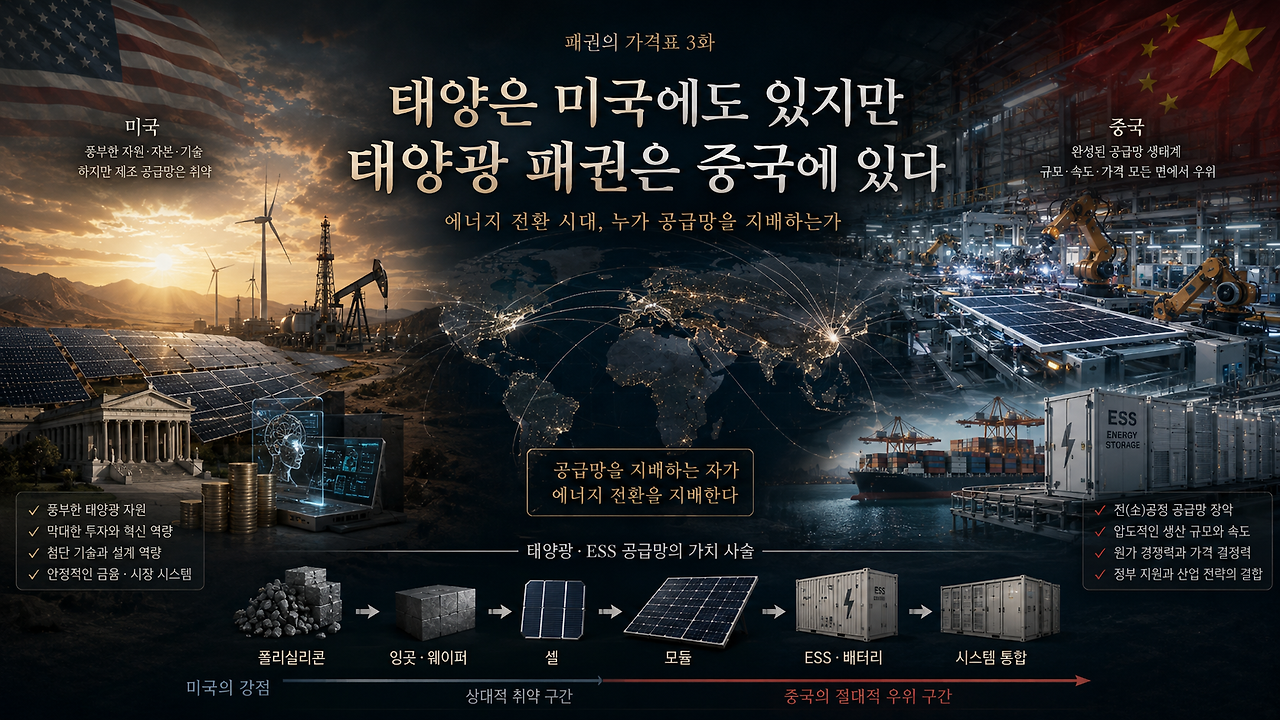
태양에는 국적이 없다.
미국 애리조나에 내리쬐는 햇빛과 중국 신장에 내리쬐는 햇빛이 다를 이유는 없다.
오히려 미국은 태양광 발전에 상당히 유리한 나라다.
남서부에는 넓은 사막이 있고, 일사량이 풍부하다. 텍사스와 대평원에는 풍력자원이 있고, 북서부에는 수력이 있다. 자본도 있고 기술도 있으며 세계 최고의 연구기관과 금융시장도 있다.
그러니 단순히 자연조건만 놓고 보면 미국이 재생에너지 시대에 뒤처질 이유가 없다.
그런데 태양광 패널 한 장을 분해해보면 이야기가 달라진다.
태양광 발전은 햇빛만으로 만들어지지 않는다.
규석을 정제하고, 폴리실리콘을 만들고, 그것을 잉곳으로 만든 뒤, 얇은 웨이퍼로 자르고, 셀을 만들고, 셀을 연결해 모듈을 만든다.
공장에서 완성된 패널은 다시 인버터와 송전망을 만나야 하고, 태양이 없는 시간까지 전기를 사용하려면 ESS와 같은 저장수단이나 다른 조정가능 전원도 필요하다.
태양은 공짜지만, 태양을 전기로 바꾸는 산업은 공짜가 아니다.
그리고 그 산업에서 지금 가장 강한 나라는 미국이 아니다.
중국이다.
패널 한 장 안에 들어 있는 패권
국제에너지기구(IEA)가 2026년 발표한 자료를 보면 중국은 태양광 공급망 전체 생산능력의 약 85%를 차지한다.
조금 더 깊숙이 들어가 웨이퍼를 보면 중국의 비중은 약 95%까지 올라간다. 리튬이온 배터리 공급망에서도 중국의 생산능력 비중은 약 80%, 배터리 음극재에서는 약 97%에 이른다. (IEA)
숫자만 봐서는 체감하기 어렵다.
IEA는 중국 내몽골의 한 태양광 웨이퍼 공장이 가진 생산능력만으로도 유럽연합과 인도의 태양광 수요를 합친 규모에 해당하는 웨이퍼를 생산할 수 있다고 설명한다. (IEA)
이쯤 되면 단순히 ‘중국이 태양광 패널을 많이 만든다’는 이야기가 아니다.
중국은 태양광이라는 산업에서 공장의 숫자만 많은 것이 아니라, 원료, 중간재, 부품, 완제품, 관련 장비와 협력업체까지 연결된 거대한 제조 생태계를 만들어놓았다.
이것이 중요하다.
어느 나라가 최종 조립공장을 하나 가지고 있다고 해서 그 산업을 지배하는 것은 아니다.
반도체를 생각해보면 이해하기 쉽다.
칩 하나를 마지막에 조립했다고 해서 반도체 공급망을 지배한다고 말하지 않는다.
장비가 필요하고, 소재가 필요하고, 설계가 필요하고, 웨이퍼가 필요하며, 공정기술이 필요하다.
태양광도 비슷하다.
모듈 하나를 미국에서 조립한다고 해서 태양광 공급망 전체가 미국산이 되는 것은 아니다.
실제로 미국 에너지부도 미국의 태양광 제조업을 확대하면서 최종 모듈 생산능력은 빠르게 늘어났지만, 웨이퍼와 셀 같은 상류공정이 상대적으로 뒤처져 있기 때문에 상당 기간 수입 의존이 필요하다고 지적해왔다. (The Department of Energy's Energy.gov)
그렇다면 질문이 생긴다.
어쩌다 이렇게 되었을까?
중국이 단순히 인건비가 싸서 이겼을까
예전에는 중국 제조업의 강점을 설명할 때 흔히 이런 말을 했다.
인건비가 싸기 때문이다.
틀린 이야기는 아니다.
태양광의 상류공정과 일부 청정에너지 제조업은 에너지와 노동비용의 영향을 많이 받는다.
하지만 2026년의 중국을 여전히 ‘값싼 노동력의 나라’만으로 설명하면 중요한 부분을 놓친다.
IEA 역시 중국의 청정에너지 제조 경쟁력에는 단 하나의 원인이 있는 것이 아니라고 분석한다.
노동비와 에너지비용뿐 아니라, 생산규모, 제조효율, 공급업체의 집적, 인프라, 자본, 숙련인력, 기술혁신, 안정적인 산업정바카라이 함께 작용한다.
특히 태양광에서는 규모의 경제가 중요하고, 배터리에서는 중국의 높은 제조효율이 경쟁국과의 생산비용 차이를 만드는 핵심 요인 가운데 하나다. (IEA)
내가 중요하게 보는 것은 바로 집적이다.
공장 하나를 세우는 것과 산업을 만드는 것은 다른 일이다.
어느 지역에 태양광 웨이퍼 회사가 있고, 바로 근처에 셀 제조사가 있고, 유리업체가 있고, 알루미늄 프레임업체가 있고, 공정장비 업체가 있고, 물류업체가 있으며, 숙련된 기술자들이 이미 존재한다면 생산비는 자연스럽게 내려간다.
신제품을 개발할 때도 빠르다.
문제가 생겼을 때 공급업체를 바꾸기도 쉽다.
생산량이 늘어날수록 원가는 더 떨어지고, 가격이 내려가면 세계 수요가 늘며, 다시 공장의 규모를 키울 수 있다.
규모가 가격을 낮추고, 낮은 가격이 다시 규모를 키운다.
중국은 오랜 시간에 걸쳐 이 순환을 만들어냈다.
그리고 어느 순간 다른 나라가 따라잡기 어려운 수준까지 커졌다.
석유와 태양광의 결정적인 차이
여기서 지난 화에서 이야기했던 미국의 석유를 다시 생각해볼 필요가 있다.
석유는 땅에서 뽑아낸다.
물론 정제와 운송, 기술이 중요하지만 기본적으로 유전이라는 자연자원은 이동하지 않는다.
미국 텍사스의 석유를 중국이 자기 나라로 옮겨갈 수는 없다.
셰일층도 마찬가지다.
미국 땅 아래에 있다.
그래서 셰일혁명 이후 미국은 아주 강한 위치를 확보할 수 있었다.
하지만 태양광은 다르다.
햇빛은 미국에도 있지만, 패널은 공장에서 만든다.
공장은 이동할 수 있다.
배터리도 마찬가지다.
리튬이 어느 나라에서 채굴됐는지만으로 공급망의 주인이 결정되는 것이 아니다.
그 리튬을 누가 정제하고, 양극재와 음극재로 만들고, 셀로 만들고, ESS와 자동차에 넣느냐가 더 중요해질 수 있다.
그래서 21세기의 에너지 패권은 과거와 조금 다른 모습으로 나타난다.
과거에는 “누가 석유를 가지고 있는가” 가 중요했다면, 미래에는 “누가 에너지를 만드는 장비와 그것의 공급망을 가지고 있는가”가 중요해질 수 있다.
이 차이를 미국보다 중국이 일찍 이해한 것인지도 모른다.
광물이 있다고 끝나는 것도 아니다
여기서 희토류 이야기도 자주 나온다.
다만 정확하게 구분할 필요가 있다.
태양광 패널이나 ESS에 들어가는 모든 광물이 희토류인 것은 아니다.
태양광에는 실리콘과 은, 알루미늄, 유리 등이 중요하고, 리튬이온 배터리에는 리튬·흑연과 배터리 화학에 따라 철·인산·니켈·코발트·망간 등이 사용된다.
희토류는 특히 영구자석을 사용하는 일부 풍력발전기와 전기모터 등에서 중요하다.
그러나 더 큰 관점에서 보면 이들 모두에게 공통점이 있다.
정제와 가공이다.
중국은 광산만 가지고 있는 나라가 아니다.
IEA에 따르면 중국은 현재 리튬·코발트·흑연·희토류 각각의 정제·가공에서 70%가 넘는 비중을 담당한다. (IEA)
이 차이는 굉장히 중요하다.
예를 들어 어떤 광물이 호주에서 채굴되고, 또 다른 광물이 아프리카에서 채굴되더라도, 그것이 중국으로 이동해 정제되고, 중국에서 소재가 되고, 중국 공장에서 부품으로 만들어진다면, 실질적인 산업의 병목은 중국에 있을 수 있다.
자원패권과 가공패권은 같은 것이 아니다.
그리고 중국은 후자에서 엄청난 힘을 만들었다.
ESS를 붙이면 문제는 더 커진다
태양광은 낮에 전기를 만든다.
하지만 우리가 전기를 사용하는 시간은 태양의 일정과 일치하지 않는다.
해가 지고 난 뒤에도 공장은 돌아가야 하고, 데이터센터도 전기를 먹는다.
그래서 태양광과 풍력의 비중이 높아질수록 전력망을 연결하고, 수요를 조절하고, 다른 발전원을 이용하거나 전기를 저장하는 시스템이 중요해진다.
대표적인 것이 ESS다.
그리고 현재 ESS 확대에서 가장 중요한 기술 가운데 하나가 리튬이온 배터리다.
그런데 배터리로 넘어가도 중국이 나온다.
2025년 중국은 전 세계 배터리 셀 생산량의 80% 이상을 차지했다.
전기차용 배터리의 양극활물질에서는 약 85%, 음극활물질에서는 90% 이상이 중국에서 생산됐다. (IEA)
그러니까 미국이 태양광 발전소를 빠르게 늘리는 문제를 단순화하면 이런 이상한 상황이 생길 수 있다.
햇빛은 미국 것이지만, 패널의 주요 공급망은 중국에 있고, 전기를 저장하는 배터리의 핵심 공급망 역시 중국에 있다.
미국 입장에서는 이것이 단순한 환경정바카라으로 보이지 않을 수 있다.
에너지 안보 문제가 된다.
석유 시대에는 중동에 의존하는 것이 걱정이었다.
그런데 에너지 전환을 서두르다 이번에는 중국에 의존하게 된다면 미국의 전략가들이 불편해하는 것은 당연하다.
그래서 미국도 알고 있었다
이 문제를 트럼프만 발견한 것도 아니다.
바이든 정부 역시 똑같은 취약성을 알고 있었다.
그래서 인플레이션감축법(IRA)을 통해 태양광, 배터리, 전기차와 핵심광물 공급망을 미국과 동맹국 중심으로 가져오려 했다.
태양광 모듈을 미국에서 만들고, 배터리 공장을 미국에 짓고, 중국 밖에서 핵심광물을 확보하려 했다.
즉 바이든과 트럼프 모두 문제의 상당 부분은 같게 보고 있었다고 생각할 수 있다.
중국에 지나치게 의존해서는 안 된다.
차이는 처방이었다.
바이든의 접근을 단순화하면, 중국이 지배하는 미래 산업을 미국으로 가져오자. 였다.
트럼프의 접근은 상대적으로, 우리가 이미 압도적으로 잘하는 에너지를 먼저 사용하자. 에 더 가깝다.
석유와 천연가스다.
그래서 이 문제는 ‘친환경 대통령과 반환경 대통령’만의 대결로 보면 제대로 보이지 않는다.
두 정바카라 모두 밑바닥에는 중국과의 산업경쟁이 깔려 있다.
그런데 중국도 석탄을 태운다
여기서 한쪽을 지나치게 미화해서도 안 된다.
중국이 세계 최대 규모로 태양광 패널과 배터리를 만든다고 해서 중국이 화석연료를 버린 나라는 아니다.
중국은 여전히 세계 최대 석탄 소비국이다.
그러니까 현재 벌어지는 경쟁은 미국은 화석연료, 중국은 친환경 이라는 단순한 대결이 아니다.
나는 오히려 이렇게 보는 편이 더 적절하다고 생각한다.
중국은 현재의 에너지 체제를 사용하면서 동시에 다음 에너지 체제의 제조업도 장악하려 한다.
미국 역시 석유와 가스를 포기하지 않으면서 청정에너지 산업을 키울 수 있다.
문제는 어느 쪽에 국가의 자본과 정바카라, 산업의 속도를 더 강하게 싣느냐에 있다.
그리고 지금 중국은 태양광과 배터리에서 이미 엄청난 생산규모를 만들어놓았다.
IEA는 현재 정바카라과 확정된 프로젝트를 기준으로 볼 때 이번 10년이 끝나기 전까지 세계 청정에너지 공급망의 높은 중국 집중도가 크게 달라지기는 어렵다고 보고 있다. (IEA)
이건 생각보다 큰 의미를 가진다.
공장은 하루아침에 생기지 않는다.
정제공정도, 숙련인력도, 협력업체도, 산업 생태계도 그렇다.
돈만 있다고 바로 살 수 없는 시간이 필요하다.
자유무역이 만들어낸 역설
여기에서 나는 대학에서 국제통상을 공부하던 시절의 이야기를 다시 생각하게 된다.
자유무역의 가장 기본적인 논리는 간단하다.
각 나라가 잘하는 것을 만들고, 가장 효율적인 곳에서 생산하면, 세계 전체가 더 싸게 상품을 사용할 수 있다.
실제로 중국이 태양광 패널을 대규모로 싸게 생산하면서 세계 태양광 발전의 가격이 낮아지는 데 큰 역할을 했다.
소비자 입장에서 보면 성공적인 세계화였다.
하지만 국가안보라는 렌즈를 씌우면 결과는 달라진다.
세계에서 가장 싸게 만드는 곳에 생산을 집중했더니, 어느 날 세계가 깨닫는다.
너무 많은 것을 한 나라에서 만들고 있었다.
가격은 내려갔지만 의존도는 올라갔다.
경제적 효율성은 높아졌지만 공급망의 위험도 함께 커졌다.
IEA도 공급망을 분석하며 아주 간단한 표현을 쓴다.
공급망은 가장 약한 연결고리만큼만 안전하다. (IEA)
바로 이 지점에서 자유무역과 경제 내셔널리즘이 충돌한다.
싸게 살 것인가?
내가 만들 것인가?
효율성을 선택할 것인가?
안보를 선택할 것인가?
오랫동안 세계경제는 첫 번째 질문에 더 많은 무게를 두었다.
트럼프의 미국은 두 번째 질문을 훨씬 강하게 던지고 있다.
태양에는 국적이 없지만 공장에는 국적이 있다
그래서 트럼프가 태양광을 바라보는 시선도 조금은 이해할 수 있다.
미국은 어렵게 석유와 천연가스에서 에너지 패권을 확보했다.
그런데 기후변화를 이유로 그 체제를 빠르게 바꾸려 하니, 새로운 산업의 중심에는 중국이 서 있었다.
그렇다면 미국은 고민할 수밖에 없다.
지금 당장 값싼 중국산 패널과 배터리를 사용해 에너지 전환을 빠르게 할 것인가?
아니면 비용이 더 들더라도 미국과 동맹국 안에서 새로운 공급망을 만들 때까지 속도를 조절할 것인가?
혹은 미국이 이미 가진 석유와 천연가스를 더 오래 사용할 것인가?
어느 선택도 공짜는 아니다.
여기에도 가격표가 붙는다.
중국산 제품을 사용하면 빠르고 싸게 에너지 전환을 할 수 있지만 공급망의 전략적 의존이라는 가격을 지불할 수 있다.
미국 내 공급망을 다시 만들면 안보는 강화되지만 더 높은 생산비용과 시간이 필요하다.
석유와 천연가스를 더 오래 사용하면 지금의 에너지 패권과 기존 인프라는 활용할 수 있지만 탄소배출과 기후변화라는 장기적 비용을 떠안게 된다.
그리고 바로 여기에서 《패권의 가격표》라는 이 카지노 게임의 질문이 다시 나타난다.
패권을 지키기 위해 우리는 무엇까지 지불할 수 있는가??
트럼프가 틀렸다고 결론을 내리기에는 아직 이르다.
중국에 공급망을 의존하지 않겠다는 문제의식 자체는 충분히 이해할 수 있다.
오히려 미국의 입장에서 묻는다면 이런 질문이 더 자연스러울 것이다.
세계 최대 산유국이면서 세계 최대 천연가스 생산국인 미국이 왜 자신이 지배하는 에너지 체제를 서둘러 버리고, 경쟁국이 제조업을 지배하는 에너지 체제로 들어가야 하는가.
강력한 질문이다.
그런데 나는 반대편에서도 묻고 싶다.
중국이 태양광 산업을 먼저 차지했다고 해서 미국이 태양광 시대 자체를 늦춘다면, 결국 중국의 우위를 더 오래 보장해주는 것은 아닐까?
태양은 사라지지 않는다.
배터리 시장도 사라지지 않을 가능성이 높다.
전력망과 ESS, 전기차와 청정에너지 제조업의 시장도 계속 커질 것이다. IEA는 주요 청정에너지 기술의 세계 시장가치가 현재 약 1조2천억 달러에서 2035년 약 3조 달러에 이를 것으로 전망한다. (IEA)
그렇다면 진짜 패권경쟁은 석유를 계속 쓸 것인가 말 것인가가 아닐 수도 있다.
다음 에너지 체제의 공장을 누가 갖는가?
그 싸움인지도 모른다.
태양은 미국에도 있다.
자본도 있다.
기술도 있다.
땅도 있다.
그런데 지금 태양광 패권은 중국에 있다.
자연이 중국을 선택해서가 아니다.
중국이 공장을 만들었기 때문이다.
그리고 미국이 다시 패권을 가져오고 싶다면 결국 선택해야 한다.
자신이 이미 이긴 석유의 시대를 최대한 오래 유지할 것인지.
아니면 자신이 뒤처진 새로운 에너지 산업에 막대한 비용을 지불하면서 다시 뛰어들 것인지.
바로 그 선택이 다음 이야기가 된다.
다음 화
석유를 버리면 패권도 중국에 넘겨주는가
트럼프가 석유를 선택한 이유를 이해했고, 중국이 태양광·배터리 공급망에서 얼마나 강한지도 살펴봤다.
그렇다면 이제 가장 어려운 질문이 남는다.
미국이 기후변화 대응을 위해 에너지 전환을 서두르는 것은 미래 패권을 준비하는 일일까. 아니면 중국이 지배하는 산업으로 스스로 들어가는 일일까.
4화에서는 트럼프의 선택과 바이든의 선택을 패권의 관점에서 직접 비교해보려고 한다.
Episode 3
The Sun Shines on America Too — But China Owns the Solar Age
Sunlight has no nationality. There is no reason for the light falling on the Arizona desert to be worth more or less than the light falling on Xinjiang. If anything, geography favors the United States: vast sun-drenched deserts in the Southwest, formidable wind corridors across Texas and the Great Plains, hydropower in the Pacific Northwest, deep capital markets, and some of the best research institutions in the world. On natural endowment alone, America has no reason to fall behind in the renewable era.
But take a solar panel apart, and the story changes.
Sunlight doesn't become electricity on its own. Quartz has to be refined into polysilicon, cast into ingots, sliced into wafers, built into cells, and wired into modules. Once assembled, the panel still needs an inverter and a grid to plug into — and if you want power after dark, you need storage, or some other source that can be dialed up on demand. The sun is free. The industry that turns sunlight into electricity is not. And the country that currently dominates that industry isn't the United States. It's China.
The Hegemony Inside a Single Panel
According to the International Energy Agency's 2026 report, China controls roughly 85% of global manufacturing capacity across the entire solar supply chain. Drill down to wafers specifically, and China's share climbs to nearly 95%. The pattern repeats in batteries: China holds about 80% of global lithium-ion battery manufacturing capacity, and close to 97% of anode material production.
The numbers alone are hard to feel. The IEA notes something more visceral: a single solar wafer facility in Inner Mongolia has enough capacity on its own to supply as much wafer output as the entire European Union and India combined.
This is no longer a story about China simply "making a lot of solar panels." China has built something closer to an entire industrial organism — raw materials, intermediate goods, components, finished products, equipment makers, and supporting contractors, all wired together.
That distinction matters. Owning a single final-assembly plant doesn't make a country the master of an industry — semiconductors make the point well. A country that merely packages a finished chip doesn't control the semiconductor supply chain; you also need the equipment, the materials, the design, the wafers, and the process technology behind it. Solar works the same way. Assembling modules on US soil doesn't make the whole supply chain American. The US Department of Energy itself has acknowledged as much: domestic module assembly capacity has grown quickly, but upstream stages — wafers, cells — remain comparatively underdeveloped, leaving the US dependent on imports for the foreseeable future.
So the question becomes: how did this happen?
It Wasn't Just Cheap Labor
The old explanation for Chinese manufacturing dominance was simple: cheap labor. That's not entirely wrong — energy and labor costs still matter a great deal in upstream solar processing and parts of clean-tech manufacturing. But treating 2026 China as merely "the country with cheap workers" misses the point.
The IEA's own analysis points to no single cause. It's a combination of production scale, manufacturing efficiency, supplier clustering, infrastructure, capital, skilled labor, technological innovation, and — critically — consistent, long-running industrial policy. In solar specifically, economies of scale matter most; in batteries, China's manufacturing efficiency is one of the central factors separating its production costs from everyone else's.
The piece I find most important is clustering. Building one factory and building an industry are not the same thing. When a wafer producer sits near a cell manufacturer, which sits near a glass supplier, an aluminum-frame maker, a processing-equipment vendor, a logistics company, and a deep bench of skilled technicians — costs fall almost automatically. New products move faster. Swapping suppliers when something goes wrong becomes trivial. And the flywheel keeps spinning: greater volume drives down costs, lower costs expand global demand, and expanding demand justifies building even more capacity.
Scale lowers the price, and the lower price expands the scale. China built that loop over decades, and at some point it grew large enough that catching up became genuinely hard.
The Crucial Difference Between Oil and Solar
This is where it's worth returning to the American oil story from the previous episode. Oil comes out of the ground. Refining, transport, and technology matter enormously, but the underlying resource — the oilfield itself — doesn't move. China cannot relocate the oil beneath Texas to its own territory. The same goes for shale formations: they sit under American soil, full stop. That immobility is precisely what let the shale revolution hand the United States such a commanding position.
Solar doesn't work that way. The sunlight may fall on American soil, but the panel is made in a factory — and factories can move. Batteries follow the same logic. Where the lithium was mined tells you surprisingly little about who owns the supply chain; what matters more is who refines it, who turns it into cathode and anode material, who builds the cells, and who puts them into an EV or a storage system.
Which means 21st-century energy hegemony may look different from the 20th-century version. In the old world, the operative question was "who has the oil?" In the new one, it may be "who owns the equipment that makes energy — and the supply chain behind it?" China may simply have understood that distinction earlier than the United States did.
Having the Minerals Isn't the Whole Story
Rare earths come up constantly in this conversation, and it's worth being precise about them. Not every mineral in a solar panel or a battery is a rare earth. Solar relies heavily on silicon, silver, aluminum, and glass; lithium-ion batteries depend on lithium and graphite, plus — depending on the chemistry — iron, phosphate, nickel, cobalt, or manganese. Rare earths matter most in permanent-magnet applications like some wind turbines and electric motors.
But zoom out, and all of these share something in common: refining and processing. China isn't just a country with mines. According to the IEA, China now handles more than 70% of global refining and processing capacity for lithium, cobalt, graphite, and rare earths, respectively.
That distinction is enormous. A mineral can be mined in Australia, another in Africa — but if both travel to China to be refined, turned into materials, and built into components in Chinese factories, the real industrial chokepoint sits in China regardless of where the ore came from. Resource hegemony and processing hegemony are not the same thing — and China has built extraordinary strength in the latter.
Add Storage, and the Problem Compounds
Solar generates electricity during the day. But demand doesn't follow the sun's schedule. Factories keep running after dark; data centers never stop drawing power. As solar and wind take up a larger share of the grid, the systems that connect, balance, and store that power — chiefly, energy storage systems — become correspondingly more important. And right now, the technology at the center of ESS expansion is the lithium-ion battery.
Follow that thread, and China appears again. In 2025, China accounted for more than 80% of global battery cell production. For EV batteries specifically, roughly 85% of cathode active material and more than 90% of anode active material were produced in China.
Simplify America's dilemma, and you get something almost absurd: the sunlight is American, but the panel's core supply chain runs through China — and so does the battery that stores the power it generates. Seen from Washington, this stops looking like an environmental policy question and starts looking like a national security problem. In the oil era, the anxiety was dependence on the Middle East. It's entirely predictable that American strategists would feel uneasy about racing toward a new energy system only to end up dependent on China instead.
Washington Already Knew This
Trump didn't discover this vulnerability. The Biden administration saw the same exposure and tried to address it through the Inflation Reduction Act — pulling the solar, battery, EV, and critical mineral supply chains toward the US and its allies: building modules domestically, standing up battery plants on US soil, securing minerals outside China's orbit.
In other words, both administrations largely agreed on the diagnosis — excessive dependence on China is a problem — and disagreed sharply on the prescription. Biden's approach, stripped to its essence, was: bring the industries China dominates back to America. Trump's approach leans more toward: lean harder into the energy America already dominates — oil and natural gas.
Read this way, the fight isn't really "the green president versus the anti-green president." Underneath both policies sits the same structural concern: industrial competition with China.
China Still Burns Coal
None of this should tip into romanticizing either side. Building the world's largest solar and battery manufacturing base hasn't made China a country that has abandoned fossil fuels — it remains the world's largest consumer of coal.
So the framing "America uses fossil fuels, China goes green" is too simple. A more accurate picture: China is running the current energy system while simultaneously working to capture manufacturing dominance in the next one. The United States, for its part, could in principle grow clean-energy industries without abandoning oil and gas. The real question is where a nation puts the weight of its capital, its policy, and its industrial urgency.
Right now, China has already built staggering scale in solar and batteries. Based on current policy and committed projects, the IEA expects China's outsized concentration across global clean-energy supply chains to remain largely intact before this decade ends — and that carries more weight than it might seem. Factories aren't built overnight. Neither are refining processes, skilled workforces, supplier networks, or industrial ecosystems. It takes time that money alone cannot buy.
The Paradox Free Trade Built
This brings me back to my old international trade classroom. The basic logic of free trade is simple: let each country make what it's best at, produce in the most efficient location, and the world as a whole gets to consume more cheaply. China's mass, low-cost production of solar panels genuinely helped drive down the global cost of solar power. From a consumer's standpoint, it was globalization working exactly as advertised.
Put on a national-security lens, though, and the picture flips. Concentrate production in whoever can make it cheapest, and eventually the world wakes up to an uncomfortable fact: too much of everything was being made in one place. Prices fell, but so did resilience; efficiency rose, but so did supply-chain risk. The IEA states the problem in one blunt line: a supply chain is only as secure as its weakest link.
This is exactly where free trade collides with economic nationalism. Buy it cheap, or make it yourself? Choose efficiency, or choose security? For decades, the global economy leaned heavily toward the first option in each pair. Trump's America is now pressing hard on the second.
The Sun Has No Nationality — The Factory Does
Seen this way, Trump's wariness of solar becomes easier to understand. America fought hard to secure energy hegemony in oil and gas. Then, in the name of fighting climate change, it was asked to pivot quickly toward a new system — only to find China standing at the center of it.
That leaves the US with an uncomfortable set of choices. Use cheap Chinese panels and batteries now, and accelerate the energy transition — at the price of strategic dependence on a rival's supply chain. Rebuild that supply chain domestically with allies, and strengthen security — at the price of higher costs and years of lost time. Or lean further into the oil and gas it already dominates — and keep collecting the bill for carbon emissions and climate change further down the road.
None of these options is free. Every one of them comes with its own price tag — which is exactly the question this magazine keeps circling back to: how much are we willing to pay to hold on to hegemony?
It's too early to conclude that Trump is simply wrong. The instinct not to hand a critical supply chain to a rival is entirely reasonable. Framed from America's side, the sharper question might actually run the other way:
Why should the world's largest oil producer and largest natural gas producer rush to abandon the energy system it dominates, in order to walk into one its rival controls?
That's a strong question. But I want to ask the mirror image of it, too:
If China got to solar manufacturing first, and America responds by slowing down the solar transition itself — doesn't that simply lock in China's advantage for longer?
The sun isn't going anywhere. The battery market almost certainly isn't either. Grids, storage, EVs, and clean-energy manufacturing will all keep growing — the IEA projects the global market value of major clean-energy technologies to roughly triple, from about $1.2 trillion today to roughly $3 trillion by 2035.
If that's true, the real contest for hegemony may not be "keep using oil or don't." It may be a simpler, harder question: who owns the factories of the next energy system?
America has the sun. The capital. The technology. The land. And yet solar hegemony, right now, belongs to China — not because nature chose China, but because China built the factories.
If the United States wants hegemony back, it eventually has to choose: hold on, for as long as possible, to the age of oil it has already won — or pay the enormous cost of catching up in the industry where it has fallen behind. That choice is where the story goes next.
Next Episode
If America Gives Up Oil, Does It Hand Hegemony to China?
We've seen why Trump chose oil, and just how dominant China has become across the solar and battery supply chains. That leaves the hardest question of all:
Is America's rush to accelerate its energy transition preparing it for future hegemony — or walking it straight into an industry China already controls?
Episode 4 puts Trump's choice and Biden's choice side by side, through the lens of hegemony itself.