네팔의 빙하가 무너졌을 때 나는 미국을 생각했다
네팔의 빙하가 무너졌을 때 나는 미국을 생각했다
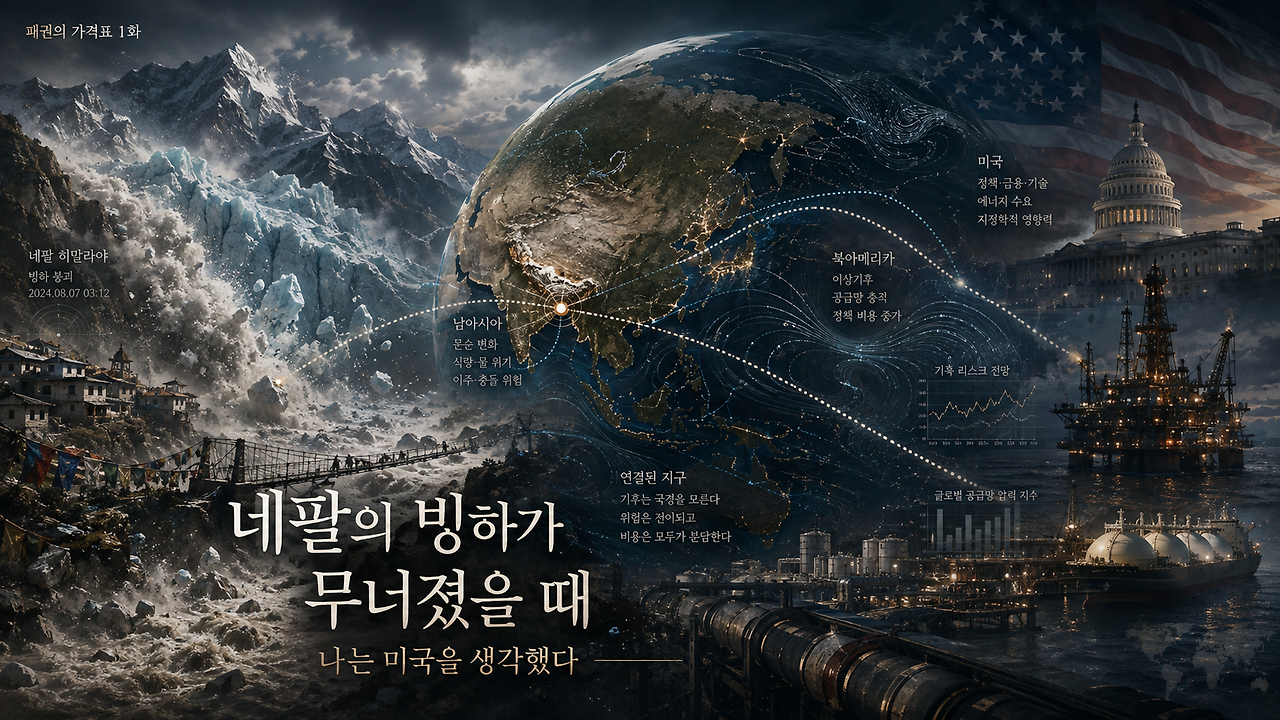
2026년 8월 26일, 네팔 랑탕 국립공원 인근에서 거대한 얼음과 암석이 무너졌다.
처음에는 지진으로 생각됐다. 그러나 미국지질조사국의 분석은 달랐다. 지진이 빙하를 무너뜨린 것이 아니라, 빙하와 암석의 붕괴 자체가 규모 5.2의 지진에 해당하는 에너지를 만들어냈다. 무너진 얼음과 암석은 물과 토사를 끌어안으며 거대한 흐름으로 변했고, 계곡과 강을 따라 거의 100킬로미터를 이동했다. 피해는 네팔을 넘어 중국 국경지역까지 이어졌다. (U.S. Geological Survey)
며칠 사이 사망자는 수백 명으로 늘었고, 수천 명의 행방을 알 수 없게 됐다. 도로와 다리가 끊겼고 발전시설과 마을이 토사에 묻혔다. 지금도 구조와 피해 집계가 이어지고 있다. (Reuters)
나는 그 뉴스를 한동안 바라봤다.
그런데 이상하게도 머릿속에 떠오른 나라는 네팔이 아니었다.
미국이었다.
정확히는 도널드 트럼프의 미국이었다.
이번 사고 하나를 놓고 “기후변화 때문에 발생했다”고 단정해서는 안 된다. 빙하는 원래 움직이고, 산은 무너지며, 히말라야는 지질학적으로도 불안정한 지역이다. 이번 붕괴에서 기후변화가 어느 정도 직접적인 역할을 했는지를 밝히려면 시간이 더 필요하다는 것이 과학자들의 설명이다. (Nature)
하지만 더 큰 흐름에서는 이야기가 달라진다.
히말라야의 빙하는 빠르게 줄어들고 있다. 힌두쿠시-히말라야 지역의 빙하는 1990년부터 2020년 사이 면적의 약 12%, 추정 얼음량의 약 9%를 잃었다. 2000년 이후에는 얼음 손실 속도가 두 배 수준으로 빨라졌다는 분석도 나왔다. (ICIMOD)
빙하만 녹는 것도 아니다.
높은 산의 암석과 흙 사이를 붙잡고 있던 영구동토층도 녹는다. 얼음이 줄어들면서 산비탈의 구조가 달라지고, 빙하호가 만들어지고, 과거에는 안정되어 있던 곳에서 새로운 산사태와 홍수의 가능성이 생긴다.
문제는 단순히 얼음의 양이 줄어드는 것이 아니다.
산의 질서가 바뀌고 있는 것이다.
나는 여기서 한 가지 질문이 생겼다.
이것이 정말 네팔만의 문제일까.
히말라야는 멀다.
서울에서도 멀고, 워싱턴에서도 멀다.
하지만 지도를 미국으로 옮겨보면 이야기가 달라진다.
미국에도 빙하가 있다. 알래스카는 말할 것도 없고, 미국 본토의 로키산맥에도 빙하와 영구적인 얼음지대가 남아 있다. 그 북쪽에는 훨씬 더 많은 빙하를 가진 캐나다가 있고, 다시 북쪽과 동쪽으로 올라가면 북극과 그린란드가 나온다.
네팔에서 보았던 얼음의 문제는 지도를 펼치는 순간 더 이상 네팔만의 이야기가 아니게 된다.
빙하는 강이 되고, 강은 호수로 들어가며, 얼음이 녹은 물은 결국 바다로 간다.
그 과정에서 수자원과 발전, 농업, 도시, 해수면, 바닷물의 염분과 해류까지 연결된다.
나는 그래서 이번 사고를 보며 빙하 자체보다 연결을 생각했다.
세계는 우리가 지도에 그어놓은 국경보다 훨씬 더 많이 연결되어 있다.
그런데 트럼프가 다시 대통령이 된 뒤 미국의 방향은 반대로 움직이고 있다.
미국에서 더 많은 에너지를 생산하고, 자국의 석유와 천연가스와 석탄을 적극적으로 이용하며, 에너지 생산을 가로막는다고 판단한 규제를 줄이는 것이다.
트럼프 행정부는 이를 ‘에너지 지배(Energy Dominance)’라고 표현한다. 2025년 취임 첫날 행정명령에서도 석유·천연가스·석탄 등의 국내 생산을 확대하고 값싸고 안정적인 에너지를 제조업과 국가안보의 기반으로 삼겠다는 방향을 분명히 했다. (The White House)
풍력과 태양광에는 훨씬 냉정하다.
트럼프 행정부는 이들 전원을 비싸고 불안정하다고 비판하는 동시에, 관련 공급망이 외국의 적대적 국가에 의존할 위험이 있다는 점도 강조하고 있다. 2025년에는 풍력·태양광 지원을 축소하는 정바카라을 추진하면서 이를 에너지 안보와 연결했다. (The White House)
처음에는 나도 이 선택을 단순하게 생각했다.
트럼프는 기후변화보다 석유산업을 중요하게 생각하는구나.
하지만 조금 더 들여다보니 그렇게 간단한 문제가 아니었다.
미국에는 석유가 있다.
천연가스도 있다.
이를 뽑아낼 기술이 있고, 파이프라인이 있고, 정유시설이 있고, LNG 수출기지가 있다.
이미 만들어놓은 거대한 산업이 있다.
반대로 태양광 패널과 배터리, 그 원료의 정제와 가공으로 들어가면 다른 나라가 등장한다.
중국이다.
그러면 트럼프의 선택은 단순히 ‘석유냐 환경이냐’의 문제가 아니게 된다.
자신이 패권을 가지고 있는 에너지 체제를 유지할 것인가.
아니면 중국이 훨씬 강한 공급망을 가진 새로운 에너지 체제로 이동할 것인가.
이 질문은 생각보다 어렵다.
그리고 이 이야기는 다음 글에서 자세히 다뤄보려고 한다.
하지만 네팔의 빙하를 보면서 내가 먼저 생각한 것은 그보다 앞선 문제였다.
트럼프의 정치에는 명확한 경계가 있다.
미국과 중국.
미국과 캐나다.
미국과 유럽.
미국의 노동자와 외국의 노동자.
미국의 공장과 외국의 공장.
누가 비용을 부담하고, 누가 이익을 얻는지를 구분한다.
국가를 운영하는 대통령이라면 당연히 해야 하는 계산이기도 하다.
그런데 기후에는 그 선을 그을 수 없다.
미국은 중국산 제품에 관세를 부과할 수 있다.
캐나다와 새로운 무역조건을 협상할 수도 있다.
파리협정에서도 탈퇴할 수 있다.
하지만 미국 영공 위의 대기만 따로 떼어낼 수는 없다.
빙하 역시 마찬가지다.
히말라야에서 녹은 얼음은 히말라야에만 머무르지 않는다.
그린란드에서 녹은 얼음도 그린란드 안에서 끝나지 않는다.
바다는 연결되어 있고 대기도 연결되어 있다.
그래서 기후변화는 경제 내셔널리즘에 아주 이상한 질문을 던진다.
국가의 이익만을 우선하면 정말 그 국가의 이익을 지킬 수 있는가.
미국이 화석연료 사용을 당장 줄인다고 해서 네팔의 빙하가 다시 얼어붙는 것도 아니다. 중국과 인도, 유럽과 수많은 국가가 함께 움직여야 한다.
그렇기 때문에 오히려 세계에서 가장 강한 국가의 선택이 중요해진다.
패권국은 혼자서 세상을 바꿀 수 있기 때문에 패권국인 것이 아니다.
다른 나라를 움직일 수 있기 때문에 패권국이다.
여기서 나는 이 카지노 게임의 제목을 다시 생각한다.
패권의 가격표.
미국은 오랫동안 다른 국가보다 많은 비용을 부담했다.
군대를 해외에 주둔시켰고, 동맹을 유지했고, 국제기구를 만들었고, 세계의 항로를 지켰다.
물론 그 모든 일이 자선사업은 아니었다.
그 대가로 미국은 세계의 규칙을 만드는 국가가 됐다.
달러가 국제통화가 되었고, 미국 기업이 세계시장으로 나갔으며, 수많은 나라가 미국을 중심으로 안보와 경제질서를 구성했다.
그러니까 패권에는 원래 가격표가 붙어 있었다.
트럼프는 그 가격표를 다시 들여다보고 있는 대통령처럼 보인다.
왜 우리가 동맹국보다 더 많은 돈을 내야 하는가.
왜 우리가 기후변화 대응을 위해 더 많은 비용을 부담해야 하는가.
왜 미국의 기업과 노동자가 중국과의 경쟁에서 손해를 보아야 하는가.
충분히 가능한 질문이다.
하지만 네팔의 빙하가 무너지는 모습을 보면서 나는 반대 질문을 떠올렸다.
그 돈은 정말 낭비였을까.
그리고 또 하나.
그 비용을 아낀 뒤 찾아오는 비용은 얼마나 될까.
아직 나는 답을 모르겠다.
트럼프의 선택이 미국을 더 강하게 만들 수도 있다. 값싼 자국 에너지로 제조업을 다시 일으키고, 중국에 의존하지 않는 공급망을 만들고, 동맹국이 더 많은 비용을 부담하게 하면서 미국의 부담을 줄이는 데 성공할 수도 있다.
하지만 반대의 가능성도 있다.
현재 미국이 강한 산업을 지키는 동안 미래 산업의 주도권이 다른 나라로 넘어가고, 동맹국들은 미국 없는 세계를 준비하기 시작하며, 기후변화의 비용이 결국 미국의 국경 안으로 돌아올 수도 있다.
그래서 나는 지금 결론을 내리지 않으려고 한다.
대신 하나씩 따라가 보려고 한다.
왜 트럼프는 석유를 선택했는가?
왜 미국처럼 태양과 바람이 풍부한 나라가 재생에너지 전환에 제동을 걸었는가.
태양광과 배터리 산업에서 중국은 어떻게 그렇게 강해졌는가.
동맹은 미국에 비용인가, 아니면 패권을 가능하게 하는 자산인가.
그리고 빙하가 계속 녹는다면 그 변화는 어디까지 이어질 것인가.
그 시작은 네팔이었다.
2026년 8월, 히말라야의 얼음과 바위가 무너졌다.
그리고 그 모습을 보며 나는 아주 멀리 떨어져 있는 나라를 생각했다.
세계에서 가장 강한 나라.
세계의 질서를 가장 오랫동안 설계해온 나라.
그리고 지금, 그 질서를 유지하기 위해 자신이 지불했던 비용을 하나씩 다시 계산하고 있는 나라.
미국이었다.
다음 화|트럼프는 왜 다시 석유를 선택했나
기후위기의 시대에 트럼프가 화석연료로 돌아간 이유를 단순한 환경정바카라이 아니라 에너지 패권과 미국·중국의 공급망 경쟁이라는 관점에서 살펴본다.
Episode 1
When Nepal's Glacier Collapsed, I Thought of America
On August 26, 2026, a massive collapse of ice and rock occurred near Langtang National Park in Nepal.
At first it was thought to be an earthquake. But the U.S. Geological Survey's analysis told a different story: it wasn't an earthquake that brought the glacier down — the collapse of the glacier and rock itself generated energy equivalent to a magnitude 5.2 earthquake. The falling ice and rock swept up water and sediment and turned into a massive flow, traveling nearly 100 kilometers along the valleys and rivers. The damage reached beyond Nepal into the border region with China.
Within days, the death toll climbed into the hundreds, and thousands more were unaccounted for. Roads and bridges were severed, and power facilities and villages were buried under debris. Rescue efforts and damage assessments are still ongoing.
I sat with that news for a while.
Strangely, though, the country that came to mind wasn't Nepal.
It was the United States.
More precisely, Donald Trump's United States.
We shouldn't leap to conclude that this single disaster was "caused by climate change." Glaciers move on their own, mountains collapse, and the Himalayas are geologically unstable to begin with. Scientists say it will take more time to determine how directly, if at all, climate change contributed to this particular collapse.
But zoom out to the larger trend, and the picture changes.
The Himalayan glaciers are shrinking fast. Glaciers across the Hindu Kush-Himalaya region lost roughly 12% of their area and about 9% of their estimated ice mass between 1990 and 2020. Some analyses suggest the rate of ice loss has roughly doubled since 2000.
It isn't only the glaciers that are melting.
The permafrost that holds together the rock and soil of high mountains is thawing too. As the ice recedes, the structure of mountain slopes shifts, glacial lakes form, and new risks of landslides and floods emerge in places that were once stable.
The problem isn't simply that there's less ice than before.
The order of the mountains themselves is changing.
That raised a question for me.
Is this really only Nepal's problem?
The Himalayas are far away.
Far from Seoul, far from Washington.
But unfold the map toward America, and the story changes.
The United States has glaciers too. Alaska goes without saying, but even the Rocky Mountains in the continental US still hold glaciers and permanent ice fields. To the north lies Canada, with far more glaciers still, and further north and east lie the Arctic and Greenland.
The moment you open up the map, the ice problem I saw in Nepal stops being only Nepal's story.
Glaciers become rivers; rivers flow into lakes; and meltwater eventually reaches the sea.
Along the way, it connects to water resources, power generation, agriculture, cities, sea levels, and even ocean salinity and currents.
So watching this disaster, what I found myself thinking about wasn't the glacier itself, but connection.
The world is far more interconnected than the borders we've drawn on maps.
And yet, since Trump returned to the presidency, America's direction has been moving the opposite way.
Producing more energy domestically. Actively using its own oil, natural gas, and coal. Rolling back regulations it judges to be obstacles to energy production.
The Trump administration calls this "Energy Dominance." In an executive order signed on his very first day in office in 2025, the administration made clear its direction: expand domestic production of oil, natural gas, and coal, and make cheap, stable energy the foundation of manufacturing and national security.
Wind and solar get a much colder reception.
The Trump administration criticizes these power sources as expensive and unreliable, while also emphasizing the risk that their supply chains depend on hostile foreign countries. In 2025, it pushed policies to cut back support for wind and solar, framing the move as a matter of energy security.
At first, I thought about this choice in simple terms too.
Trump values the oil industry more than climate change.
But looking a little closer, it wasn't that simple.
America has oil.
It has natural gas too.
It has the technology to extract them, the pipelines, the refineries, the LNG export terminals.
It already has a massive industry built and ready.
But go the other direction — into solar panels, batteries, and the refining and processing of their raw materials — and another country appears.
China.
Which means Trump's choice isn't simply a matter of "oil versus the environment."
It's a question of whether to hold on to the energy regime in which America holds hegemony —
or move toward a new energy regime where China holds a far stronger supply chain.
That question is harder than it looks.
And I plan to dig into it in detail in the next piece.
But watching Nepal's glacier, what I thought of first was a question that comes before that one.
Trump's politics draws clear lines.
America and China.
America and Canada.
America and Europe.
American workers and foreign workers.
American factories and foreign factories.
Who bears the cost, and who reaps the benefit.
That's a calculation any president running a country has to make.
But climate doesn't allow you to draw that line.
America can impose tariffs on Chinese goods.
It can renegotiate trade terms with Canada.
It can even withdraw from the Paris Agreement.
But it cannot cordon off just the atmosphere above American airspace.
The same goes for glaciers.
Ice that melts in the Himalayas doesn't stay in the Himalayas.
Ice that melts in Greenland doesn't end within Greenland's borders either.
Oceans are connected. The atmosphere is connected.
So climate change poses a very strange question to economic nationalism.
If a nation puts only its own interest first, does it actually protect that interest?
Even if the US cuts its fossil fuel use immediately, that won't refreeze Nepal's glaciers. China, India, Europe, and countless other nations need to move together.
Which is exactly why the choices of the world's most powerful nation matter so much.
A hegemon isn't a hegemon because it can change the world by itself.
It's a hegemon because it can move other nations to act.
Here I find myself returning to the title of this magazine.
The Price of Hegemony.
For a long time, the United States bore more cost than other nations.
It stationed its military abroad, maintained alliances, built international institutions, and guarded the world's shipping lanes.
None of that, of course, was charity.
In exchange, America became the nation that wrote the rules of the world.
The dollar became the international currency. American companies expanded into global markets. Countless nations built their security and economic order around the United States.
So hegemony always came with a price tag attached.
Trump looks like a president who is going back and re-examining that price tag.
Why should we pay more than our allies?
Why should we bear more of the cost of fighting climate change?
Why should American companies and workers come out losing in competition with China?
These are all fair questions to ask.
But watching Nepal's glacier collapse, I found myself asking the opposite question.
Was that money really wasted?
And one more thing.
How large is the bill that comes due after you save that money?
I still don't know the answer.
Trump's choices could make America stronger. Cheap domestic energy could revive manufacturing, build supply chains independent of China, and shift more of the cost onto allies — succeeding in lightening America's own burden.
But the opposite is possible too.
While America protects the industries that are strong today, leadership in tomorrow's industries could slip to other countries. Allies could start preparing for a world without America. And the costs of climate change could eventually come back across America's own borders.
So for now, I'm not trying to reach a conclusion.
Instead, I want to trace it piece by piece.
Why did Trump choose oil?
Why did a country as rich in sun and wind as America put the brakes on its renewable energy transition?
How did China grow so dominant in solar and battery industries?
Are alliances a cost to America — or an asset that makes hegemony possible in the first place?
And if the glaciers keep melting, how far will that change reach?
It began in Nepal.
In August 2026, ice and rock collapsed in the Himalayas.
And watching it happen, I thought of a country very far away.
The most powerful nation in the world.
The nation that has designed the world's order longer than any other.
And now, a nation recalculating, one line at a time, the price it once paid to maintain that order.
It was the United States.
Next Episode | Why Trump Chose Oil Again In an age of climate crisis, we look at why Trump turned back to fossil fuels — not as a simple environmental policy, but through the lens of energy hegemony and the US-China supply chain competition.