2011년, 국제통상론에서 들엇던 이야기
머리말
2011년, 국제통상론에서 들었던 이야기
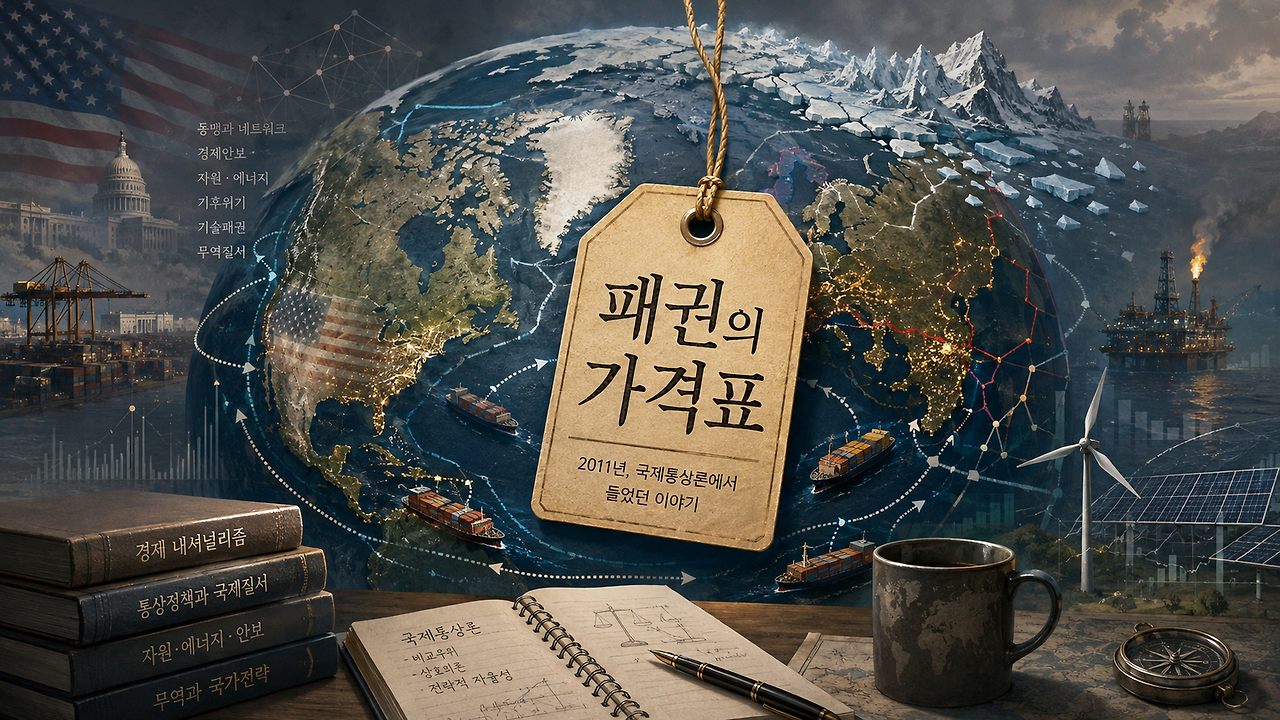
2011년, 나는 대학에서 국제통상론을 들었다.
수업에서는 자유무역과 보호무역, 국가 간 이해관계와 세계경제의 흐름을 배웠다. 그러나 내가 유독 오래 기억하고 있는 것은 교과서의 무역이론보다 당시 조영정 교수님이 자주 이야기했던 민족주의와 자유경제, 그리고 세계경제의 블록화였다.
당시는 지금과 분위기가 많이 달랐다.
세계화는 여전히 거스를 수 없는 흐름처럼 보였다. 중국은 세계의 공장이 되어가고 있었고, 자유무역협정은 계속 확대됐다. 기업들은 더 싼 생산지를 찾아 국경을 넘었고, 자본과 상품의 이동은 점점 자유로워졌다. 적어도 경제만 놓고 보면 국경의 의미는 계속 희미해질 것처럼 보였다.
하지만 교수님은 다른 가능성도 이야기하셨다.
경제가 아무리 자유로워져도 국가는 사라지지 않는다는 것. 국가의 이해관계가 충돌하면 민족주의는 다시 강해질 수 있고, 세계경제 역시 하나의 시장으로만 나아가는 것이 아니라 서로 다른 이해관계를 가진 경제권으로 다시 블록화될 수 있다는 이야기였다.
당시에는 흥미로운 이론이었다.
나는 그해 대학을 졸업했고, 교수님은 이후 학교를 떠나 스탠퍼드대학교로 가셨다. 졸업 후 그때의 이야기를 다시 나눠볼 기회는 없었다.
그리고 15년이 흘렀다.
2026년의 세계를 보고 있으면 이상하게 그 수업이 자주 떠오른다.
미국은 관세를 다시 무기로 사용하고 있다. 중국과 미국은 단순히 상품을 사고파는 경쟁을 넘어 반도체, 배터리, 핵심광물, 에너지와 공급망을 놓고 충돌하고 있다. 기업의 생산기지가 어디에 있는지가 다시 국가안보의 문제가 되었고, 동맹국조차 얼마를 부담하고 무엇을 미국에 제공하는지 계산의 대상이 되었다.
자유경제를 세계에 가장 강하게 확산시켰던 미국에서 오히려 경제 내셔널리즘이 강하게 나타나고 있는 것이다.
그 중심에 도널드 트럼프가 있다.
트럼프의 선택은 언뜻 단순해 보인다.
미국에서 석유와 가스를 더 생산한다.
중국산 제품에는 관세를 부과한다.
미국으로 공장을 돌아오게 한다.
동맹국에는 안보 비용을 더 부담하라고 요구한다.
모두 하나의 문장으로 설명할 수 있다.
미국의 돈은 미국을 위해 사용해야 한다.
그런데 나는 최근 네팔의 빙하가 무너지는 모습을 보면서 오래전 국제통상론 수업에서 생각하지 못했던 변수를 하나 떠올렸다.
기후였다.
경제에는 국경을 만들 수 있다.
미국은 중국산 제품에 관세를 부과할 수 있고, 중국 기업의 공급망을 차단할 수도 있다. 캐나다와 무역조건을 다시 협상할 수도 있고, 유럽에 더 많은 방위비를 요구할 수도 있다.
그러나 대기에는 관세를 부과할 수 없다.
네팔의 빙하가 녹는 것을 네팔 안에서 끝나게 할 수도 없고, 캐나다의 빙하와 수계에 국경선을 그을 수도 없다. 그린란드에서 흘러나오는 담수에 여권을 요구할 수도 없으며, 북대서양의 해류에 어느 국가의 영해까지만 움직이라고 명령할 수도 없다.
그런데 바로 이런 시대에 미국은 다시 화석연료를 국가 경쟁력의 중심으로 가져오고 있다.
물론 그 선택에는 이유가 있다.
미국은 세계 최고의 석유·천연가스 생산능력과 이미 완성된 관련 산업 인프라를 가지고 있다. 반면 태양광 패널과 배터리, 핵심광물의 정제와 가공, 에너지저장장치의 공급망에서는 중국이 압도적인 영향력을 갖고 있다.
미국 입장에서 에너지 전환은 단순히 석유를 태양광으로 바꾸는 문제가 아니다.
어쩌면 자신이 패권을 가진 에너지 체제에서, 중국이 더 강한 에너지 체제로 이동하는 문제일 수도 있다.
그래서 트럼프의 선택은 생각보다 단순하지 않다.
그리고 바로 그 때문에 나는 이 글을 쓰려고 한다.
이 카지노 게임은 트럼프가 옳은지 틀린지를 판정하려는 글이 아니다.
나는 오히려 그가 왜 그런 선택을 했는지를 먼저 이해해보려고 한다. 그리고 그 선택이 미국에 무엇을 가져다주고, 반대로 무엇을 잃게 할 수 있는지를 따라가려고 한다.
석유와 태양광을 이야기할 것이다.
중국의 공급망을 이야기할 것이고, 캐나다와 미국의 관계를 이야기할 것이다. 동맹이 정말 비용인지도 생각해볼 것이다. 빙하가 녹으면서 변하는 담수와 바다, 그리고 북대서양의 거대한 해류까지 따라가 볼 생각이다.
그 끝에서 다시 하나의 질문으로 돌아오려고 한다.
미국은 지난 수십 년 동안 세계에서 가장 많은 비용을 부담한 국가 가운데 하나였다.
동맹을 유지하는 데 돈을 썼고, 세계질서를 유지하는 데 돈을 썼으며, 때로는 다른 나라보다 더 많은 부담을 떠안았다.
트럼프는 그 모든 것에 가격표를 붙이고 있다.
왜 미국이 이 비용을 부담해야 하는가.
충분히 물어볼 수 있는 질문이다.
하지만 나는 반대편의 질문도 해보고 싶다.
혹시 그 비용을 지불했기 때문에 미국이 패권국이 될 수 있었던 것은 아닐까?
2011년 국제통상론에서 시작된 질문을, 15년이 지난 지금 다시 꺼내본다.
경제는 다시 국경을 세우고 있다.
그런데 우리는 이제 또 하나를 물어야 한다.
기후에도 국경을 세울 수 있을까?
그리고 그 질문에 대한 미국의 선택에는 과연 얼마의 가격표가 붙어 있을까?
《패권의 가격표》는 그 가격을 따라가 보는 기록이다.
A Story I Heard in International Trade Theory, 2011
In 2011, I took a course on International Trade Theory at university.
The class covered free trade and protectionism, the interests of nations, and the currents of the global economy. But what I remember most vividly isn't the textbook trade theory — it's what Professor Cho Young-jeong talked about again and again back then: nationalism, the free economy, and the blocization of the world economy.
The mood was very different at the time.
Globalization still looked like an unstoppable current. China was becoming the world's factory, and free trade agreements kept expanding. Companies crossed borders in search of cheaper places to produce, and the movement of capital and goods grew freer and freer. At least on the economic front, it seemed like the meaning of borders would only keep fading.
But the professor also raised another possibility.
No matter how free the economy becomes, he said, the nation-state doesn't disappear. When national interests collide, nationalism can grow strong again, and the world economy might not move toward a single market after all — it could re-block into separate economic zones with competing interests.
At the time, it was an interesting theory.
I graduated that year, and the professor later left the school for Stanford University. After graduation, I never had the chance to revisit that conversation with him.
Fifteen years have passed since then.
Looking at the world in 2026, that class oddly comes to mind again and again.
The United States is once more wielding tariffs as a weapon. The US and China are no longer just competing over who sells more goods — they're clashing over semiconductors, batteries, critical minerals, energy, and supply chains. Where a company's production base sits has again become a matter of national security, and even allies now find themselves the subject of calculations over how much they should pay and what they should offer the United States.
In the very country that spread the free economy across the world more forcefully than any other, economic nationalism is now surging.
At the center of it all is Donald Trump.
Trump's choices look simple at first glance.
Produce more oil and gas domestically. Impose tariffs on Chinese goods. Bring factories back to the United States. Demand that allies shoulder more of the security burden.
All of it can be summed up in a single sentence:
America's money should be spent for America.
But recently, watching the glaciers collapse in Nepal, I found myself thinking of a variable I hadn't considered back in that international trade class.
Climate.
Borders can be drawn around an economy.
The US can impose tariffs on Chinese goods, cut off a Chinese company's supply chain. It can renegotiate trade terms with Canada, or demand that Europe pay more for its own defense.
But no tariff can be placed on the atmosphere.
You cannot contain a melting Nepalese glacier within Nepal's borders, or draw a boundary line across Canada's glaciers and watersheds. You cannot demand a passport from the freshwater flowing out of Greenland, or order the currents of the North Atlantic to stop moving at the edge of some nation's territorial waters.
And yet, in precisely this era, the United States is once again placing fossil fuels at the center of its national competitiveness.
Of course, there's a reason for that choice.
The US holds the world's top oil and natural gas production capacity, along with an already-built industrial infrastructure to support it. China, meanwhile, holds overwhelming influence over the supply chains for solar panels, batteries, the refining and processing of critical minerals, and energy storage systems.
For the United States, the energy transition isn't simply a matter of swapping oil for solar power.
It may, in fact, be a matter of moving from an energy regime where America holds hegemony to one where China holds a stronger position.
Which is why Trump's choice is less simple than it looks.
And that's exactly why I'm writing this.
This piece isn't an attempt to judge whether Trump is right or wrong.
Instead, I want to first try to understand why he made the choices he did. And I want to trace what those choices might bring the United States — and, conversely, what they might cost it.
I'll talk about oil and solar power.
I'll talk about China's supply chains, and about the relationship between Canada and the United States. I'll think about whether alliances are really just a cost. I'll follow the changing freshwater and oceans as glaciers melt, all the way out to the vast currents of the North Atlantic.
And at the end of it, I want to return to a single question.
For decades, the United States was one of the countries that bore the heaviest costs in the world.
It spent money to maintain its alliances, spent money to maintain the world order, and at times shouldered a heavier burden than any other nation.
Trump is now putting a price tag on all of it.
Why should America bear this cost?
It's a fair question to ask.
But I want to ask the question from the other side, too.
Isn't it possible that paying that cost is precisely what allowed America to become the hegemon in the first place?
A question that began in an international trade class in 2011, I'm picking back up now, fifteen years later.
The economy is building borders again.
But now there's another question we have to ask.
Can borders be built around climate, too?
And just how large is the price tag on America's answer to that question?
The Price of Hegemony is a record that follows that price.