Brokerages are...
Brokerages are being undervalued
Brokerages are being undervalued in the 8,000-point era
Brokerages are being undervalued in the 8,000-point era
Korean securities firms just posted their best quarter in history — and the market barely noticed. Here's why, and which of the "Big Three" deserves your money in the second half.
Korean brokerages just had the best quarter in the industry's history. Combined net income across the sector hit ₩4.33 trillion (~$3.1B) in Q1 2026 — a record by a wide margin, riding a historic bull run that pushed the KOSPI past 8,000 for the first time ever.
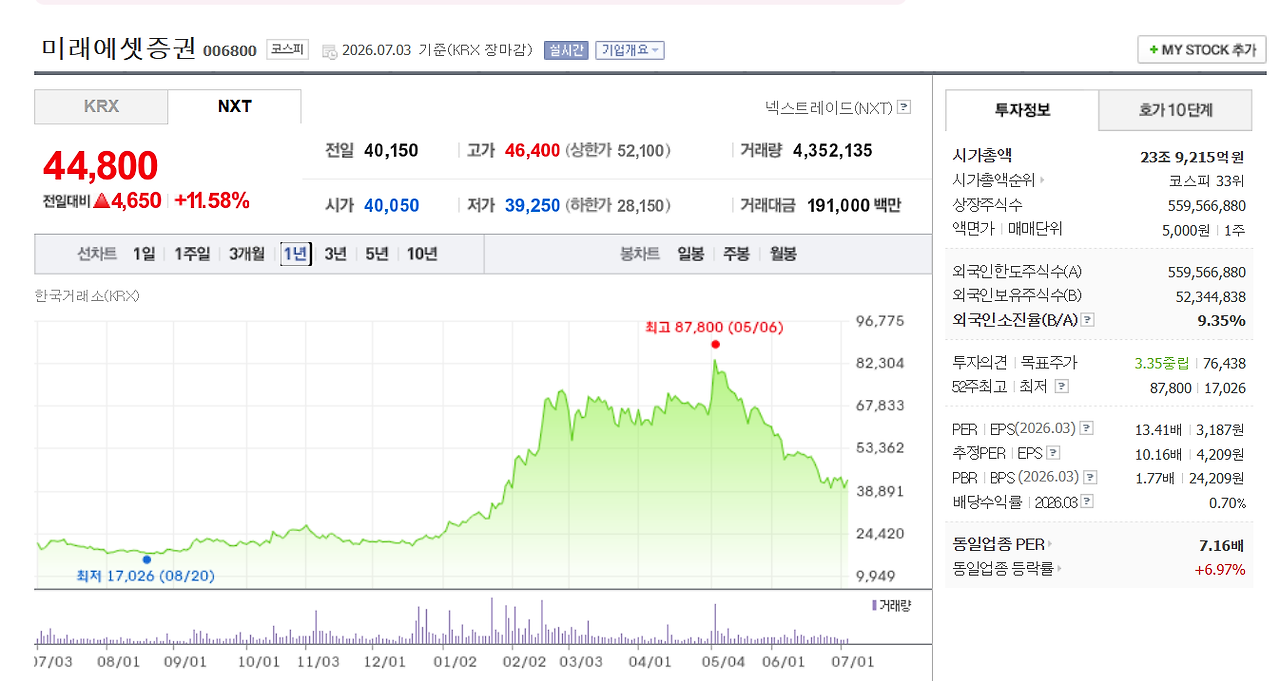
And yet brokerage stocks are some of the cheapest names on the board. That's the paradox worth unpacking: as money floods into semiconductor megacaps, brokerage valuations have been left behind. Major players are trading at 0.4–0.6x P/E and P/B — near historic lows — while their implied dividend yields sit at 6–7%.
Heading into a second-half rotation that could finally close that gap, the real question is which of Korea's Big Three — Mirae Asset, Kiwoom, and Korea Investment & Securities (KIS) — deserves the money. Each is making a genuinely different bet.
1. Betting on scale and global disruption: Mirae Asset Securities
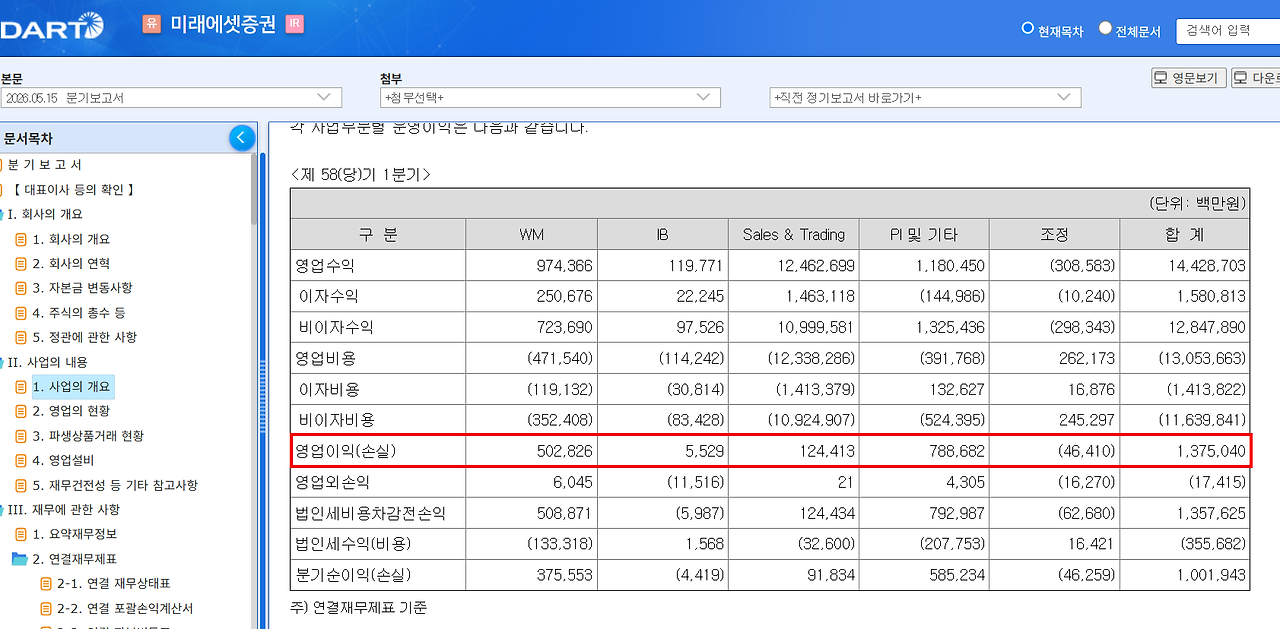
If you believe in territorial expansion and the raw force of proprietary capital, Mirae Asset is the name. The firm posted ₩1.0019 trillion (~$716M) in Q1 2026 consolidated net income — the first time any Korean brokerage has cleared ₩1 trillion in net income in a single quarter.
That record wasn't built on trading commissions. It came from years of aggressive principal investment (PI) — proprietary bets on global growth companies — made under founder Park Hyeon-joo. The single biggest driver: a stake in SpaceX, whose valuation surge alone generated roughly ₩804 billion (~$574M) in trading and PI gains in Q1. If SpaceX's rumored Nasdaq listing materializes in Q2, Mirae Asset could book up to ₩2 trillion (~$1.4B) in additional mark-to-market gains — giving it the strongest earnings momentum of the three heading into mid-year.
Mirae Asset's business spans five pillars: an 11-country global network, a full-service investment bank (IPOs, bonds, acquisition finance, project finance, alternatives), sales & trading across equities, bonds, FX and derivatives, an industry-leading wealth management arm built on overseas equities and pension assets, and the PI book that's currently doing the heavy lifting.
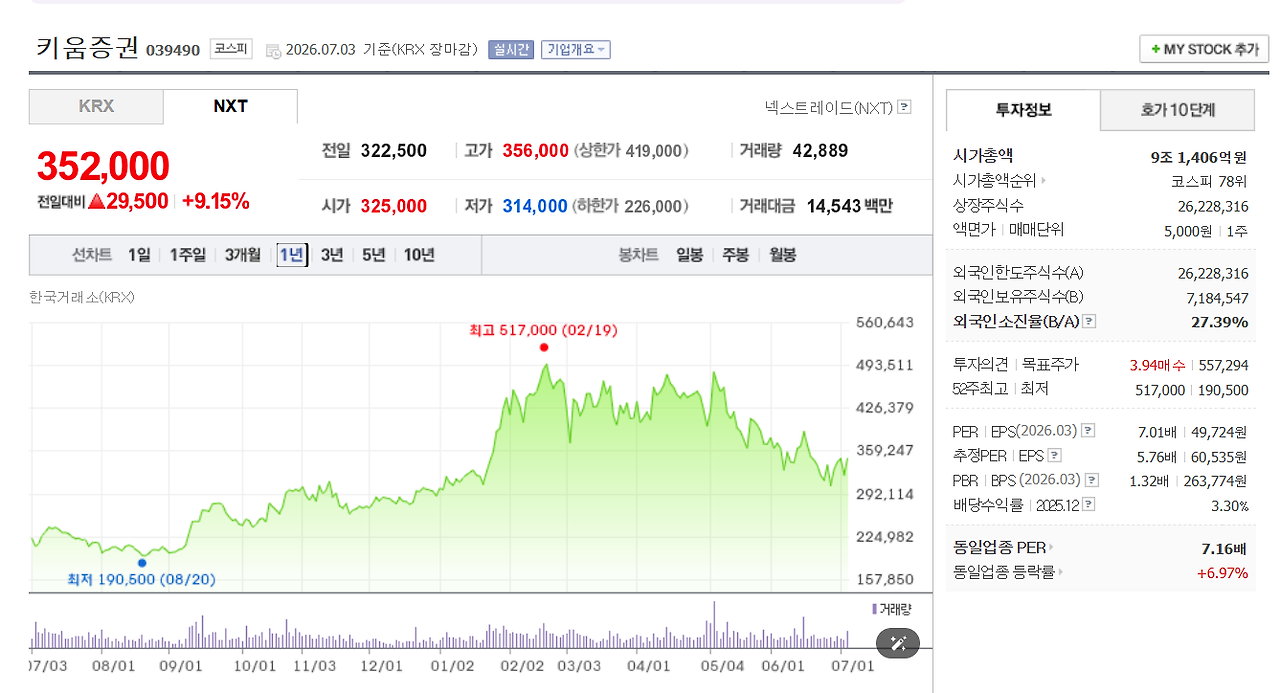
2. Betting on capital efficiency and a clean "value-up" story: Kiwoom Securities
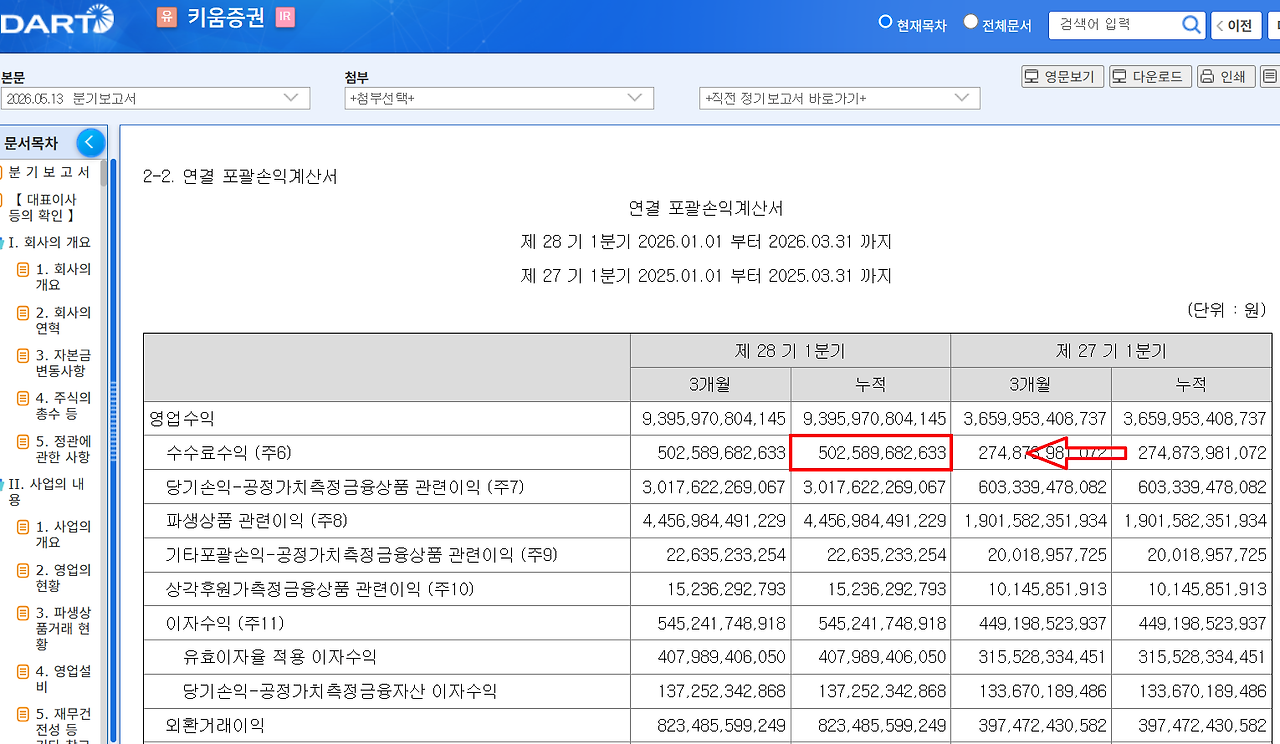
If what matters to you is return on capital and the certainty of getting paid, Kiwoom is the unambiguous pick. Q1 2026 net income came in at ₩477.4 billion (~$341M) — but the number that matters is ROE of 28.6% on a standalone basis, by far the highest of Korea's ten major securities groups.
Kiwoom runs a branch-free online brokerage model (its "Heroes" platform) that converts trading-volume surges directly into profit without adding cost — a textbook case of operating leverage. Combined with a dominant 25.7% share of retail equity trading, it also captures an outsized share of margin-lending interest income from individual investors.
Kiwoom has also leaned hardest into the government's corporate value-up program: it fully retired 900,457 treasury shares in March 2026 to lift per-share value, and has committed to a shareholder-return ratio above 30% and ROE above 15% going forward. With an expected dividend yield around 6.4% and a preferential tax treatment for high-dividend stocks, Kiwoom looks best positioned to catch a second-half rotation into value names.
From the Q1 filing: consolidated assets reached ₩94.0 trillion (~$67.1B), up 55.8% year-on-year; equity reached ₩6.98 trillion (~$5.0B, including non-controlling interests), up 23.6%; and operating profit of ₩621.2 billion (~$444M) rose 90.9% year-on-year.
3. Betting on balance and business-mix stability: Korea Investment & Securities
If what you want is a firm that doesn't wobble when one segment turns, KIS is the strongest case for "boring, and proud of it." Its portfolio is built on two genuinely balanced pillars — investment banking and asset/wealth management — rather than a single dominant driver.
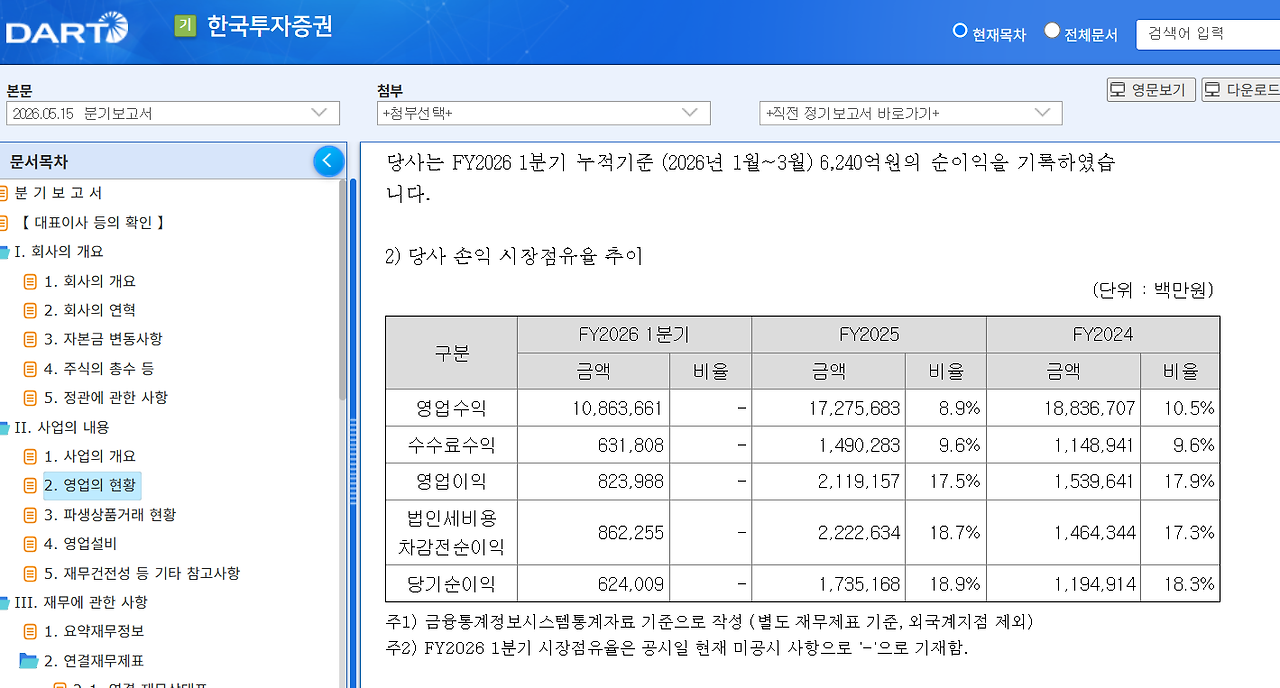
The result: ₩959.9 billion (~$686M) in Q1 operating profit and ₩784.7 billion (~$560M) in net income, putting KIS on the verge of becoming the first Korean brokerage to clear ₩1 trillion in quarterly operating profit on a standalone basis. It also led all major securities groups in net operating revenue — the cleanest measure of core business efficiency — meaning it's the most operationally efficient of the three by that metric. Because its wealth-management and deal-advisory businesses tend to offset each other through rate cycles and market swings, KIS is arguably the easiest of the three to hold through volatility.
The editor's one-line take
Want the dopamine hit of a SpaceX Nasdaq listing and global growth exposure? → Mirae Asset
Want the highest ROE in the industry and a government value-up tailwind? → Kiwoom
Want a portfolio that defends earnings no matter what storm hits? → Korea Investment & Securities
Why the "house always wins" — even when the market itself is shaking
Korea's stock market hit 8,088.34 on the KOSPI this year — an all-time high. But that same market has triggered a buy-side circuit breaker ("sidecar") — a mechanism that temporarily halts program buy orders during extreme intraday volatility — 31 times this year alone. A record index high and record intraday instability, happening at the same time: that contradiction is the real story of Korea's "new normal" in capital markets.
At the center of that volatility is a structural shift in who's actually trading: Korean retail investors going global.
The Korean version of the Mrs. Watanabe trade
In 1990s Japan, amid decades of near-zero rates, Japanese households — nicknamed "Mrs. Watanabe" — famously borrowed cheap yen to chase higher-yielding assets and FX trades abroad, a trade that shaped global currency flows for a generation. Korea now has its own version: "seohak-gaemi" ("overseas-studying ants") — retail investors who've gone all-in on U.S. mega-cap tech and leveraged products to escape the long stagnation of the domestic market (dismissively nicknamed the "Boxpi," for its years spent range-bound).
The scale is staggering: Korean retail holdings of U.S. stocks have grown more than 20x in just six years, surpassing ₩236 trillion (~$169B). Because this money is overwhelmingly unhedged, it's created a genuinely new macro dynamic — one where the won can weaken even during periods of strong current-account surplus, simply because capital keeps flowing out through retail brokerage accounts.
This isn't a passing theme. It's structural: wage income alone no longer supports upward mobility or wealth building in Korea, and mobile trading platforms now let anyone move capital globally in real time. Together, those two forces have built a form of retail participation that doesn't go away — regardless of whether the KOSPI sits at 8,000 or 10,000.
And when the amplitude of boom and bust gets this large, there's an old finance-industry saying for who wins either way: the house always wins. Whether the market is soaring or the sidecars are screaming, brokerage coffers keep filling. Once retail investors get a taste of markets like this one, they rarely leave for good.